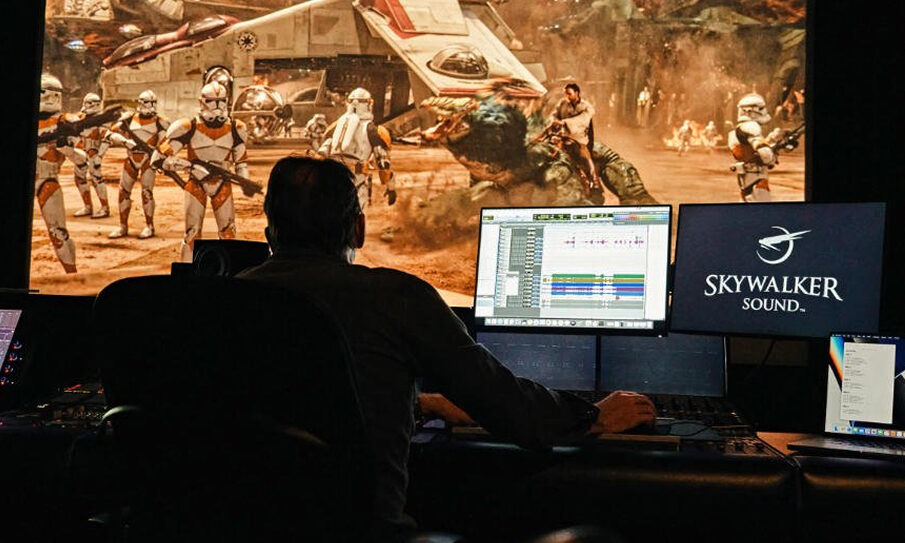
Sounds of Metal: Skywalker Sound’s Work on The Mandalorian and Grogu
Matthew Wood, David Acord, Bonnie Wild, and Chris Boyes delve deep into their process for the latest Star Wars film.
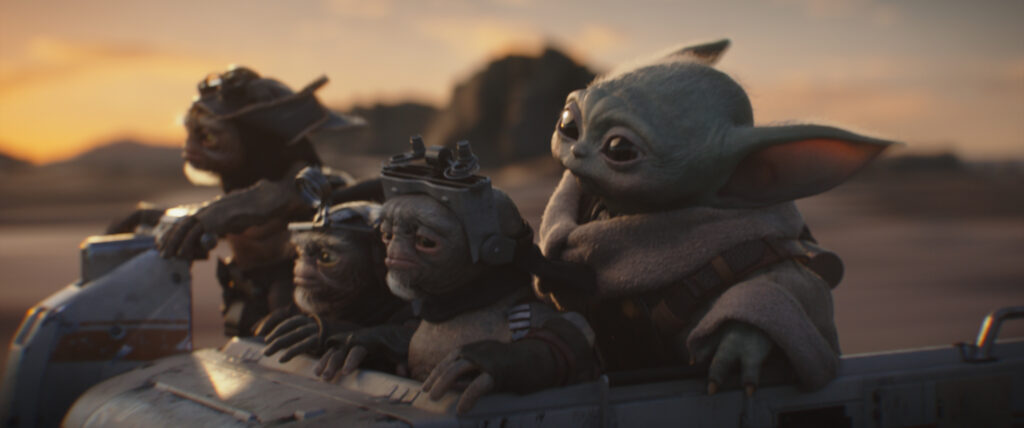
Grogu’s gurgles. Monster mayhem. Rotta’s roar. No matter the scale, each of the sounds of The Mandalorian and Grogu (2026) required significant cinematic effort, a challenge the Skywalker Sound team was more than happy to meet. “It just fit the bill of a classic, incredibly energetic, well-thought-out action movie,” recounts re-recording mixer Chris Boyes.
 Credit: Lucasfilm
Boyes has been at Skywalker Sound since 1987 – starting at the company’s San Rafael facility when they were still known as Sprocket Systems – and has since worked on some (maybe most) of the biggest movies of all time: The Lord of the Rings trilogy (2001-03), Avatar (2009), The Avengers (2012), Jurassic World (2015) – the list goes on. So his opinion on blockbuster filmmaking can be considered rather valid. “In many ways, it was one of our strongest teams ever, because nobody had an agenda to do anything other than make sure that we got Jon [Favreau] the best mix possible.
“And you don’t always get that on a mix!” Boyes continues, “Not because people aren’t playing fair, but because people are coming from different positions and with different questions and different perspectives. But for us – Matt [Wood], Dave [Acord], and I – we had all grown up at Skywalker, and now Bonnie [Wild] has extensive experience working with the two of them. We were all very close. It was a dream team.”
But despite “growing up at Skywalker,” for the veteran Boyes, The Mandalorian and Grogu was actually the first time he really got to work on a Star Wars project. A longtime collaborator with the film’s director Jon Favreau (including on 2008’s Iron Man and 2014’s Chef), Boyes was finally able to bridge his two worlds. “I had never worked on any of the films in the Star Wars sandbox before, even though I had been at Skywalker Sound since I was literally a kid, and I’m not a kid anymore,” he laughs. “So I came at it like a kid, actually.
“It was a bucket list thing for me to work on a Star Wars film, and it just all congealed on The Mandalorian and Grogu,” Boyes adds. “Matt and Dave and I have worked together many times over the years, and we have a really close relationship. Jon is often a client of mine whenever he does features. He’s one of those beautiful clients who says ‘hooray’ to what I love to do. He was looking to have me involved in this film, so it was a perfect storm of circumstances that brought me to it. I was probably the giddiest person on the planet.”
 Credit: Lucasfilm
Boyes shared re-recording duties with Bonnie Wild, who worked on the first two seasons of The Mandalorian (2019-21), among many other Star Wars projects. “And then I got to work with Bonnie, which I hadn’t really been able to do before,” says Boyes. “We’ve been friends – she was a mix tech for me a long time ago – but this time I got to work with her as a mixer, and it was nothing short of a blast.”
So how did Wild and Boyes manage their workflows with each other? “Oh, you step on toes,” laughs Boyes. “That’s how you get things done. Dialogue and music and effects don’t seamlessly go together, but you have to recognize that’s the reality. You have to figure out a path where you’re complementing everything in terms of deference to the story. You know there are issues to work out, and so if you have a partner, as I did with Bonnie, somebody who’s not just easygoing, but also funny, cooperative, and super collaborative, it shows in the product. You just come up with a better mix.”
“It’s all about respecting each other’s time,” Wild adds. “With Star Wars, the effects are as important as the dialogue. It’s full of these sounds that people love and want to hear, and you have to be mindful of that. There’s always a balance to be had, and you find it better if you’re working together and communicating and having a good time. And we had such a good time, man.”
Early Bird
Skywalker Sound’s involvement on the film started early, with supervising sound editor Matthew Wood brought in when only some animatics and storyboards were complete. As Wood remembers, “Before they started shooting and were still in preproduction at Manhattan Beach Studios, they had a day where Jon read the script out to all of the department heads. It was very similar to some of our early work with George Lucas, where he would want to plan the movies out down to the exact shot, so there wasn’t a lot of fat that you had to trim off the movie in editorial.” Postproduction has always been a huge part of the Star Wars movie-making process, so the sound needed to be planned out from the very beginning. “Early on, we were able to get a lot of Dave’s sound design into the Avid, so that was very helpful. Things aren’t just a big shock when you get to the mix,” explains Wood.
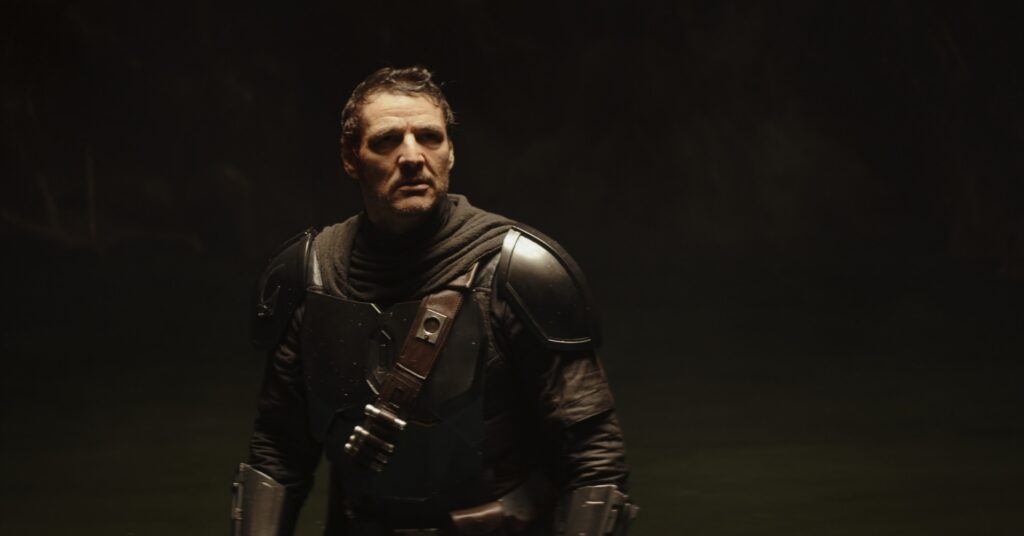
Laying this early groundwork provided incredible flexibility, as well as an ability to further augment the story. “I came on pretty early just to record all of Pedro Pascal’s lines, as well as the lines of any digital characters like Stephen McKinley Henderson’s Gatori,” says Wood. “When characters have masks on, it gives you a lot of leeway to make rewrites, and so Jon and [writer] Noah Kloor would be at those sessions with Pedro and would come up with new things to say and try out.”
 Credit: Lucasfilm
In order to make this conducive for the actors’ process, Wood built an ADR recording booth dubbed “the Annex” at Favreau’s Fairview Portals offices in Playa Vista, California. “The actors would just come to him. It was much more laid back than a traditional ADR studio,” notes Wood. “Pedro would come in, and we’d work together. I’d have the pages for the day all ready to go, so he could see things in the cut, and then we would just freeform from there. He would do his process with a very small group of folks, and we all had suggestions and would work with him. It was just a very easy, supportive environment for the actors to be able to work and not think about all the technical stuff that’s going on. That’s what we try to provide for the actor, so they can thrive.”
But what does it take for the Mandalorian to get into character without the additional benefit of putting on the heavy beskar armor? Wood gives one such example: “He would do funny things, like yell into a pillow to make his voice really gravelly.”
But while Fairview served as a good hub for early production, the sound design, editorial, and premixing happened at Skywalker Ranch, with the final mix finishing at Sony in Culver City. “The mix was really where it all came together,” says Wood. “It was such a fun time because it felt like you were really ‘movie-making.’ You were in a giant, movie-theater-sized room, the lights were down, and we were all focused on making it work. There was a lot of motivation, and it felt good.”
It’s Grogu’s World, We’re Just Living In It
Before the film, Wood, Acord, and Wild were all alumni of The Mandalorian episodic series, and its variety of streaming spin-offs. So, how did their work differ between the streaming series and film? “We had more time, which gave us the scope to really dial in, detail, and experiment,” explains Wild. “The big note for this show was to make it a cinematic experience, and use sound effects and music to do so. We could explore how to be bombastic with it. We got a lot more freedom to increase the dynamic range of things: to get really quiet and then to get really big, as well.”
Acord, who has been working within the Star Wars galaxy since he was an apprentice sound editor on Attack of the Clones (2002), agrees. “With an episodic, 24-minute show like The Clone Wars [2008-13], the work-hours-per-minutes of screen time is about 20% of what you get for a feature in terms of resources. With The Mandalorian and Grogu, we had more opportunities to really dive in and sit with things a little longer, experiment a little more, and bounce ideas back and forth with the editors and the director. When you’re working with episodic content, there’s far less time for that sort of thing to evolve.”
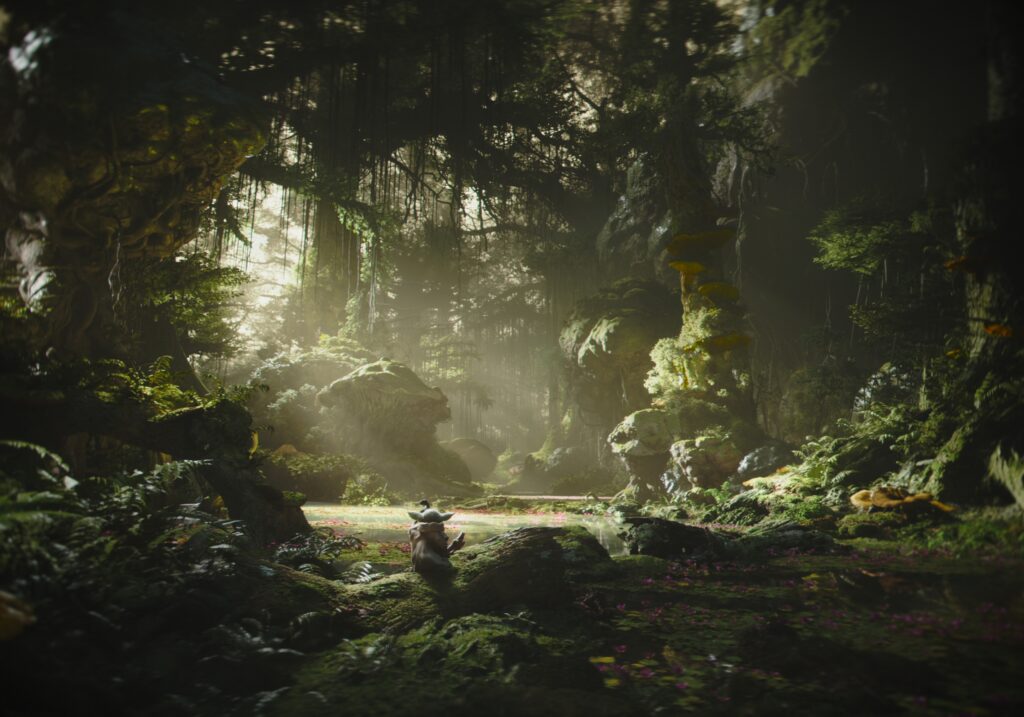
One of the film’s standout sequences, a quiet, slower-paced segment internally dubbed “Grogu’s World,” was incredibly challenging but became the best demonstration of the benefits of additional time. “There was not a lot of music and not a lot of dialogue. How was this going to work?” Wood elaborates. “It was a sequence that surprised us because it eventually became very effective. It really felt like you were on Nal Hutta with Grogu. It was cool to be there at the beginning with it so bare, and then to see how fleshed out it became.”
 Credit: Lucasfilm
Wild found inspiration in a perhaps not-so-surprising place. “Musically, there was a lot of space,” she explains. “When we first went into that reel, I went out to make some tea, and The Empire Strikes Back [1980] was playing in the hallway, where Yoda is teaching Luke on Dagobah. I remember listening to that for a bit, thinking, ‘Historically, everything can fit and work together. You could hear the environment, you could hear the music, and you could just be really in it.’ We hadn’t seen this language in a movie in a while. Everything was being carried by the puppetry, so we leaned into that. It’s just lovely to watch. The reel became a weird little dopamine hit of Star Wars-y stuff.”
“It was a largely music-driven sequence, and rightfully so,” adds Acord. “It felt very old-school Jim Henson, like The Dark Crystal [1982] or Labyrinth [1986]. But we did have our lush jungle backgrounds and distant weird creatures that you never saw, but you heard. We could play around with the closer environments, with just little Foley things. We had a great Foley crew on this show. They really knocked it out of the park, especially with things like Grogu feeding Mando that medicine or Gatori’s little rocking chair porch. It all really helped sell the scene, especially when the characters are either CG or puppets. You really needed that sort of grounding element, and I think they did a really great job there.”
Out of the Mouths of Babes
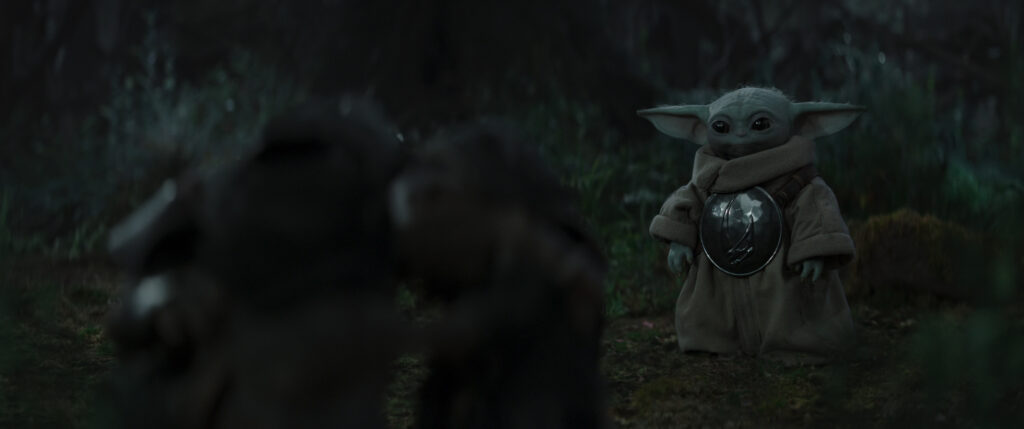
Two of the most important characters in the film are aliens: the diminutive Grogu and the (relative) newcomer Rotta the Hutt. Both required significant work from the sound department. Grogu is classified as a “sound design voice,” so there are multiple elements that Acord used to make up the vocal. “When he’s doing his little grunts and growls, that’s a bat-eared fox, as well as maybe a kinkajou that I recorded,” says Acord. “And then there are also some actual baby recordings, actual baby cooing or little gurgles. There have been various babies that have been used over the years. And then when he’s actually trying to form a word or he’s really emoting or if he does, like, a little scream, that’s when you need to create a performance.”
 Credit: Lucasfilm
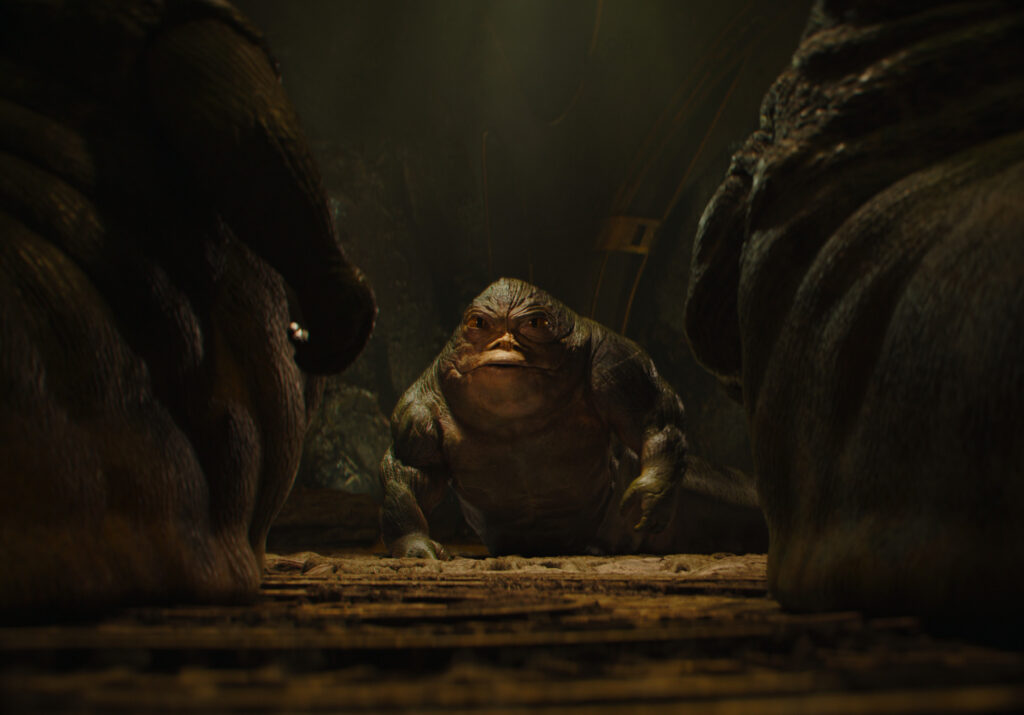
Acord also helped provide the voice for the baby Rotta the Hutt in his first appearance: the animated Star Wars: The Clone Wars movie, which premiered ahead of the television series in 2008. But in The Mandalorian and Grogu, Rotta is now all grown up, and so required a much different sonic method. “When we were casting for Rotta, there were a lot of ideas on the table early on for what Jon wanted,” begins Wood. “I would take voices that he was interested in and process them as a test. It became pretty clear early on that if we were going to cast a named actor, we couldn’t completely modulate their voices. Throughout the history of the Hutts, one hasn’t really been an A-list celeb, so when we used to change their voice to be completely unrecognizable, it wasn’t a big deal. But we wanted to have an empathy come through, which actor Jeremy Allen White completely provided. So there was just a small amount of pitching done to his voice.”
But in order to mimic the weight of the physically enormous character, Acord and Wild had to try a special trick. “We tried a couple of things, actually,” explains Wild. “Years ago, we did the Bendu on Star Wars Rebels [2014-18], and that was a similar thing, but a different kind of beast, for want of a better word. It was Tom Baker’s voice, and we had to figure out a way to fake it to seem even bigger.” For Rotta, they wanted to fill out the low end without it feeling processed, without layering on something that felt unnatural. And so, the original voice of Rotta returned to help. “We ended up having Dave, who has a deep voice, double the lines,” says Wild. “I would still pitch Dave down a little, and then send his performance through a low-end processing chain to fill it out, so you could feel that depth and size.”
 Credit: Lucasfilm
Holochess, Not Checkers
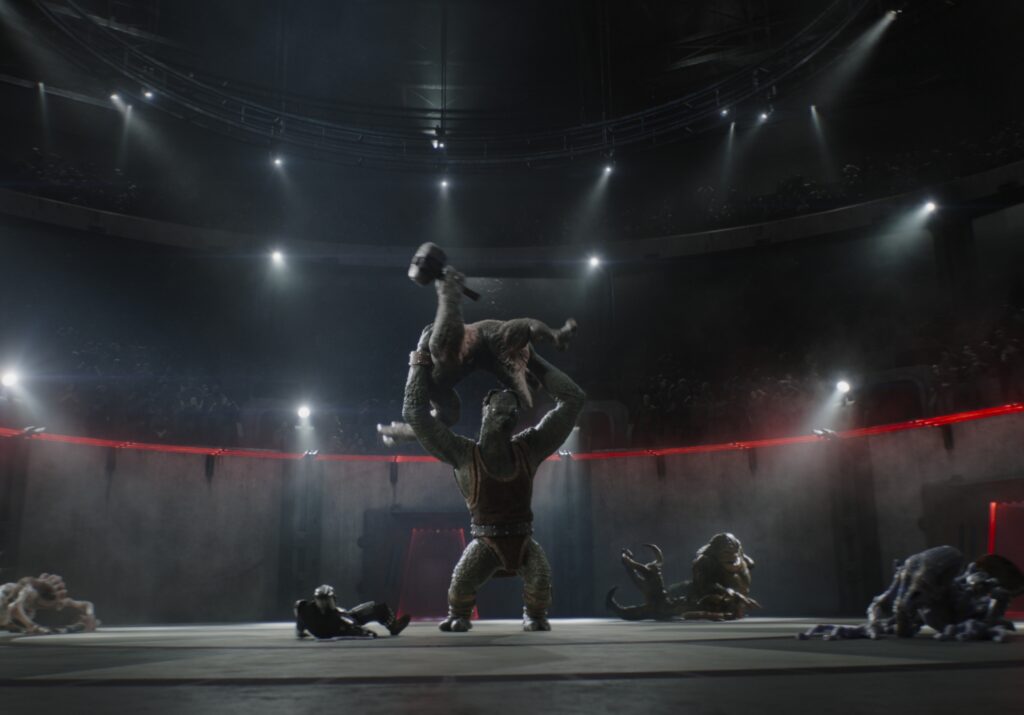
One of the most complex moments in the film takes place about midway through its runtime: the arena battle between the Mandalorian, Rotta, and a host of larger-than-life gladiators. First seen in the original Star Wars: A New Hope (1977), this monstrous menagerie required a delicate sonic balance. As Acord puts it, “Our original thought was, ‘Can we use any of the sounds from the first film?’ But if you listen, there were only a handful of sounds, and any attempt made to blow them up, to make them bigger through whatever means possible, ended up sounding pretty artificial or just wrong.”
There was one exception, however: the small but shocking Hoojix. “At one point, he does this squeaky little runaway sound that I liked, and so we did actually end up using that original chess sound in the film,” notes Acord.
But juggling all these aspects was a serious challenge. “I loved the arena scene when we were finished with it,” says Wild. “There were times when we were working on it where we were just like, ‘Oh my god.’ Sometimes, we would just have to come back to it, because after a while, you just can’t hear it as well. You physically need to just come back another time.”
 Credit: Lucasfilm
“We would peel it back, rebuild it, peel it back, and rebuild it again,” says Boyes. “That one kept coming back at us.” Wild adds, “It ended up being so cool. It always felt like a little showpiece. If any of the filmmakers were bringing someone by, I’d be like, ‘Oh yeah, come look at the arena.’ It was just classic Star Wars.”
Bringing Balance
With the arena becoming the height of the film’s action and “Grogu’s World” turning into its quiet breath of relief, the sound team really needed to be the glue that held the picture together. “From a mix perspective, these high-intensity films can be challenging. You need to deliver the power but not overdeliver it,” explains Boyes. “You have to know how to bend the world so it morphs together in a way that propels you forward.” One example? Right before the arena sequence kicks off, the Mandalorian wakes up after he’s been gassed and groggily walks down a hallway. “We spent a lot of time mixing so that the world that he was about to enter slowly evolved in a very emotional and intense way.”
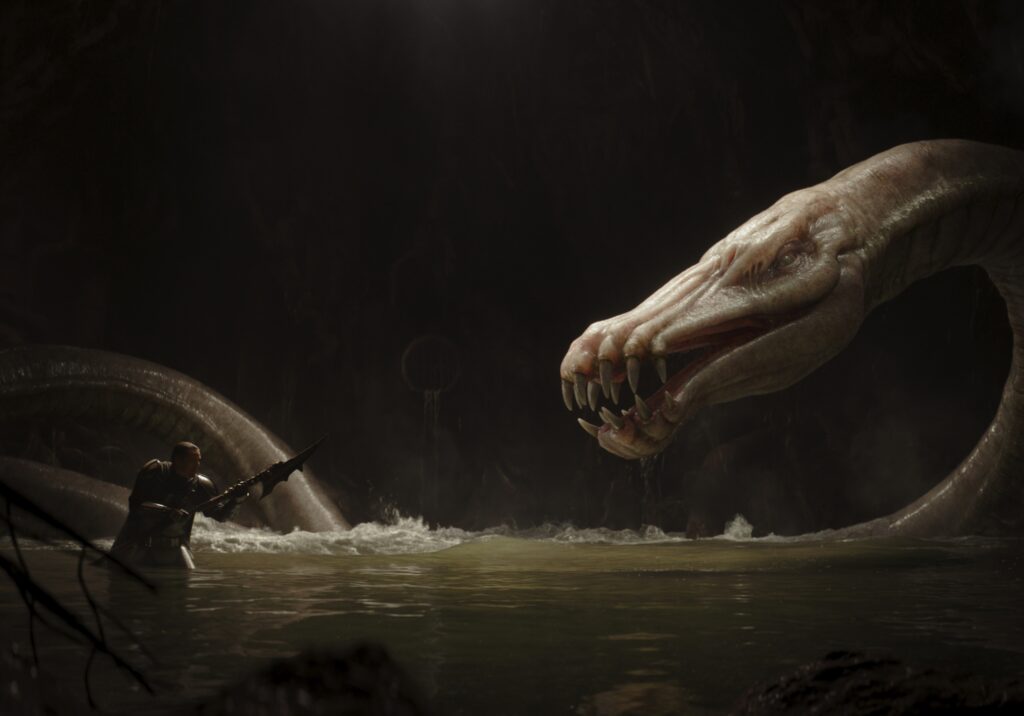
But for Boyes, the most difficult scene to mix might have been when the Mandalorian falls into the pit below the Hutt’s lair. “The dynamics of it went from really subtle, very mysterious and scary, to really intense, with a very powerful snake vocal,” says the mixer. “That kind of stuff is not something where you can just put the faders up and step back and see how it sounds. It takes a lot of heavy lifting. I love when we get challenged like that because it really takes you to a place that you didn’t even know you could go.”
 Credit: Lucasfilm
That challenge was constant for Boyes and the rest of the team. “You needed to preserve the music, you needed to preserve the spoken word, you needed to take the audience on the best ride they’ve ever had. But you also needed to make sure that the ride wasn’t so intense that it took your audience out of it. You can really put the pedal to the metal too hard, and suddenly, the audience is feeling overwhelmed. When that happens, they just shut down, and now they’re not engaged in the film anymore.” Boyes credits the cohesive crew and their fearless leader for sticking the sonic landing. “I love working with Jon. It’s very special to have a client who says, ‘OK, show me what you’ve got.’ He allowed us to take our time, work it out, and then present it to him. He would turn to Matt and Dave and say, ‘Is this OK? Can we do this?’ He knew that they understood Star Wars as well as anybody and always wanted to make sure he wasn’t breaking any rules.
“As a mixer, I loved the fact that we had a director who respected what we could bring, and then was able to roll up his sleeves and get to work, all with a collaborative mentality,” finishes Boyes. “It’s sometimes hard to be that focused on a project and still be able to dig into the details of the sound, when you probably have 500 moving parts moving around you all the time. But Jon was able to do it in a way where everybody feels respected, while also respecting the universe he’s stepping into. It was a wonderful experience.”
Acord agrees, adding, “It was a full team effort, including Stephanie McNally, our fantastic music editor, a great backfield in dialogue effects with James Spencer, plus Addison Teague and JR Grubbs cutting effects for us. We also had our Foley team, including artists Jana Vance, Ronni Brown, and Sean England, editors Devon Kelley and Alyssa Nevarez, and mixer Richard Duarte. From simply an emotional perspective, I think this was probably the most fun I’ve ever had on a show. It was like working with all your friends, which is a very rare and special thing.”
 Credit: Lucasfilm
—
Brandon Wainerdi is a writer and interviewer, whose work can be found in Star Wars Insider, on StarWars.com, and inside the iconic horror magazine, FANGORIA. He is the author of two Star Wars books, including the recent Star Wars Encyclopedia of Starfighters and Other Vehicles. He is also the host of Talking Bay 94, a long-running behind-the-scenes podcast that interviews the cast and crew of the Star Wars saga. You can find him on Twitter and Instagram.