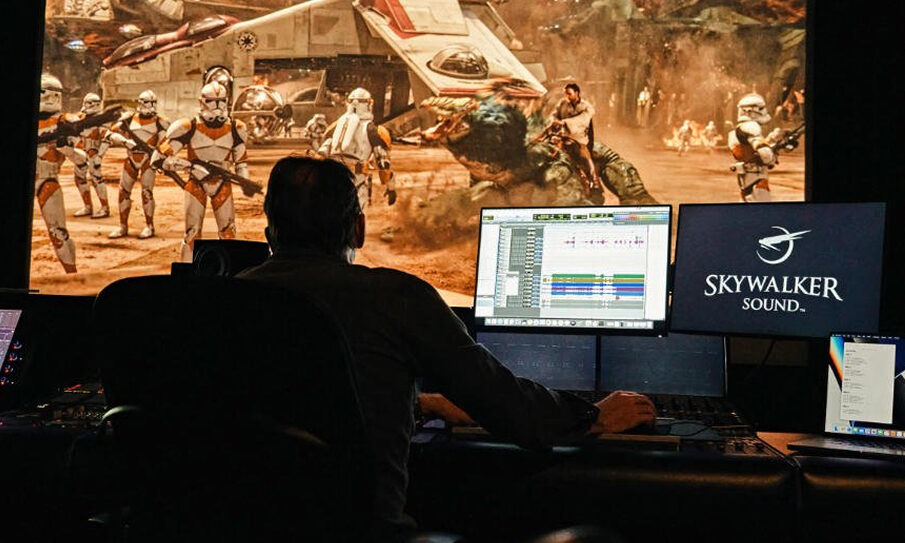
Skywalker Sound and Lucasfilm Animation’s Collaboration on Star Wars: Maul — Shadow Lord
Artist David W. Collins joins supervising director Brad Rau and head writer Matt Michnovetz to discuss the latest entry in a years-long Star Wars partnership.
The year is 2007 and 35,000 Star Wars fans are attending the fourth Star Wars Celebration in Los Angeles, marking the 30th anniversary of Star Wars: A New Hope. David W. Collins is preparing to moderate a panel with director Dave Filoni and producer Catherine Winder, revealing the trailer for the upcoming Star Wars: The Clone Wars, the first public presentation for anything related to the series.
“I remember the room erupting,” says Collins, now a supervising sound editor at Skywalker Sound. “I remember yelling that we should roll it again, and we did, and I watched Dave Filoni basically go from being anonymous at the top of the weekend, and by the end of the weekend, he had to have handlers because people kept coming up to him. And that was an amazing experience to have a front-row seat to.” The 2008 movie was a milestone for many reasons, including the fact that it marked the beginning of a beautiful collaborative relationship between Skywalker Sound and Lucasfilm Animation.
Their most recent collaboration, the Disney+ series Star Wars: Maul — Shadow Lord, was the first animated project to be mixed in Dolby Atmos 7.1.2. Collins served as supervising sound editor, sound designer, and re-recording mixer, working in partnership with Lucasfilm Animation supervising director and executive producer Brad Rau and head writer and executive producer Matt Michnovetz. But it’s not where their working relationship started.
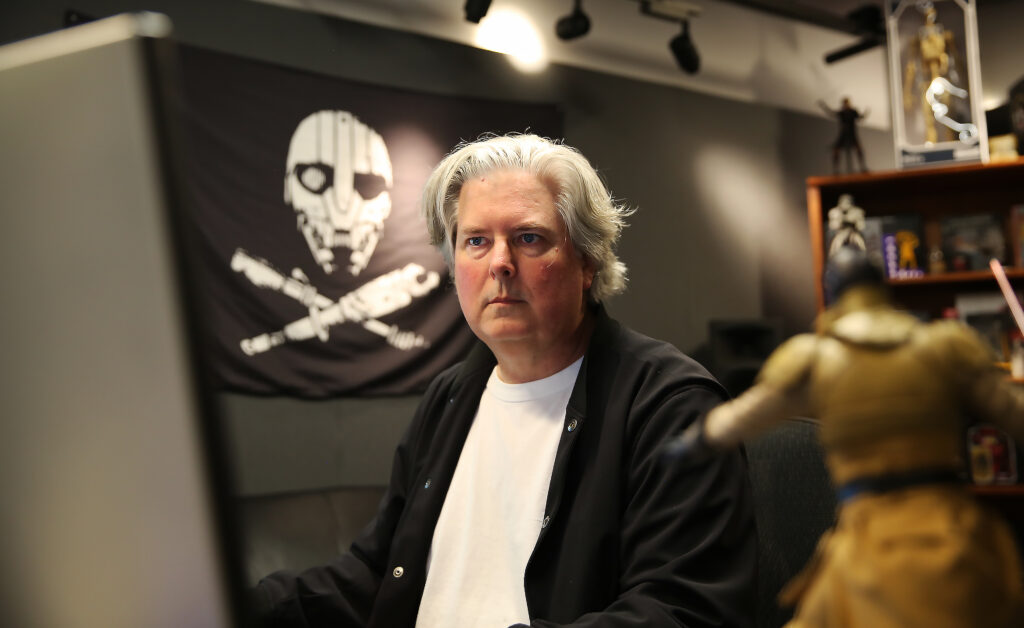
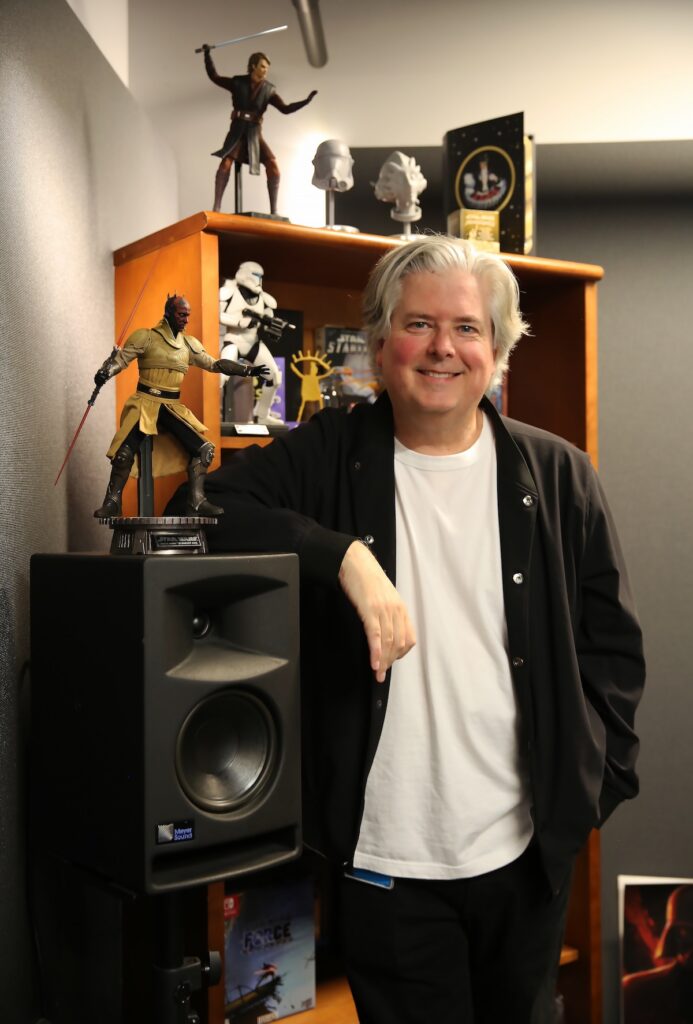 Supervising sound editor, sound designer, and re-recording mixer David W. Collins (Credit: Skywalker Sound).
Collins was hired as an intern at Skywalker Sound in 1999 before working at former games division LucasArts from 2000 to 2011. He began working on Lucasfilm Animation projects at Skywalker Sound in 2018, partially thanks to the voice of Maul himself, Sam Witwer. Back in 2006, Collins had actually slipped Witwer’s headshot into the pile of actors to consider for the role of Starkiller for the 2008 game, Star Wars: Force Unleashed, and this time it was Witwer’s turn to return the favor by recommending Collins for Star Wars: Resistance (2018–20).
“[Sound designer] Matthew Wood and Sam and I have all become friends over the years, doing loop group and voice-over work,” Collins says, “and Matt was working on Lucasfilm Animation projects like Star Wars: The Clone Wars when Sam came in and did the Mortis character [Son] and Maul, of course. It’s funny how everyone’s gotten to know each other and work together over the years. Matt Wood had said to me, ‘Hey, we have a new animated series, do you want to work on it?’ and, ironically, it was Sam that had recommended me for the gig.”
Collins would go on to work on a myriad of Star Wars projects, including Star Wars: Skeleton Crew (2024–25), which won the Children’s and Family Emmy award for Outstanding Sound Mixing and Sound Editing for a Live Action Program. For Lucasfilm Animation, Collins also worked on projects including Resistance, three seasons of Star Wars: The Bad Batch (2021–24), Star Wars: Tales of the Jedi, Star Wars: Tales of the Empire, Star Wars: Tales of the Underworld, and most recently, Star Wars: Maul — Shadow Lord.
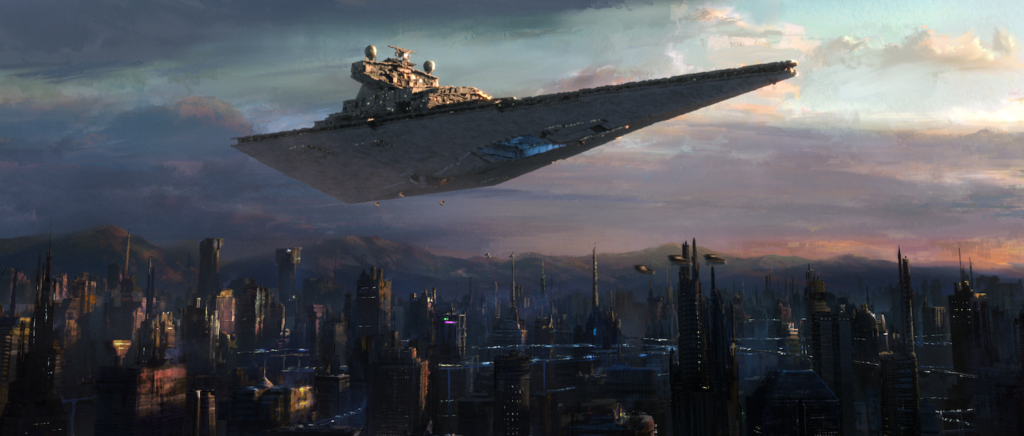 (Credit: Lucasfilm).
“It’s been great seeing the progression all the way from the very beginning in 2007 to working on the team helping it grow,” says Collins. “I was mixing Resistance while Bonnie Wild was mixing Star Wars: Rebels [2014–18] finale down the hall. That was such an exciting time to be in the building because I knew that the Rebels finale was super emotional and amazing, and I knew that animation was still growing and expanding its possibilities.”
Collins’s working relationships with his fellow Skysound employees evolved over time. “Bonnie Wild and David Acord were the ones to really show me the ropes,” he explains, “and then Matt Wood would come in and listen to the mix and give me pointers, and that’s when I would realize, you know, it’s one thing to watch someone’s work, it’s another thing to work alongside them because you’re exposed to a level of brilliance that’s fun to see in action.”
The same is true of his evolving relationship with Brad Rau, which Collins credits to time spent together on shows like The Bad Batch for their easy collaboration style. “If you’re going to do three seasons of a show with someone, you get to know someone very well,” the artist says. “There’s a lot of time on the stage taking his notes, listening to suggestions, trying things out, and constantly upping the ante with each other. That took years of collaboration to where, when we finally did get to working on Maul — Shadow Lord, we had kind of a shorthand and a real trust there. I knew whatever he was going to ask me to do was always going to make it better, and I was able to kind of drift out of my lane and just offer suggestions or try things or pitch things, and Brad was always willing to try it.”
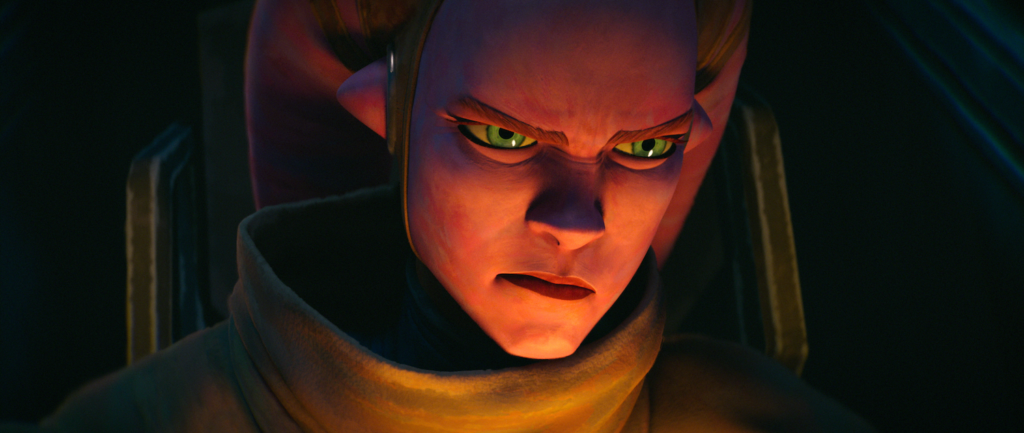 (Credit: Lucasfilm).
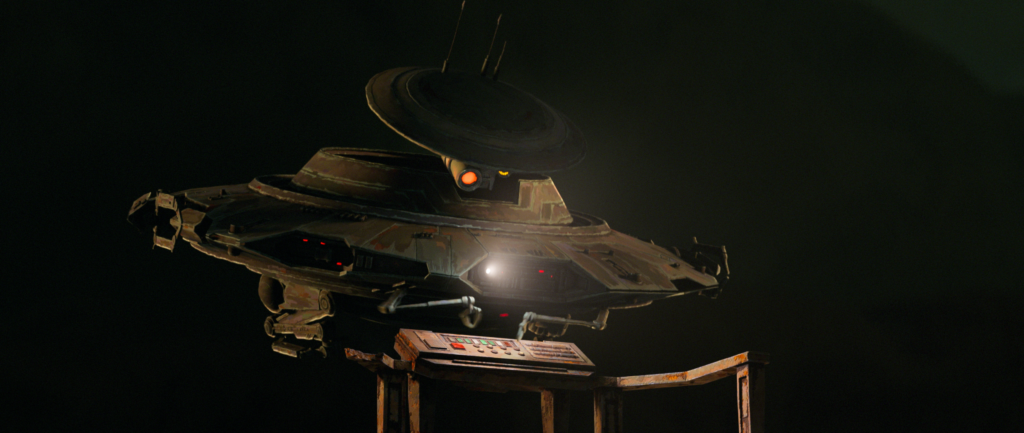
Part of this was also due to the fact that, as Brad Rau puts it, the Lucasfilm Animation team “spoiled everything” for Collins ahead of the mix. “When we knew that episode one to ten was going to essentially take place over about eight days, making it very serialized, that is a massive, massive challenge for everybody,” Rau explains. “So knowing that going in, I spoiled everything. Things like: Here’s where we’re going, here’s what we should think about in terms of the sounds of everything from ‘What does the sound of half of Maul’s saber sound like when Devon is holding it in episode three compared to when she’s holding it in episode ten?’ At every point we kept pushing. I just remember telling David at many junctures ‘Let’s go crazier. Let’s go nuts.’ He stepped up to the challenge in the best way.”
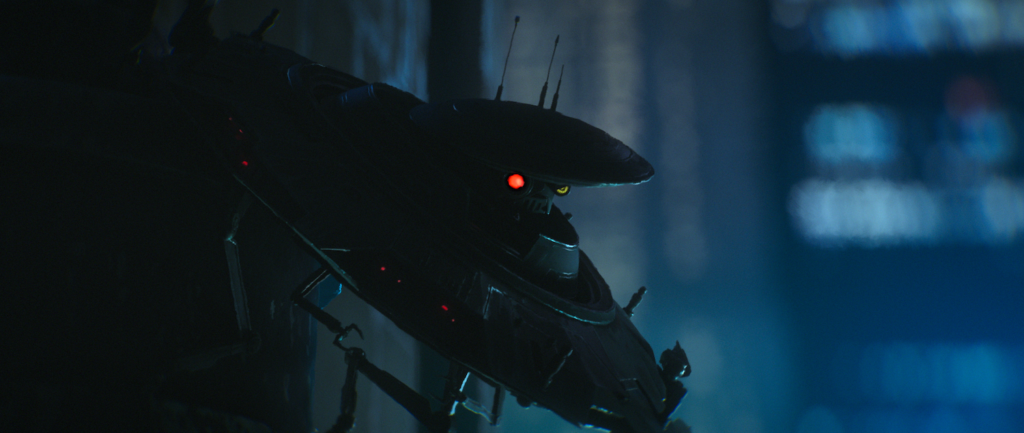
One of the best examples of this collaboration shows up in the form of the beloved Spybot, Maul’s feline-like droid introduced in Maul — Shadow Lord and voiced by Collins himself. When they were first starting the creation process for Spybot, Matt Michnovetz remembers, “Dave Filoni gave us some drawings of this thing and gave us the pitch, and I started kind of figuring out what this thing does and what it sounds like. When we have the scene where Spybot comes up to Maul, and Maul kind of pets it, it has to be like a panther meets a Ferrari engine, right? It’s got this sleek chassis attitude, and the cat-like reflexes and rhythm of a feline.”
“Immediately when I read the script, I texted Matty and said, this is incredible, we need more of this,” notes Rau. “When we talked to David about voicing the character, we explained that we didn’t want any common English or Basic or anything. Just give us some emotes. And we did a whole pass recording David doing emotes throughout the pilot episode. When we got into the backend, David started experimenting with lines like “peekaboo” and “knock, knock!” It was all really fun and added tons of personality to the character. We realized, this is who Spybot is. David added more and more throughout each episode, and Spybot came to life with very little screen time.”
 (Credit: Lucasfilm).
Collins was adamant about using Spybot as a driver of the storyline, which also helped further the character’s complexity. “If he says a joke, it’s funny, but it’s also an extension of the story,” he explains. “We can further establish relationships, such as making him worried about Maul. If he’s an extension, or if he’s Maul by proxy, he’s going to have a feeling that he wants to spit at the Jedi, or he feels the same way about the Empire that Maul does. He calls a probe droid a trashy droid, that sort of thing. That really helps the story, and that really helps identify what Maul’s gang is all about. Because you don’t get a lot of insight into that, other than with Rook, and so Spybot is very valuable in that way.
“Randy Thom says this a lot,” Collins adds, “and Matt Wood says this a lot. We’re storytellers, and we’re filmmakers, and it’s our job not to just make things sound cool but to make the story come alive. And to completely support the vision of the filmmaker. And that means bringing your whole self to the project, bringing all of your experience,” says Collins. “Being involved in the process from the recording studio all the way up to the mix stage is a level of involvement that goes far beyond anything technical that Skywalker does. It really makes good on George Lucas saying that “sound is 50% of the motion picture experience,” when you have those kinds of series of events in creating something from conception all the way to the final mix.”
Sound design is crucial for any film or television show, and it often serves as a character voice or story element in its own right. In the Star Wars universe in particular, you have iconic sounds that have evolved over the years, from the Wilhelm scream to the blaster sounds to the legendary lightsabers. Brad Rau shares, “Even as a kid, with the sound effects, my brother and I would be playing action figures when we were six or seven years old, and we would try to mimic Ben Burtt’s sound effects. That’s what everybody did. Not just the lightsabers, but every little thing.”
 Collins at work (Credit: Skywalker Sound).
The same is true for animated projects, which allow for a more “sky’s the limit” approach. Both the Lucasfilm Animation team and the Skywalker Sound team agree about treating every animation project as if it were a live-action project. As Collins says, “If anything, you can do even more with animation. You’re liberated from the constraints of live-action. You can do anything you can imagine.”
“It’s inspiring. It elevates our game,” shares Michnovetz. “I try to look for moments where we can maximize potential so that Skywalker Sound can go, and we can constantly one-up each other. It’s a constant challenge. The final effect is always jaw-dropping.”
The effect certainly holds true, and it is part of why the collaboration between Skywalker Sound and Lucasfilm Animation has remained so strong after all of these years. “They’re the best in the world,” Michnovetz adds. “Simply the greatest of all time. The legacy of all legacies. A team of the most brilliant, talented artists and imaginations that you could have.”
Having worked with them since his days on Resistance, Brad Rau concludes, “They’re the best in the business. And I do think it is because they approach every project as a unique story. I mean, just such a big part of Star Wars is the music, and the sound design. That’s in the DNA of the franchise.”
 (Credit: Lucasfilm).
—
Logan Peck is the public relations coordinator for Industrial Light & Magic and Skywalker Sound. She’s also a lifelong fan of Star Wars and an Anakin Skywalker enthusiast.