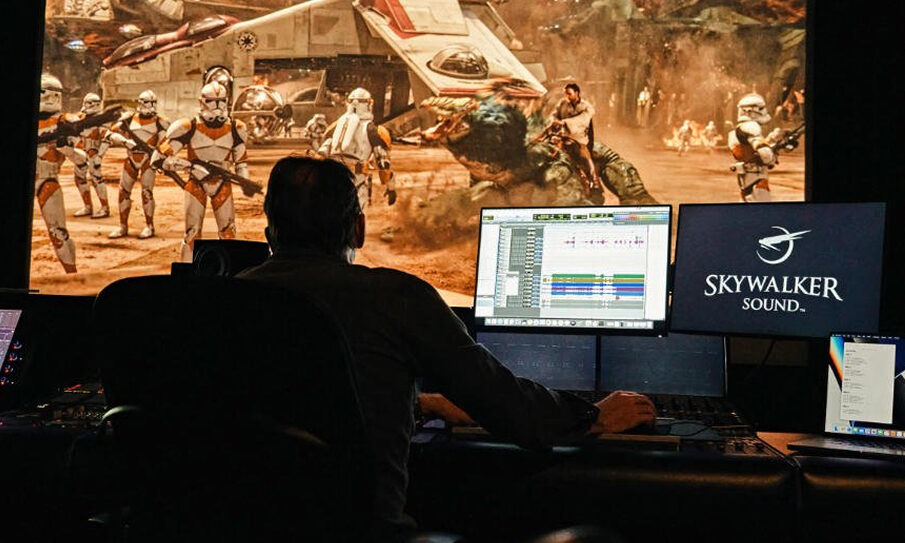
Sounds of Sith: MPSE Celebrates 20th Anniversary of Episode III with Special Screening
The Motion Picture Sound Editors show Star Wars: Revenge of the Sith for the first time in Dolby Atmos, bringing out Skywalker Sound special guests Ben Burtt, Matthew Wood (and General Grievous himself).
Star Wars: Revenge of the Sith may be 20 years old this year, but an audience of audio professionals recently got to experience the film in a brand-new way.
In the darkened Darryl F. Zanuck Theater on the Fox Studio Lot in Los Angeles, members of the Motion Picture Sound Editors (MPSE) and their guests screened Episode III in the sonically immersive Dolby Atmos format for the first time ever. “A big shoutout to Disney and Lucasfilm for this one-of-a-kind Atmos screener for you to enjoy today,” says MPSE president David Barber, introducing the film.
The special Star Wars Day treat was followed by a Q&A session with Skywalker Sound veteran Matthew Wood. He was joined by his longtime mentor, colleague and fellow Revenge of the Sith supervising sound editor Ben Burtt, making a surprise remote appearance.
That evil General Grievous showed up, too.
Wood, who has performed the voice of Grievous since 2005, brought along a computer to process his speech in real time, transforming it into the distinctive sound of our favorite cybernetic warlord. With the help of the audience shouting Obi-Wan’s famous greeting (“Hello there!”) as a setup, Wood grabs a microphone to respond.
“General Kenobi! You are a bold one. Kill him!” Grievous’ voice bellowed from the speakers. The audience cheered.
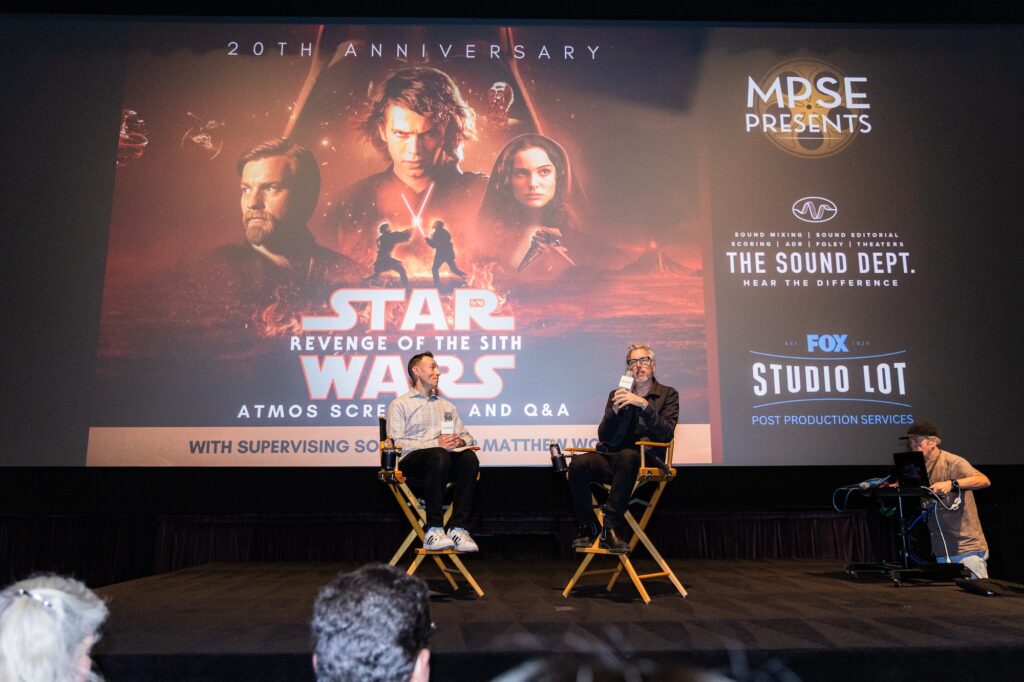 MPSE vice president and Q&A moderator Eric Marks (L) and Star Wars: Revenge of the Sith supervising sound editor Matthew Wood (Credit: Chris Schmitt Photography/MPSE).
Wood fondly recalled Burtt’s instructions when it came to gathering sounds for Sith.
“When we were together, you’d have me go out in the field and just get things,” Wood explains. “When we were in Sydney, Australia, it’d be like, ‘Go out and just record things. I’ve heard that there might be some penguins down at this place.’”
Thousands of everyday sounds were shaped into a fantastic galactic library of ships, creatures, props, and environments.
“We all know that sounds spur the imagination,” Burtt continues. “It takes a little bit of thinking, but you can take any real organic sound and just shift it around slightly or put it in this other context. People won’t recognize it.”
One Episode III creature named Boga — a screeching, wingless lizard that Obi-Wan rides in pursuit of Grievous on Utapau — had a much more pedestrian origin.
“Boga is almost entirely coyotes,” Burtt reveals. “Snippets recorded in a few different places. Some here in Marin County, up north, where we’ve had some waves of coyotes. Even packs that you can hear in the distance. They yelp with this nice, echoey kind of feeling to it.”
Wood appreciates the faith that director George Lucas placed in the sound team during production of the prequel films. “We were coming into Star Wars after there’d already been three amazing movies,” recalls Wood. “There was just a lot of trust. He never came in and micromanaged our situation. He just wanted it to tell the story. And he brought us on really early, which was also great.”
“With George,” Burtt adds, “fortunately the development process with sound has always been right from the start.”
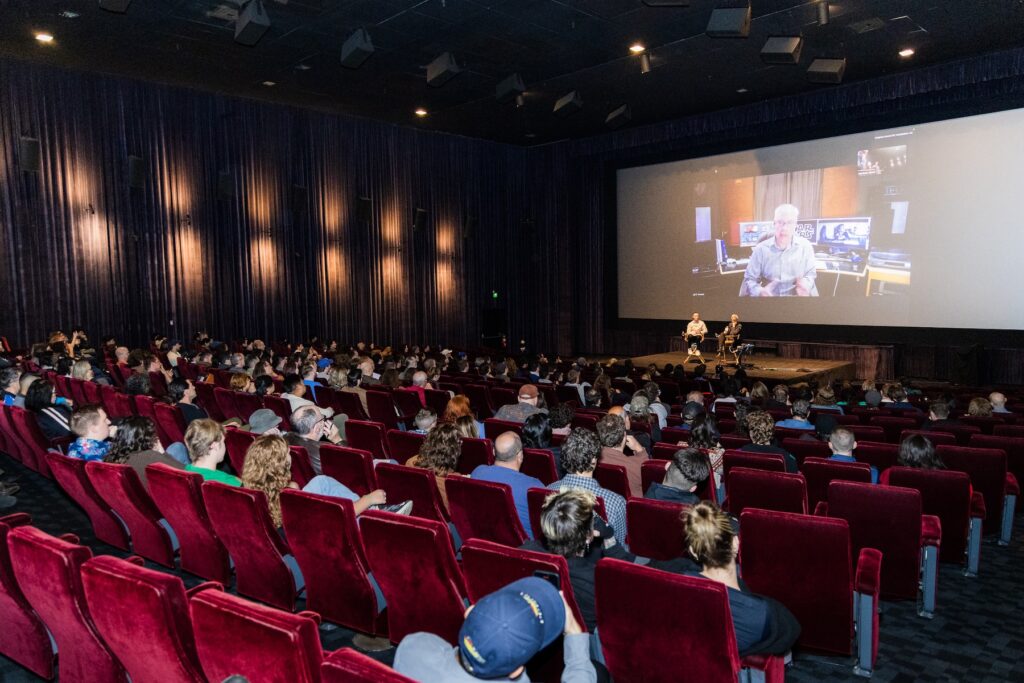 Star Wars: Revenge of the Sith supervising sound editors Matthew Wood and Ben Burtt (joining remotely) during a Q&A after the screening. The film was presented in Dolby Atmos for the first time (Credit: Chris Schmitt Photography/MPSE).
One important element to the success of Revenge of the Sith, Burtt says, was a creative team working side-by-side at Skywalker Ranch in Nicasio, California. “We were fortunate. Our whole sound editing team was all in the same place. The director was there, the producer, the post-production supervisor. So there was constant communication.”
Burtt and Wood also offer advice to aspiring sound professionals. “Your team-making abilities and your positive outlook,” says Wood. “That is, for me, the most valuable part of it. And that’s the kind of people I love working with.”
Burtt says sound designers should always be honing their craft, whether they have a job or not. “My advice is to build your own library,” he tells the crowd. “And ultimately, when you become a sound editor or supervisor or begin to contribute to the post-production process, then you have built up a repertoire of things that represent your taste and your interest.”
Burtt also told the audience of sound professionals that they should not forget that they are also entertainers.
“We’re contributing to the net effect of entertainment on the audience. And that’s the fun for me,” says Burtt. “The fact that you’re working for an audience out there and eventually your ideas, your skills, may show up in something very exciting or pleasing or charming to the audience.”
Wood says that he’s still proud of what the team accomplished on Revenge of the Sith. “To have the opportunity to see it in a theater again 20 years later is very sobering in a lot of ways,” he says. “But also, I think the patina of what we did is still there. I love it.”
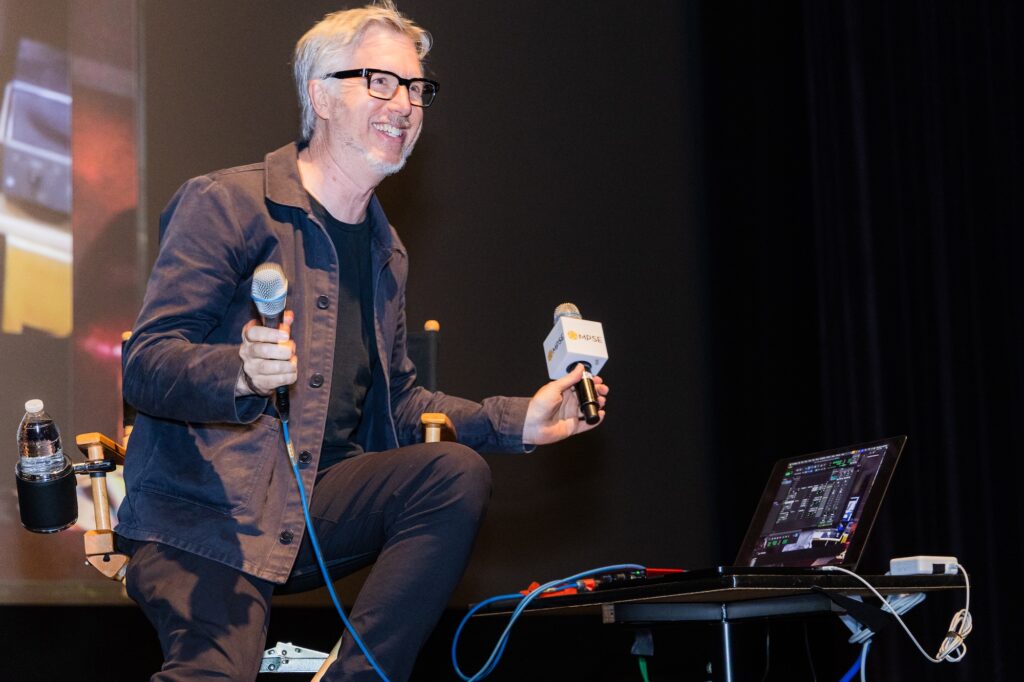 Matthew Wood, Star Wars: Revenge of the Sith supervising sound editor and voice of villain General Grievous, demonstrates how the cybernetic warlord’s distinctive speech comes to life (Credit: Chris Schmitt Photography/MPSE).
—
Clayton Sandell is a Star Wars author and enthusiast, and a longtime fan of the creative professionals who keep Industrial Light & Magic and Skywalker Sound on the leading edge of visual effects and sound design. Follow him on Instagram (@claytonsandell) Bluesky (@claytonsandell.com) or X (@Clayton_Sandell).