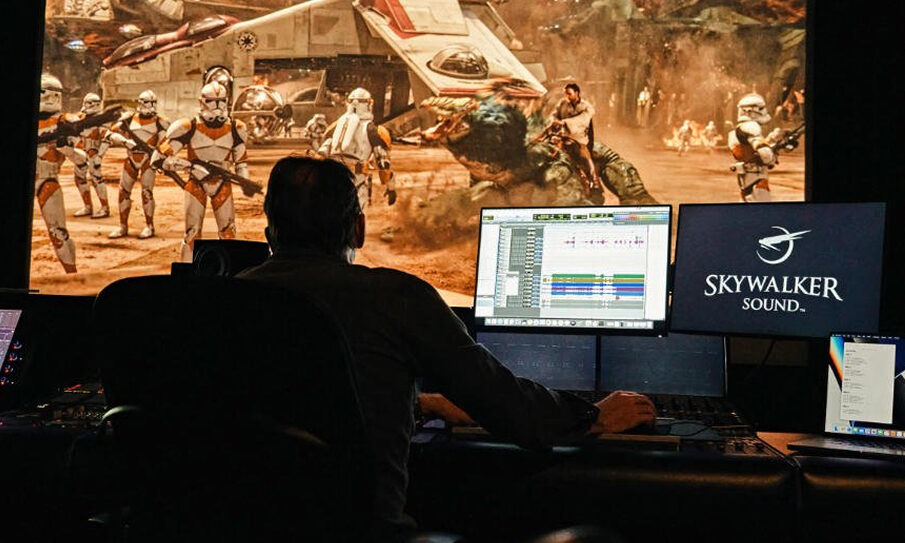
Skywalker Sound’s Jon Borland Talks Marvel’s ‘Daredevil: Born Again’
The sound designer and supervising sound editor has spent years working in the Marvel Cinematic Universe.
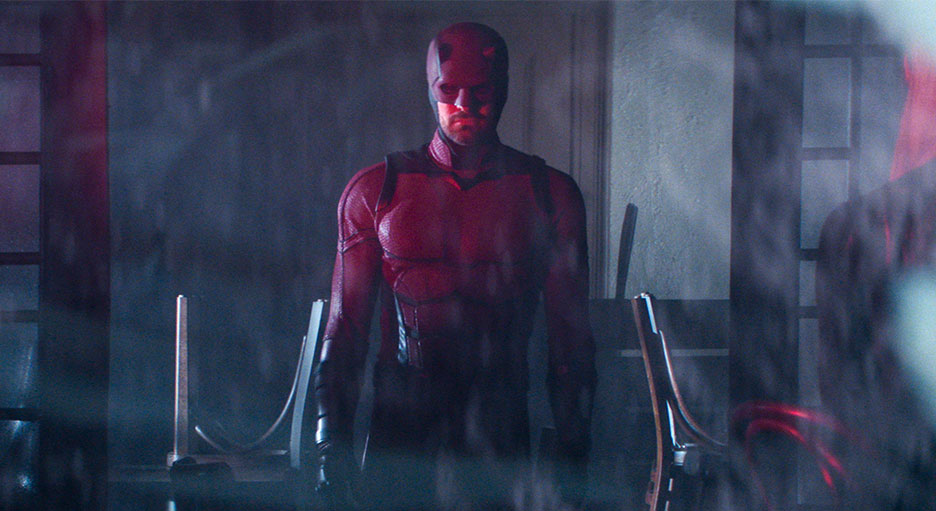
Daredevil: Born Again, the long-awaited continuation of the 2015–2018 Netflix series starring Charlie Cox as Matt Murdoch/Daredevil, Vincent D’Onofrio as Wilson Fisk/Kingpin, Deborah Ann Woll as Karen Page, and Elden Henson as Foggy Nelson, arrived on Disney+ on March 4, 2025. The 13th television series from the Marvel Cinematic Universe (MCU), it not only adopted the tone of the 1986 Daredevil comics storyline “Born Again” by Frank Miller and David Mazzucchelli, but also ensured that the spirit of the Netflix series was preserved.
We took the opportunity to sit down with Skywalker Sound sound designer and supervising sound editor Jon Borland (Hawkeye, Echo, Obi-Wan Kenobi) to discuss how the project not only honored what came before in the three Netflix seasons, but pushed the soundscape forward into the broader MCU.
“It’s always challenging to step into an established world,” explains Borland. “If you step into a Star Wars project, there are rules. You know what things are supposed to sound like, so the challenge is how do you make something that sounds like it belongs in that world? How do you remain true to what’s been established while making something new that people haven’t heard before? That can be daunting.”
 (Credit: Marvel).
While Daredevil: Born Again is a brand-new show for Disney+, Daredevil characters had been around in the MCU for a while. Lawyer Matt Murdoch made a surprise appearance in Spider-Man: No Way Home (2021), while Daredevil appeared in She-Hulk: Attorney at Law (2022) and Echo (2024). Meanwhile, Wilson Fisk/Kingpin arrived in Hawkeye (2021) and returned in Echo. Borland first learned of the return of Hell’s Kitchen’s favorite combatants while he was working on Hawkeye.
“I got the script and they were talking about the ‘big guy,’ and everything pointed to Kingpin,” he explains. “I remember asking the filmmakers, ‘Is it going to be Vincent D’Onofrio?’ Kingpin in Hawkeye was very different from the Netflix shows. He wore prosthetics to make him look comic book-accurate. We pitched his voice down to make him deeper and lower, and added weight to his footsteps. He’s not the Hulk, but he’s as close to the Hulk as a human can be. We took that character forward into Echo and kept those same elements to give him a little more size to match.
“When we got to Daredevil: Born Again, the plan was to stick with that, but as Matt says, he steps a little lighter; he’s clearly lost the weight,” Borland adds with a smile. “We’ve slowly dribbled these characters out. I got Fisk first on Hawkeye, then Echo and now Born Again, so this is my trilogy of Kingpin.”
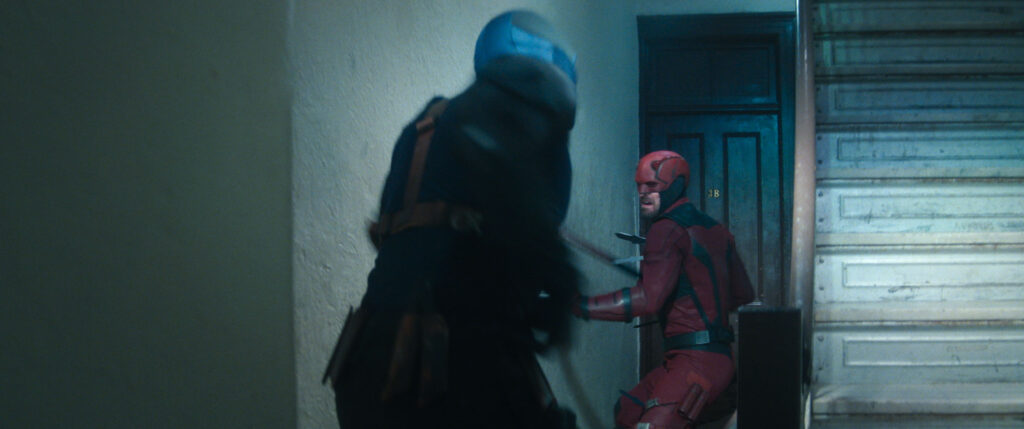
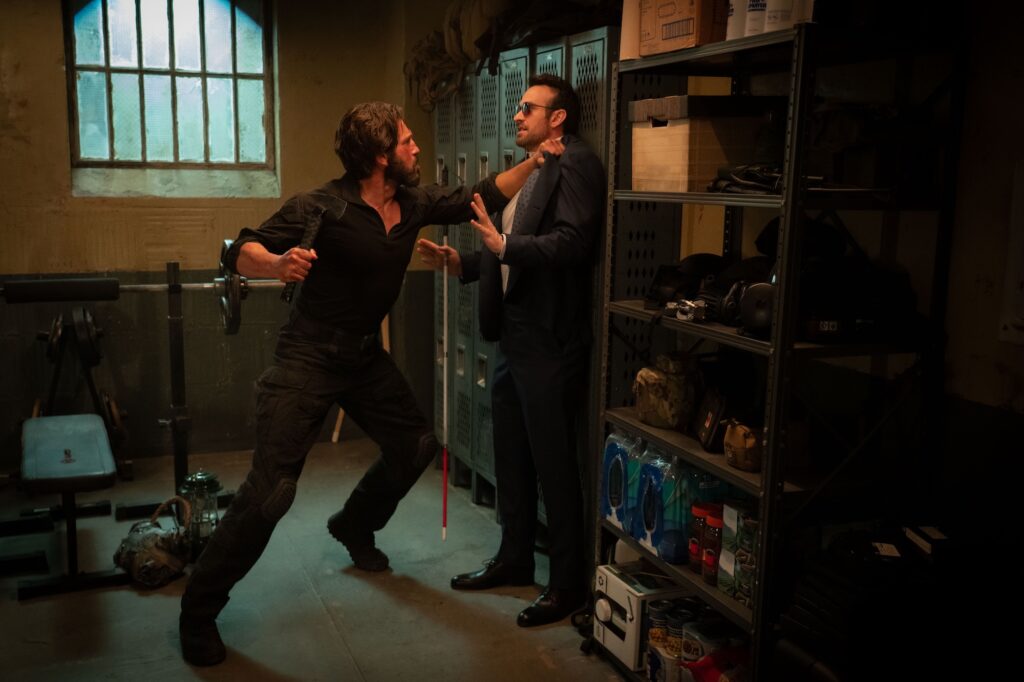
One of the most memorable sequences in Born Again is the brutal bar fight in the first episode, “Heaven’s Half Hour,” which sees Daredevil and Bullseye (Wilson Bethel) battle at Josie’s bar, a confrontation that ends in tragedy. It was a complex, intricate scene to tackle.
 (Credit: Marvel).
“I did a pass with my ‘normal’ Marvel fight sounds and presented it to the showrunner [Dario Scardapane], but coming out of that the feeling was that it’s too cool-sounding, too superhero-sound-a-like. Then it became a kind of dance,” explains Borland. “We finally honed it into this very aggressive, very real, gritty and grounded sound but, at the same time, making it interesting.”
Amidst all of this work there’s a logic to the flow and rhythm of a fight sequence. “I think of fights as like a drum solo,” Borland says. “If you think about punching, it all sounds pretty similar. What we tried to figure out was when he gets hit in the helmet, we want that to sound different than the torso, so that gave me a palette to do that kind of percussive drum solo-type of approach, especially with that fight scene.
“Some people wanted it to be completely brutal; no music, completely realistic, let’s make people feel this marathon of a beating,” Borland continues. “What if there was a jukebox? We had source music, and it became this experimental thing. You smash into the window and the sound effects are leading, then we pass the baton to the music taking over, giving you more of an emotional fight.”
 (Credit: Marvel).
Additionally, Borland explains how dialogue and ADR supervisor Chris Gridley and his team made important contributions to the sequence. “Once Bullseye gets away from him and he’s going up the stairs and Matt shows up and they’re both panting and they stop fighting, that really tells you that these guys are winded and tired, so the dialogue team really helped with that.
“One of the offhand comments that really stuck with me with Matt’s superpower is that he can take a beating,” Borland continues. “It’s not that he can do the coolest kicks or the coolest punches, it’s that he can get back up and keep going. It’s about finding those realistic and brutal-sounding punches and trying to figure out how to orchestrate them in a way that makes you feel that. Once we got that scene tackled, the rest of the show made sense. We used that as our anchor and went from there.”
There is elaborate work behind the sounds that the audience hears, with the pulse of the sequence passing from words to music to sound effects and back again. But central to the whole aural experience of Born Again is Matt’s heightened senses and how he navigates the world as a blind man. As Borland explains, that layer of the soundscape is absolutely key to the show.
“When I first got the project, I found a book called Being Matt Murdock by Christine Hancock. She wrote the book from a scientific approach, looking at the source material, which are the comics. What would it be like to be Matt Murdoch? Based on the comics, he can hear many miles away, and where an average person can perceive a change at six decibels, he’d be able to hear a change in zero decibels. He can feel the ink on a page, so even though it’s not Braille, he can still read it. Given all of that, what would it be like to have all that information coming at you all the time? The amount of skill and discipline it would take to hone it and be in the moment to hear what you need to hear is incredible.
“[Lead directors, co-writers, and executive producers] Aaron Moorhead and Justin Benson gave me a great visual reference,” Borland explains. “In the bar when Matt and Karen are talking, they had three cameras set up, so they could switch. Visually you’re seeing Matt hone in on something, and the ‘language’ we came up with was like tuning a radio, but in an organic way. They didn’t want anything to sound electronic or affected, nothing supernatural, so as you’re sweeping across the radio, you get these little glimpses of somebody doing a sermon in Spanish, then a sportscaster, a radio commercial, music, but as you sweep through, they come in and out and you pick up these little things. In the bar somebody’s typing on a cash register, there’s the receipt printing, somebody’s racking up billiard balls, people are laughing, somebody stumbles into a chair, those kinds of things. That was the motif. Foggy’s outside on the street and he’s tuning his radio dial into what he’s saying on the phone. I came with the approach of whatever environment we’re in, what would Matt be hearing?”
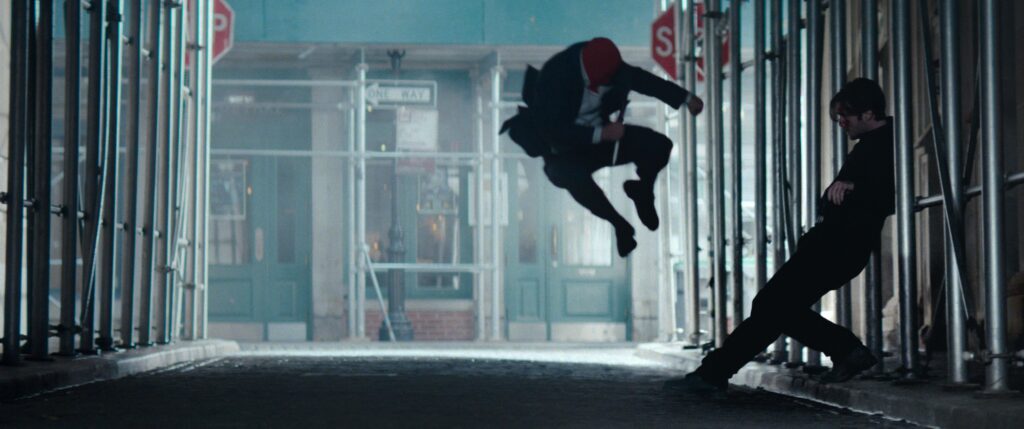 (Credit: Marvel).
It’s one thing determining what Daredevil hears and how, but then the challenge was to bring those concepts to life, a huge task in any production but especially one where the ability to hear is one of the character’s greatest strengths.
“For each environment where Matt uses his hypersense, I took a notepad and wrote down every possible thing you could hear there,” Borland says. “Then I’d either record or find something in the library that was a clean example, so there’s no other noise in it. What I would do is Doppler it, so it sounded like a train going by where the pitch changes. Even though he’s not physically moving, he’s moving past it, so these things Doppler around him and he narrows in. Then we go through the glass, because Foggy’s out in the street, so now the Doppler becomes a car horn or a police helicopter, or something five blocks away. It was acoustically sweeping the environment to hone in.
Music, sound effects, and dialogue all share the same space. Balancing each element requires teamwork.
“It’s a collaboration with our picture editors. I’d take a pass at it, then our picture editors would take that,” says Borland. “So when they’re doing playbacks for everybody on their side, they’re hearing bounces of our stuff and I’m getting notes from those playbacks so we can tweak things. By the time we get to the final mix, nobody was hearing anything for the first time.
“Nowadays it’s easy for everybody to jump on a Zoom and put something in front of somebody, then give their feedback,” Borland continues. “The picture editors were our main champions. Getting feedback from Cedric Nairn-Smith, Melissa Lawson Cheung, and Steph Filo was essential because they knew what they were going for. With the Marvel shows, we’re making nine hours of content. Compare that to a feature film which is maybe two hours, it’s a lot, and because I’ve stayed mostly in the Marvel streaming world it’s been a little bit easier to feed them stuff they like.”
Each show compiles its own sound library, giving consistency to the soundscape as the show develops. It’s an aspect of the production people might not consider, but an essential one in a world of superheroes and superpowers.
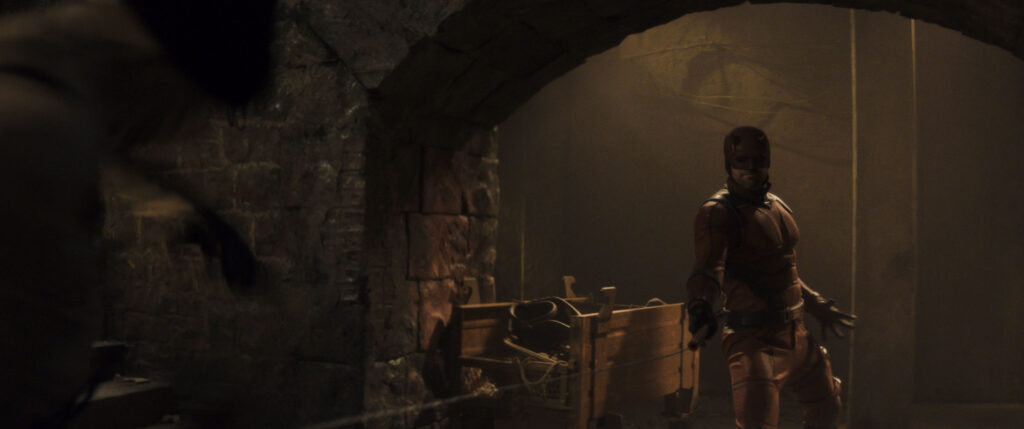 (Credit: Marvel).
“There’s a library of commercially available sounds that Skywalker Sound has purchased, so whenever you need something, we can get it,” Borland explains. “Then there’s the Skywalker Library, which is made up of every show Skywalker has ever done. With every completed project, that library grows.”
Borland further explains that some signature sounds are unique to specific productions. “The T-Rex roar from Jurassic Park [1993] is the T-Rex roar; you can’t reuse that. With Star Wars or Marvel there are property-specific libraries, so we have a Marvel library. When Captain America or Thor shows up, we can grab that stuff real quick.
“For Born Again I have a show library where all the new stuff I’m making lives,” Borland notes. “I can show my effects editor Jesse Drake what I did in that Episode 1 scene, and then she can go and cut the other scenes and I can guide her. Now she knows if I need a punch or Daredevil’s Billy club, that’s where she’s going to go. If the show library doesn’t have something, she asks me to make it, or she goes to the Skywalker Library and if they don’t have it, then you go to the commercial library.”
When legendary artist Walt Simonson was drawing Thor he would “draw” sounds better than any other comic artist, while the Frank Miller-style circles that surrounded characters like Daredevil, Banshee, Black Bolt, Havoc, or Professor Xavier were a visual cue to “show” sound or psionic power emanating from them. These comic visuals have continued to have an influence on Borland’s work.
“Hawkeye was such a fun project,” he says. “It was a buddy cop serial that had a different vibe to it, so you could get away with more. On that show I wanted the arrows to sound like a thwip, I wanted it to sound like they drew it in the comic books.”
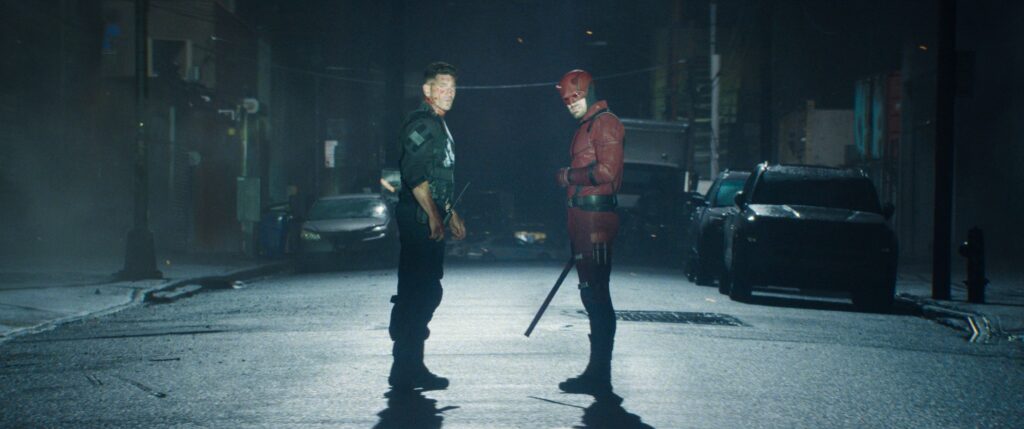 (Credit: Marvel).
Those sound effects can take as much time to finesse and perfect as any visual effect, the feel and tone of a sound often hitting home with more immediacy than the feast of a hi-def, widescreen visual. Given that, some key scenes were tougher to bring home than others.
As with many Marvel projects, Born Again is set in New York. Just as Captain America is from Brooklyn, Spider-Man hails from Queens, the Fantastic Four call Manhattan home, and the X-Men are in Westchester County, Daredevil operates in Hell’s Kitchen, and the city itself is very much a character in the show, as Borland explains.
“New York is a member of the cast, so you want to feel the energy, the life, the cacophony of what New York City is, but at the same time you still have to be able to tell the story. That was a challenge in and of itself. We established New York and then dialled it back a little bit, but at some point, people wanted to hear more of the city. We had this masterfully crafted sonic environment that we had control over; every car horn going by, every siren, every drunk yelling out of an alleyway. If they wanted more, we could give them more.” Sound effects editor Teresa Eckton was responsible for creating those ambient environments.
Ultimately, the soundscape of Daredevil: Born Again is there to ease the viewer or listener into the world, and one of the most bittersweet moments of the nine-episode season was the fate of White Tiger (Kamar de los Reyes), the street-level vigilante who got caught up in the machinations of Kingpin and paid the ultimate price. The final moments of Episode 3, while the credits rolled, highlighted the lightness of touch required by Borland and his team to aurally add even more emotion and meaning to an episode.
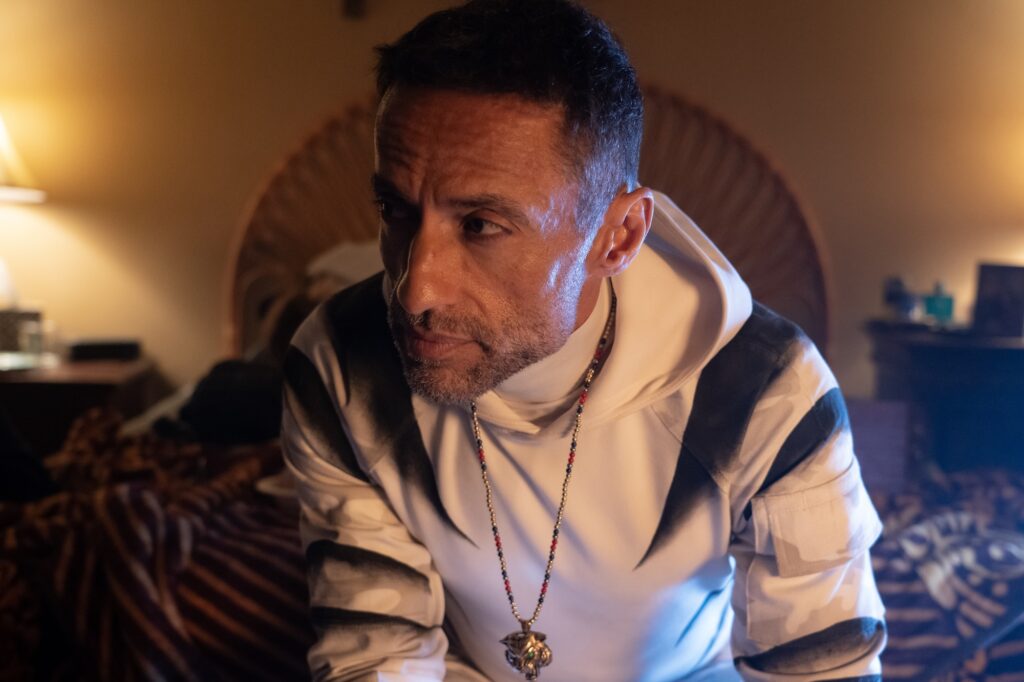 (Credit: Marvel).
“At the beginning of Episode 3, White Tiger spoke about Coqui frogs, so the decision was made that the credits would have the sound of Coqui frogs doing their thing,” Borland notes. “I then had the challenge of recreating those sounds in high quality without travelling to Puerto Rico to record them. I was able to clean up some commercial sounds. And when Hector Ayala whistles, that’s his own voice, and it sounds really close. I was able to use a bit of it. Tom Myers was the mixer, I gave him all this separation, and he did a great job.
If you listen to it in surround sound, there’s one frog up front and one in the back,” Borland concludes. “It’s an emotional moment where this character we fell in love with over three episodes is dead. Sound effects can elicit an emotional response. Usually that’s where you hand off to the composer. ‘Ok people, we need to feel something.’ But here, the sound effects sell the emotion better than music, and that rarely happens.”
—
Mark Newbold has contributed to Star Wars Insider magazine since 2006, is a 4-time Star Wars Celebration stage host, avid podcaster, and the Editor-in-Chief of FanthaTracks.com. Online since 1996. You can find this Hoopy frood online @Prefect_Timing.