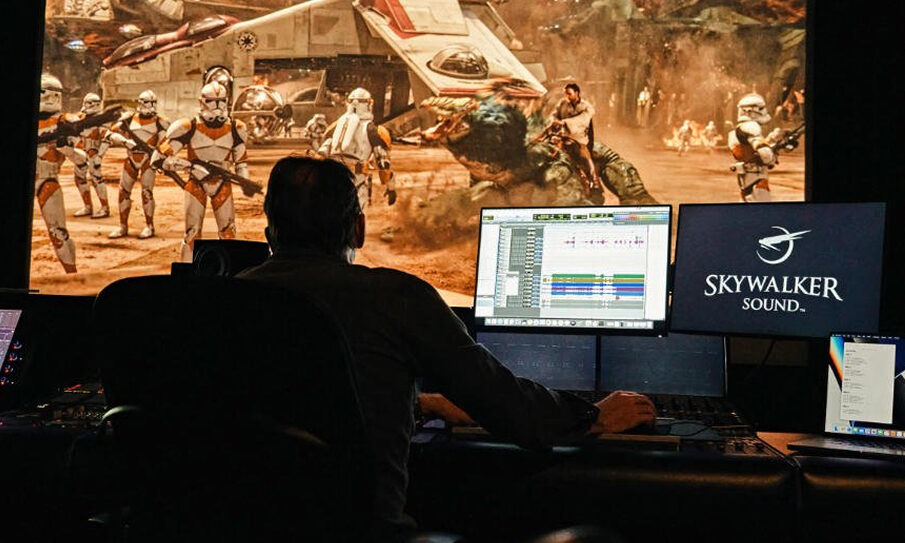
Skywalker Sound’s Matthew Wood and Danielle Dupre on the Sonic Landscape of The Fantastic Four: First Steps
The Skysound veterans outline their involvement in developing the sound of the Marvel Cinematic Universe’s latest box office hit.
Featuring an intergalactic expedition set against the backdrop of a retro-futuristic world, Marvel Studios’ The Fantastic Four: First Steps (2025) was destined to require a wealth of distinctive and compelling sounds to accompany the escapades of Reed Richards (Pedro Pascal), Sue Storm (Vanessa Kirby), Johnny Storm (Joseph Quinn), and Ben Grimm (Ebon Moss-Bachrach). Director Matt Shakman (It’s Always Sunny in Philadelphia [2005-present], WandaVision [2021], Monarch: Legacy of Monsters [2023-present]) enlisted Skywalker Sound for this enormous task, bringing the team onboard to shape the soundscape for Earth-828 and shepherd it through to its final mix.
Skywalker Sound supervising sound editor Matthew Wood (Star Wars: Revenge of the Sith [2005], Guardians of the Galaxy [2014], The Mandalorian [2018-2023]) and re-recording mixer Danielle Dupre [Loki (2021-2023), Obi-Wan Kenobi (2022), Agatha All Along (2024)] spoke with Skysound.com about their work on The Fantastic Four, chronicling Skywalker Sound’s initial involvement in the film’s preliminary stages, their creative relationship with the director, the insight they invested into the sounds of Galactus and H.E.R.B.I.E., and much more.
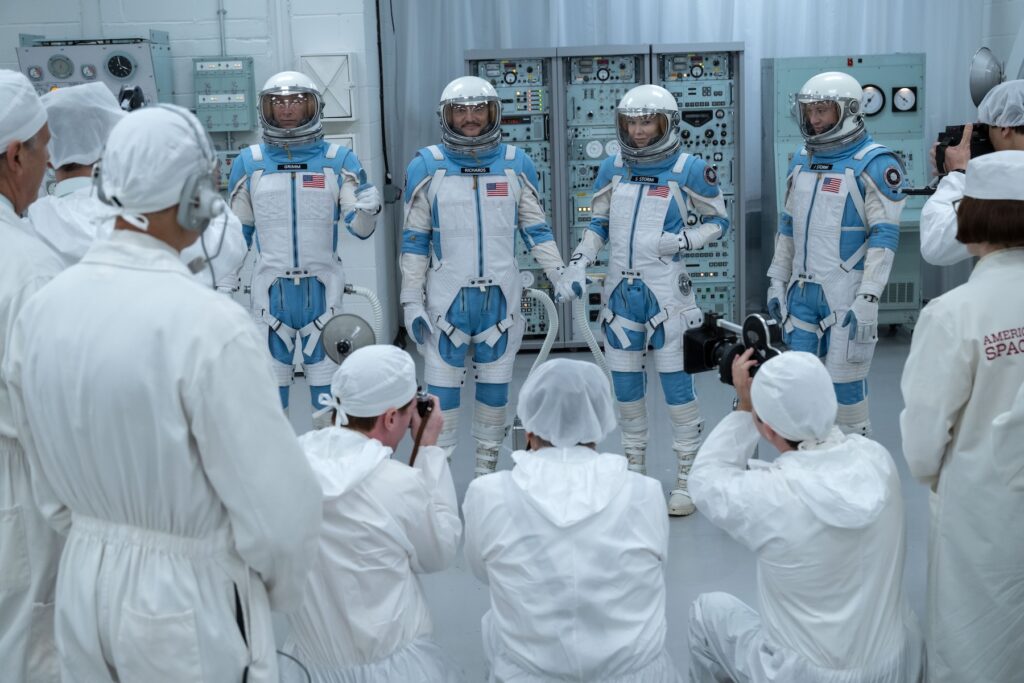 (Credit: Marvel).
A Perfect Prelude
Matthew Wood served as The Fantastic Four’s supervising sound editor alongside his Skywalker Sound colleague Josh Gold, who also assumed some sound design duties on the project. “I worked with all the sound editors for dialogue, ADR, Foley, sound effects, and design,” Wood tells Skysound.com. “Josh and I came on to Fantastic Four early to sort out droids and other subjective elements, whose sounds are not going to be cut from a library but rather made specifically for this film. Marvel has a giant legacy of sound that’s come from Skywalker, and if there’s anything that touches upon that legacy, we’re going to use it. At the same time, this particular version of Earth was new to the Marvel Cinematic Universe, so there was a lot to be created.”
Wood and Gold coordinated with Matt Shakman to ensure everything the director requested would be delivered, while Skywalker Sound’s Robert Stambler and Ian Chase were embedded at Marvel’s picture department, so the material that Skysound was crafting could, as Wood states, “get right in front of them and be integrated into their picture edit. The edit was happening fairly aggressively, so as they’re cutting the picture and evaluating it, we wanted them to hear our most current sound effects and dialogue.”
Re-recording mixer Danielle Dupre praises the collaborative environment the director championed on The Fantastic Four, remarking, “There were many occasions, like with the end bonanza where Galactus is King Kong-ing through the city or with Sue’s magic, where we presented ideas to Matt Shakman, and he was always all for it. One of the best parts about this project was the collaboration across the board, not just amongst our Skysound crew, but with Matt Shakman and [editors] Nona Khodai and Tim Roche.”
This symbiosis manifested in ways that extended beyond the film itself, such as when the filmmakers’ preparations for early public reveals at San Diego Comic-Con in 2024 helped determine some of Skywalker Sound’s earliest sonic priorities. “Matt Shakman and [executive producer] Grant Curtis kept us in the loop as far as the hot-button items that would be revealed at the event. The Fantasticar was going to fly over the heads of the crowd in Hall H, so we wanted its sound to feel big and throaty and cool and retro,” Wood shares. “Once Josh locked that in, I don’t think it deviated much from that once it was in the film.”
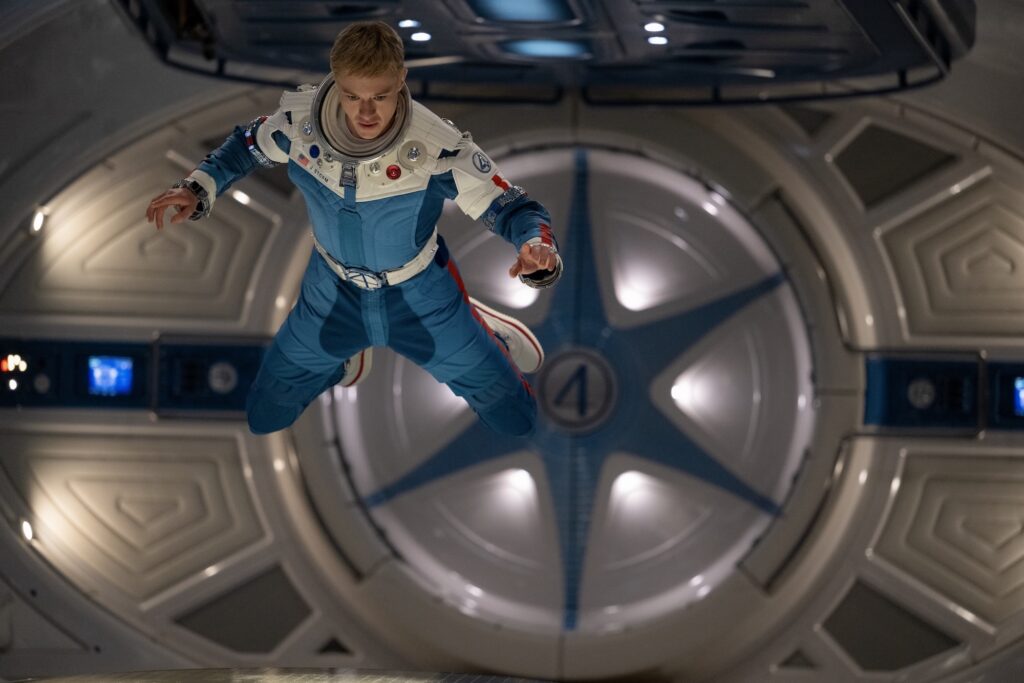 (Credit: Marvel).
Earth ‘Tones’
One of the team’s most crucial assignments centered upon establishing the retro-futuristic sounds of the alternate universe’s 1960s-era Earth-828. “Danielle and I had both worked on WandaVision with Matt Shakman, and he definitely knows how to build a world. We knew this place needed to feel unlike anything we’ve heard previously in Marvel. It had to feel modern yet still have a vintage patina similar to The Jetsons [1962-1963],” Wood recalls. “Coming up with that sonic landscape was difficult, as was determining whether items would be able to make particular sounds in the 1960s timeframe that we were loosely basing Earth-828 on.
“All the synth tones that Josh was using to create the sound of the Baxter Building and the different areas the Fantastic Four visited had a unique feel,” Wood continues. “Each location had its own sound, and it was challenging to assemble that and have it sound similar to something like Space Mountain at Disneyland. That was one of the descriptions that were bandied about by Matt when we discussed what he wanted this world to sound like. The refinements were constant. We watched an early version of the cut and had a session with Matt to talk about what sounds he wanted to go with, so we were fairly integrated into that process. After that, a lot of our work was based on our own instincts and what we gleaned from our meetings.”
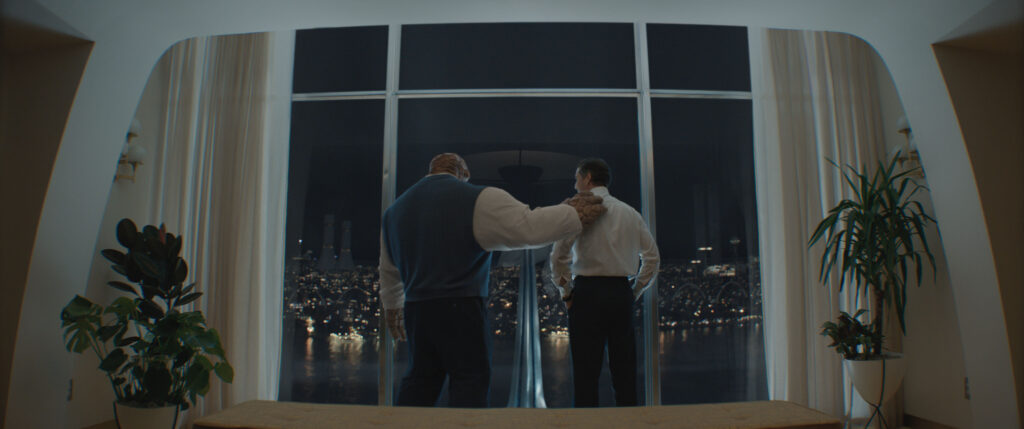 (Credit: Marvel).
An Audible Antagonist
As the Skywalker Sound re-recording mixers on The Fantastic Four, Dupre and Lora Hirschberg divided the sound elements across two categories, with Hirschberg mixing dialogue and music while Dupre mixed the sound effects, Foley, and sound design elements. “We sit on a big dub stage that is made to mimic a theater where you’d watch the film. We have a mixing console in the middle, and we take all of the elements that our amazing collaborators from upstream have prepared for us – dialogue recorded on set, ADR, loop group, the score, and the sound design made by our in-house team – and cut it in sync and creatively to the film,” Dupre elaborates, “And we mix them all together in real time against the picture in front of us.”
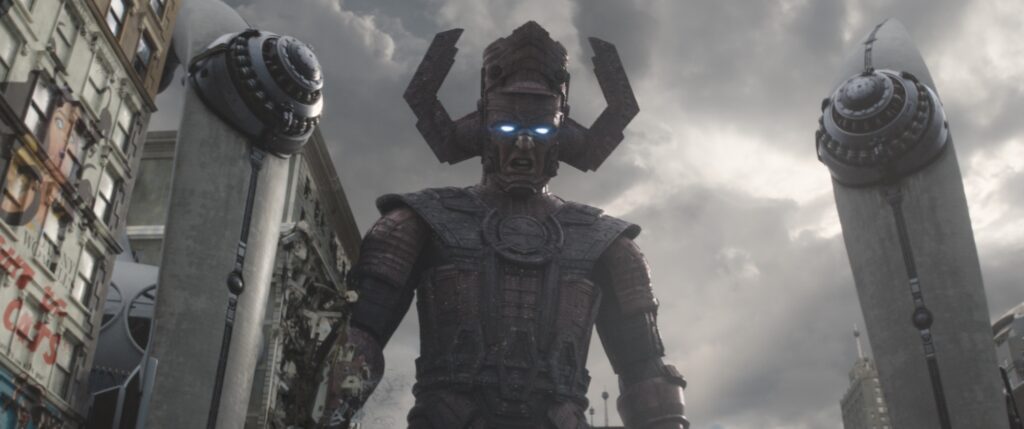
One of Dupre’s most memorable assignments focused on Galactus (Ralph Ineson), the film’s gargantuan antagonist. “Galactus is something like 40 stories tall,” Dupre explains. “In The Fantastic Four, the actor portrays Galactus’s face and voice, but the rest of what we see of Galactus is all CG [computer graphics, created by Industrial Light & Magic]. His body is composed of a metallic suit. I worked closely with our sound designer, Josh Gold, to try to understand what Galactus would sound like when he moves around. Josh took sounds from our library, but he also recorded new sounds of pieces of metal, rocks, movement, and creaks so we had an even larger library to choose from.”
These pieces were then assembled in a manner that reflected how they believed Galactus would sound when leaning forward, standing up, or completing other motions. “Sound-wise, Josh and I worked together to bring Galactus to life on screen,” Dupre notes. “There are a variety of different creative choices in which elements we used to make Galactus sound like a giant metal beast, but on the dub stage, we also had to figure out how we were going to place the sounds in the room to make it seem like he is actually larger than life – that the scale is there and he is towering over us when he’s speaking. One of the bonuses of a digital workflow is that you have endless amounts of options, and you can keep shooting and changing up until the last minute.”
 (Credit: Marvel).
The Retro Robot
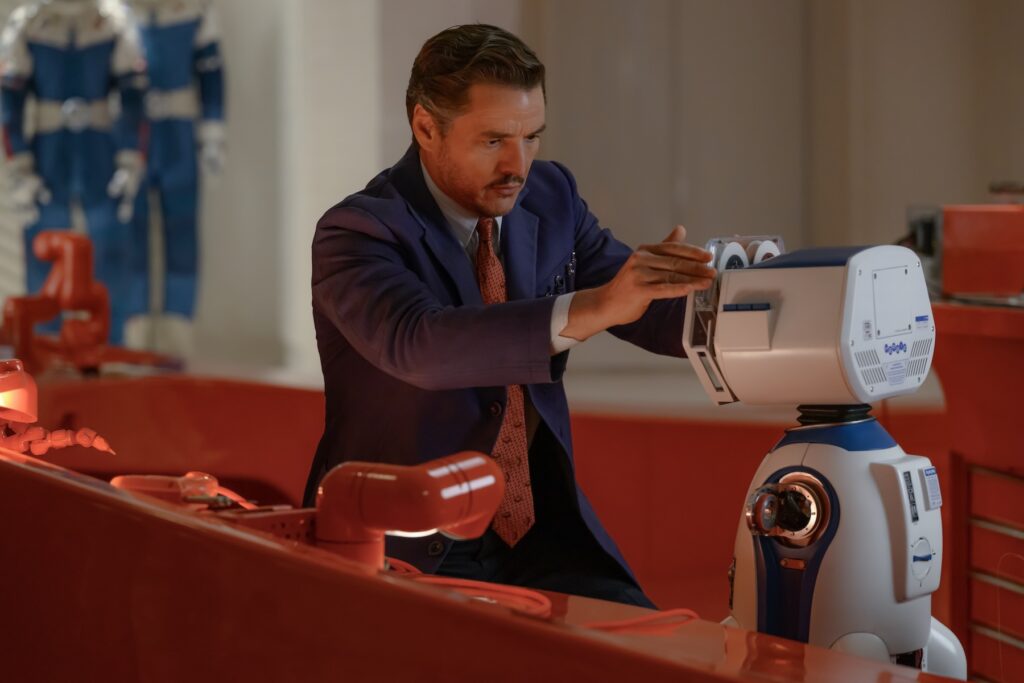
Another key character that received Skywalker Sound’s specialized attention is H.E.R.B.I.E., the Fantastic Four’s beloved robot. “H.E.R.B.I.E. was a retro-futuristic design, and we had to figure out how his gears and mechanical elements would sound when he moves,” Wood outlines. “Josh did an excellent job with H.E.R.B.I.E.’s non-verbal mechanical side – which becomes verbal in a way, because the absence of dialogue can work as dialogue, too. As for the vocals, we had a session with Matt Shakman early on. We all came to an agreement about what H.E.R.B.I.E. would be saying, and I performed it. I used my own voice as an instrument there, and I performed my own interpretations of what I thought he’d be doing in those scenes.”
Once integrated into the film for a test screening, Wood’s H.E.R.B.I.E. performance received positive reactions from the director, as well as from Marvel producers Kevin Feige and Louis D’Esposito. “My take hit in the Venn diagram between Star Wars and Pixar, both of which I’ve worked on. As we went on, Matt Shakman was very receptive to little tweaks because after we had the sound down, I’d see something and try to make it funnier, more charming, or anything I could do to help the script or the story. I’d get to preview it first for Danielle and Lora to see if they liked it, and then I’d play it for Matt and everybody else. We changed a lot of H.E.R.B.I.E. during our final mix, just to refine him and see how far I could push it,” Wood laughs.
“It reminded me of working on Star Wars or WALL-E (2008),” Wood adds. “Once you have your voice as the instrument, you can get instant feedback and devise different versions of it. I loved H.E.R.B.I.E., especially with the idea that he understands human speech, yet his own ability to reproduce it is limited based on his tech. You’re hearing this syllabic, tonal quality of the words he’s saying. I’d perform him saying them and then round off the intelligibility so you couldn’t hear them as much.”
 (Credit: Marvel).
A ‘Sound’ Story
Wood and Dupre both credit Matt Shakman for the engaging atmosphere he fostered. “Matt was cutting the picture and making changes on the film up to the last possible minute. Whenever Matt, Kevin [Feige], Lou [D’Esposito], and the picture department would come into our mix, there was a collaborative spirit as they all got to hear our material for the first time on a big stage,” Wood remembers.
This cooperation manifested in several monumental scenes, including the interstellar birth of Franklin Richards. “The actors performed their lines in ways which might’ve been a little bit quiet in their delivery on set, but it could be loud also. We had the ability to refine that focus of whether we were going to make it an overwhelming scene where everyone’s going to have to yell at the top of their lungs – with the effects and music going super loud – or hone in on a very intimate moment between Reed and Sue,” Wood asserts.
“We’d do small tweaks, like I would go and record Pedro Pascal and Vanessa Kirby doing new versions of lines that might be more clear to hear, based on where Lora and Danielle have put the noise floor of what’s happening and how intimate we want the scene to be,” Wood details. “Even though it looks like it’s a big effects sequence, the mix is actually an amazing balance between all those elements. I thought we found a good balance for the scene and made it quite poignant.”
Dupre emphasizes Skywalker Sound’s goal of bolstering the film’s narrative, declaring, “It’s just as important, if not more so, than the technical aspect of our work. It’s not only understanding the narrative that’s happening in front of us, but are we supporting the audience leaning forward on the edge of their seat when there’s an exciting moment? We’re constantly identifying the important beats that we need to hit, as well as making sure we get out of the way for jokes and performances. The script was so great, and the actors were incredible, so we don’t want to overpower them in the exposition scenes. We want to support them without announcing ourselves or taking somebody out of the scene. It’s a fun job, because if we do it correctly, nobody really knows that we’re there.”
 (Credit: Marvel).
A Legendary Locale
In addition to its distinguished legacy of work, Skywalker Sound also holds a special advantage in terms of its home base. “George Lucas invested a lot of his Star Wars earnings into Skywalker Ranch and made this beautiful location for us to work,” Wood pronounces. “It’s artistically satisfying, with the wonders of nature on the outside and astonishing high-tech engineering on the inside. Our library of sound effects at Skywalker is fairly unique, as they’ve been made over the last 50 years and are organized in such a way that we’re able to access and design with them.”
Skywalker Sound’s appealing atmosphere was on display during the production of The Fantastic Four, as Dupre mentions that acclaimed composer Michael Giacchino “pretty much camped out in the back of our dub stage. He had a makeshift studio there with his editors and was constantly on the mix with us. He’d listen to his music and what Lora was doing with it, so he could hear what worked and what didn’t.”
“I love watching the mix because that’s where it all comes together,” Wood adds. “We’re in a movie-theatre-sized room, and the whole crew is geared towards this. We’re all fans of each other, hanging out and seeing what we can bring to the table. The egos are checked at the door, and it’s really all about a core group of people working together. We don’t treat sound as just a technical thing, but as something to enhance your story and give it a bigger scope.” Citing the benefit of watching Hirschberg and Dupre share re-recording mixer duties on this project, Wood proclaims, “It’s tremendous to see their generational exchange of knowledge.”
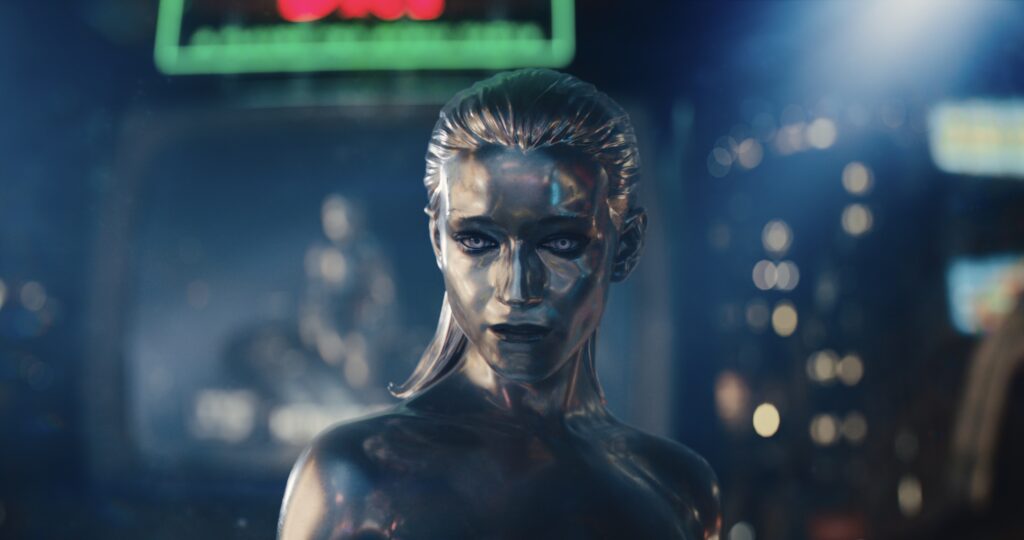
Dupre applauds Skywalker Sound’s personnel, commending her colleagues for the bonds they’ve forged over the years as they have worked side by side in the company’s distinctive environment. “We’ve been through life and have grown up together. That lends itself to a special shorthand, especially when you’re in a space where you need to be creative on demand and are under pressure. We know we’re in this safe space with people who know and value us.”
 (Credit: Marvel).
The ‘Fantastic’ Finale
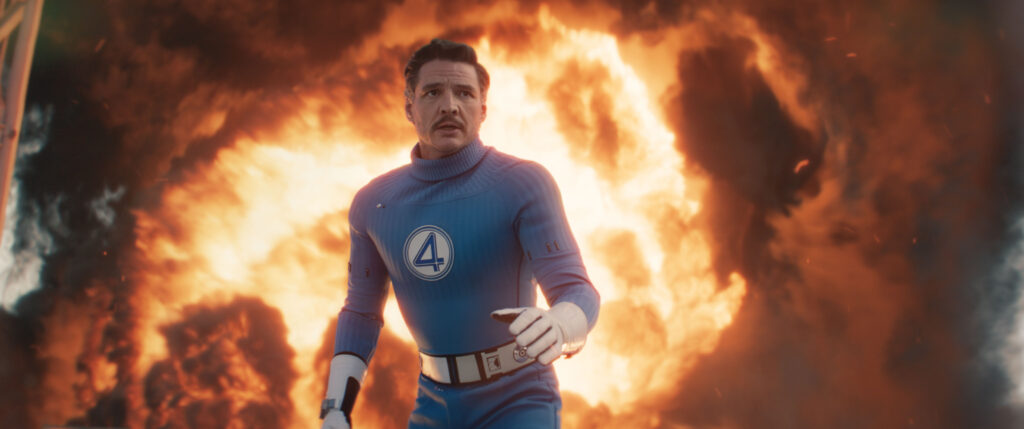
Both Dupre and Wood beam with pride when conversing about their contributions to The Fantastic Four, with each offering their gratitude and respect to director Matt Shakman, Marvel Studios, their Skywalker Sound coworkers, and the film’s entire cast and crew. Contemplating the film as a whole, Wood – who recently surpassed the 35-year mark of his Skysound career – surmises, “When I watch The Fantastic Four again, I’m not going to feel like I wish we had done anything differently. Everything we wanted to accomplish is already up there on screen, and I have good memories about what we’ve created, so that’s super fun.”
 (Credit: Marvel).
–
Jay Stobie (he/him) is a writer, author, and consultant who has contributed articles to ILM.com, Skysound.com, Star Wars Insider, StarWars.com, Star Trek Explorer, Star Trek Magazine, and StarTrek.com. Jay loves sci-fi, fantasy, and film, and you can learn more about him by visiting JayStobie.com or finding him on Twitter, Instagram, and other social media platforms at @StobiesGalaxy.