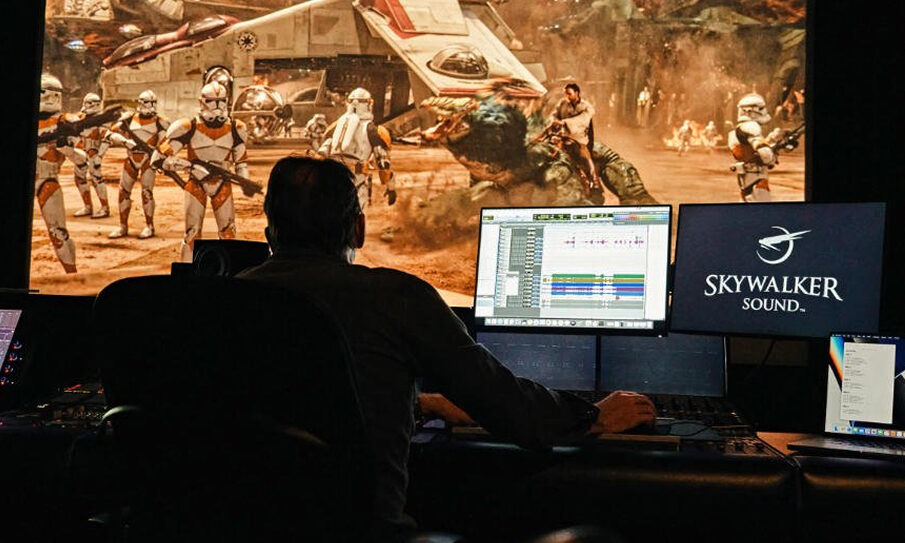
Precision, Power, and Personality: Skywalker Sound Helps Bring F1 to the Big Screen
How director Joseph Kosinski and the Skywalker Sound team crafted the authentic, cinematic sound of F1: The Movie (2025).
In the opening minutes of F1: The Movie (2025), the roar of engines begins not with the shrill, metallic wail of a modern Formula 1 engine, but the guttural thunder of GT cars, hammering around Daytona speedway. It’s an audacious choice for a film about the pinnacle of open-wheel racing, and one that immediately signals director Joseph Kosinski’s intent: This isn’t going to be a straightforward chronicle of the sport. It’s going to be both authentic and cinematic.
From there, the story accelerates, trading the stocky silhouettes of sports cars for the sleek, knife-edge shapes of Formula 1 machines. The sound shifts with them, from the muscular bass of Daytona’s grid to the tightly wound, high-frequency scream of the hybrid turbocharged era. Around that core, the sound mix layers the clatter of wheel guns in the pits, the snap of gear changes, the thump of tires over curbs, the whoosh of “dirty air” disrupting a rival’s run, and the call-and-response of team radio and trackside commentary. Each element was placed with intent, matching the action on-screen, by a team with one overriding mission: to make audiences feel the sport.
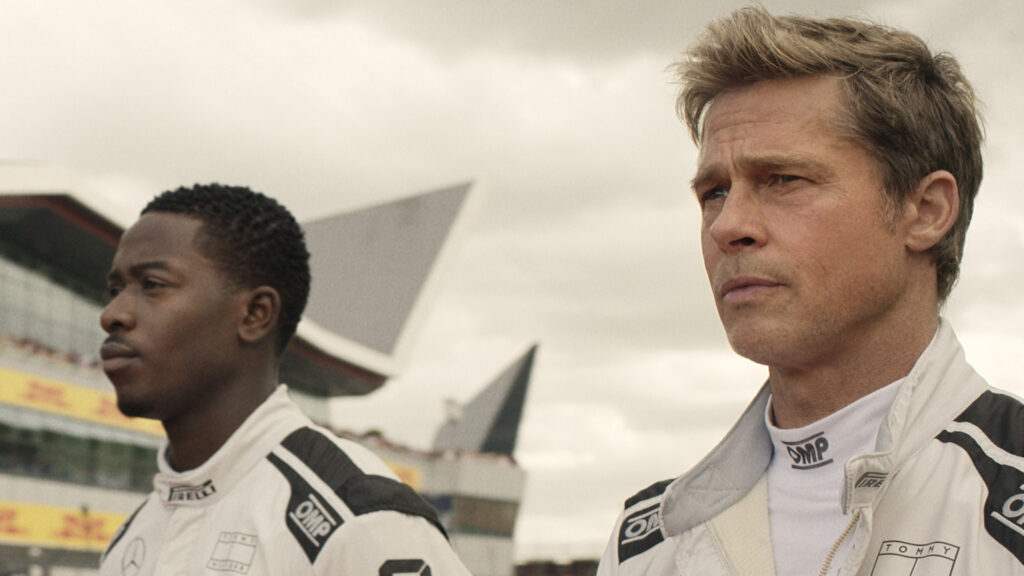
Driven by Authenticity
For supervising sound editor and sound designer Al Nelson, supervising sound editor Gwendolyn Yates Whittle, re-recording mixer Juan Peralta, and re-recording mixer Gary Rizzo, and the wider Skywalker Sound team, bringing the roar of Formula 1 to the big screen in F1: The Movie wasn’t just about volume, it was about accuracy, and bringing the energy audiences expect from the big screen.
Joseph Kosinski, known for his bold soundscapes in Top Gun: Maverick (2022) and Tron: Legacy (2010), set the tone from day one: The sound needed to put audiences right on the tarmac to make them feel the tension and thrill of racing at over 200 miles per hour.
Kosinski’s approach mirrored Formula 1’s own ethos: precision, focus, and a relentless pursuit of detail. He called on Skywalker Sound to translate that idea into a theatrical experience, walking a tightrope that could satisfy die-hard fans while captivating audiences new to the sport.
Kosinski’s creative compass pointed toward immersion, citing as a reference John Frankenheimer’s Grand Prix (1966), which remains one of the most technically ambitious racing films of its time, notable for its inventive camera work, authentic trackside locations, and a focus on capturing the rhythms and atmosphere of real Formula 1 events. While Grand Prix was released in both mono and stereo in 1966, for F1: The Movie, the team would use every modern tool available, including the full scope of Dolby Atmos.
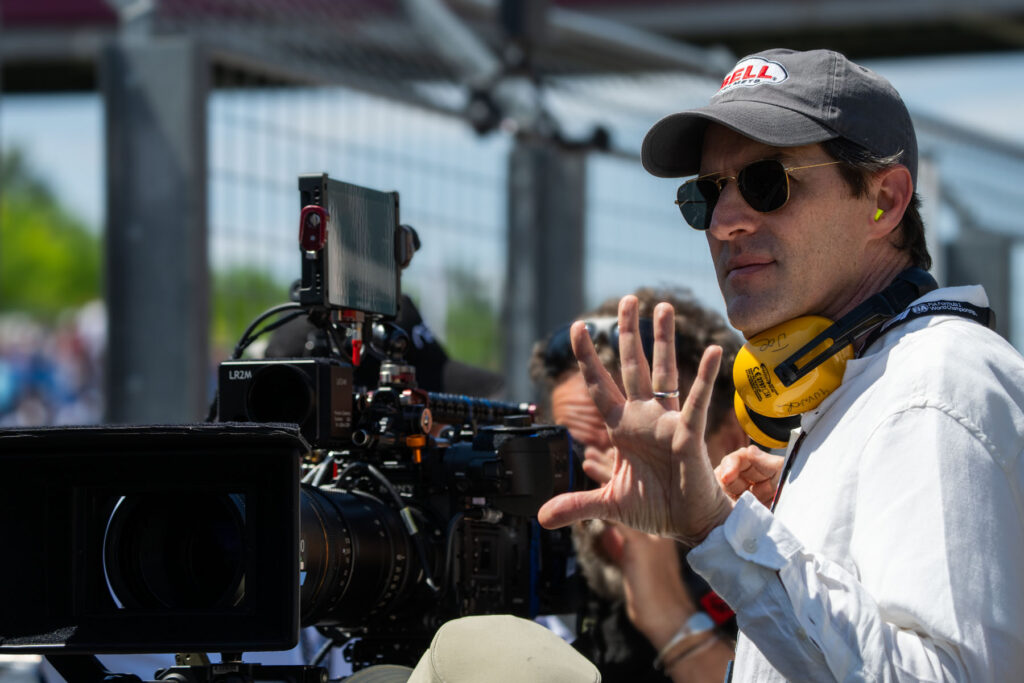
“When Joe first mentioned that this was his next film, he specifically called out Grand Prix. I hadn’t seen it,” Al Nelson tells Skysound.com. “So I immediately made sure I did. Grand Prix is one of the best. And it being the ’60s, back then you couldn’t just put a recorder on the car,” says Nelson, pointing to the technological challenges ahead. “I had seen Rush [2013],” he continues, “but that’s more of a drama. Those old V12 cars were ripping. For this, we were dealing with V6 hybrids, so eking out personality from those cars was going to be a lot more of a challenge.”
Re-recording mixer Gary Rizzo approached the project as both a sound craftsperson and a newcomer to the sport. “I revisited Days of Thunder [1990] and the more recent Gran Turismo [2023],” he explains. “The key was to really absorb as much reference as I could. Not being a Formula 1 fan, I wanted to get current. I also watched a little Drive to Survive [2018–2025] because I wanted to get familiar with the energy. I know what a good movie feels like, and I want to believe I know what a good movie sounds like. It was kind of fun to go into a mix of this magnitude surrounded by people like Juan and Al, who are both longtime fans of the sport, and to go with my gut.”
This combination of F1 expertise and fresh ears created a dynamic interplay in the sound design process. Nelson and Peralta brought the deep knowledge of the sport’s sonic nuances, while Rizzo challenged assumptions with cinematic instincts. “We’d say, ‘they don’t really do that,’ but Gary would challenge us, saying ‘This is cinema, let’s try it,’” Nelson recalls. “We didn’t want it to just be a documentary. We wanted it to be a cinematic experience.”
Building the Sound from the Ground Up
If authenticity was the mandate, the path to achieving it required meticulous planning and execution. The cars used during filming were actually Formula 2 vehicles. F2 is the feeder series to Formula 1, producing recent graduates like Andrea Kimi Antonelli, Oliver Bearman, Isack Hadjar, and Gabriel Bortoleto. But here, the F2 cars served as placeholders.
“The F2 cars were only visual guides,” says Nelson, explaining that the cars were going to be replaced by the visual effects teams. “We couldn’t use anything sonically because they’ve got six gears, and F1 cars have eight. So the way we approached it was we would get these sequences with the F2 cars and then we would compare them to F1 drivers, often Sir Lewis Hamilton, on the same track. We’d see that Sonny [Brad Pitt] or Joshua Pearce [Damson Idris] were at turn three going to turn five … so we’d go watch Lewis going from third gear up to fourth, up to fifth, up to sixth, back down, and back up again. And so we would record those actual sounds. We’d get the exteriors, we’d get the onboards. And then, as Gwen likes to say, we would ADR [automated dialogue replacement] the cars and then match them exactly.”
Whittle credits assistant sound designer Andree Lin with that line. “She had this enormous task of tracking all the onboards for all the races, for all the drivers. So she knew all this stuff hands down. ‘We can’t use any of the F2 car sounds,’ she would say. ‘They all have to be ADR’d.’”


“Joe was really invested early, and was already interacting with us to make sure that the first trailer wasn’t a surprise to F1 fans,” Nelson explains. “F1 has done a really great job, especially over the past five years or so, of getting their own mics — and good, reliable mics — on the cars for the broadcast. But it’s still broadcast quality, and so for cinema, we wanted to build on that. But we always started with the right gear, right speed, right place on the track, and Lewis and other people were checking to make sure we were being authentic.”
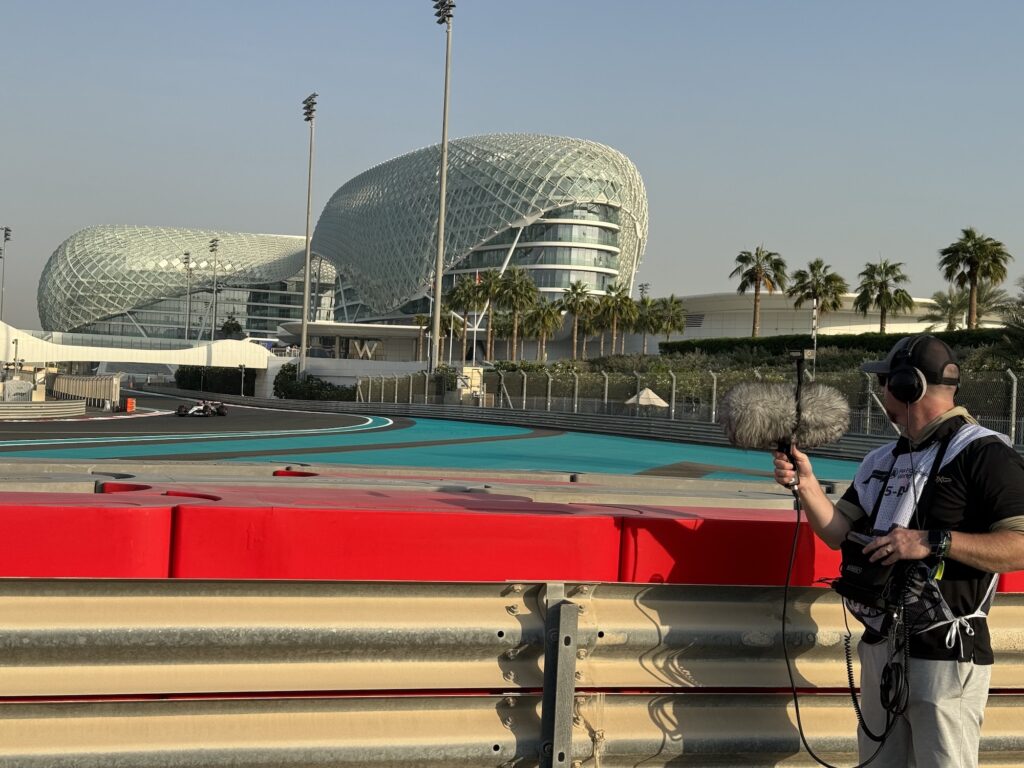
Production sound mixer Gareth John was crucial to that need for true-to-life sounds. “He did a fantastic job being out there in the middle of all this F1 chaos and arranging to get all the voices and all the performances,” Nelson says. “And he still made time to get recordings of the cars. In the beginning, he was really helpful in getting really tiny lavalier systems on the cars so that we could get 24-bit full-fidelity recording.
“And then later on,” Nelson continues, “we met with Lewis, who said, ‘You need more of this. I want to feel the car.’ He was really integral, along with Joe, in getting us further integrated with the teams. At one point, Lewis reached out and said, ‘You need to go and put recorders on our cars.’ We literally went through Toto Wolff [team principal and CEO for the Mercedes-AMG Petronas F1 Team]. I remember showing him these little Zoom F3 recorders we have, which weigh about half a pound. Toto said, ‘Absolutely not. You’re never putting that on our car,’” Nelson says with a laugh.
“So we did a bunch of research, and we found these recorders that are about the size of a matchbook,” Nelson adds. “Ultimately, we weren’t able to put anything on during practices or race days, but for tire tests, they let us put them on. We ended up getting hours and hours of recordings from George Russell’s [Lewis Hamilton’s Mercedes teammate at the time] car, in particular.”
“The edict from Sir Lewis Hamilton was: authentic, authentic, authentic,” says Peralta. “From there, we could start to break and bend the rules to make it cinematic,” adds Nelson.
Dialogue, Comms, and Sonic Geography
The realism of the film’s audio extended beyond the engines. F1 television viewers are used to hearing commentary and team radio alongside engine sounds. The movie’s character dialogue, team comms, and broadcast commentary all provide a crucial storytelling layer, echoing the complexity of live racing where drivers, engineers, and commentators all speak at once. It was Whittle who had the job of ensuring clarity amongst the potential chaos of voices.
“If you don’t understand what they’re saying, nothing else matters. Dialogue is the queen,” says Whittle. “You set the level for the dialogue, and everything’s got to work around it. You start there, and then Juan mixes it, and the music is added, everything’s got to kind of work around it.”
The pit wall communications became a favorite element, balancing clarity with the gritty reality of race-day sound. “The pit wall comms, what is called the ‘Wendy Wall,’ were great to work with,” Rizzo notes. “They had this warmth in the low end you don’t get from regular radio futz. We used a mix of production recordings and ADR to match that charm.”
Even the film’s commentary leans into real life. Legendary F1 commentators David Croft and Martin Brundle provided their voices to mirror their real broadcast chemistry. “One of the greatest things Joe brought to it was Crofty and Brundle,” says Rizzo. “They are as much a signature of F1 as the cars themselves.”
“We had just a ton of material for them,” adds Whittle. “They would come into the ADR stage, and they would watch the edited races, and they would just ad-lib. They played off each other really well. There were plot points they had to hit. But we would ask them, ‘How would you say that?’ then they’d go off on a riff and give us the real version.”
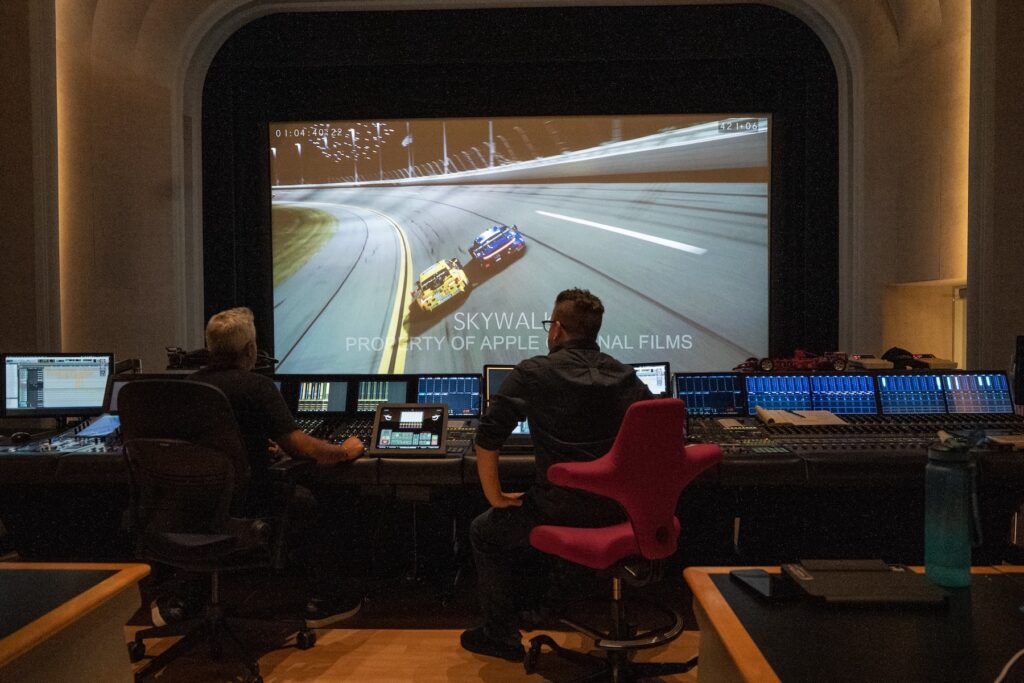
While in reality the commentators’ voices are beamed to millions of homes down the center of a 5.1 mix, for the movie, the Skysound team strove for more immersion. “I went to see Gary, who was premixing the dialogue,” recalls Peralta, a self-confessed F1 fan since the 1990s. “And it was the first time I ever heard Crofty and Brundle over a PA, as if I was there at the track, and it was a little shocking. I was like, ‘Whoa,’ it took me a second, but then I totally bought it. And Joe did too. His reaction was, ‘Okay, I feel like I’m there.’ And then we just went with it. It was different, but in a really cool way.”
“There are ping- pong delays that are happening all over the hemisphere to make you believe that the PA is coming from many speaker cabinets in an outdoor space, as well as the music playing, as well as the sound effects playing,” Rizzo adds. “That said, what I do love about Juan’s mixing style is that he doesn’t abuse the concept of objects in Atmos.”
The result is a restrained sonic geography that guides the audience intuitively, from cockpit to pit wall to the grandstands, without ever losing the emotional core of the story. “The true benefit of Dolby Atmos is the hemisphere,” Rizzo explains. “Yes, the audience is facing forward as in stereo, but now sound can originate from many other places. We use it for envelopment through music, and it lets other elements of the mix play more specifically. We can make a car have a vector in that hemisphere, not just point to point. We never want the audience to lose focus on the screen; we want them further invested.”
A Whole Lotta Music
Opening F1 with Led Zeppelin’s “Whole Lotta Love” (1969) isn’t just a musical flex; it sets the tone for a film that marries rock-and-roll adrenaline with high-speed racing precision. The raw energy of John Bonham’s drumming and Jimmy Page’s iconic riff became a sonic handshake for the audience: Buckle up, this ride is going to be loud, fast, and unapologetically cinematic.
“We did an elaborate temp mix months before the final to create the sonic arc,” Rizzo explains. “We wanted each race to sound different to the others. We had to open with an explosive Daytona race, and who better than Led Zeppelin for that? When John Bonham’s drums enter early in the film, when you first feel the magnitude of Led Zep, you know how they’re gonna carry you. I love how that moment comes together at Daytona.”
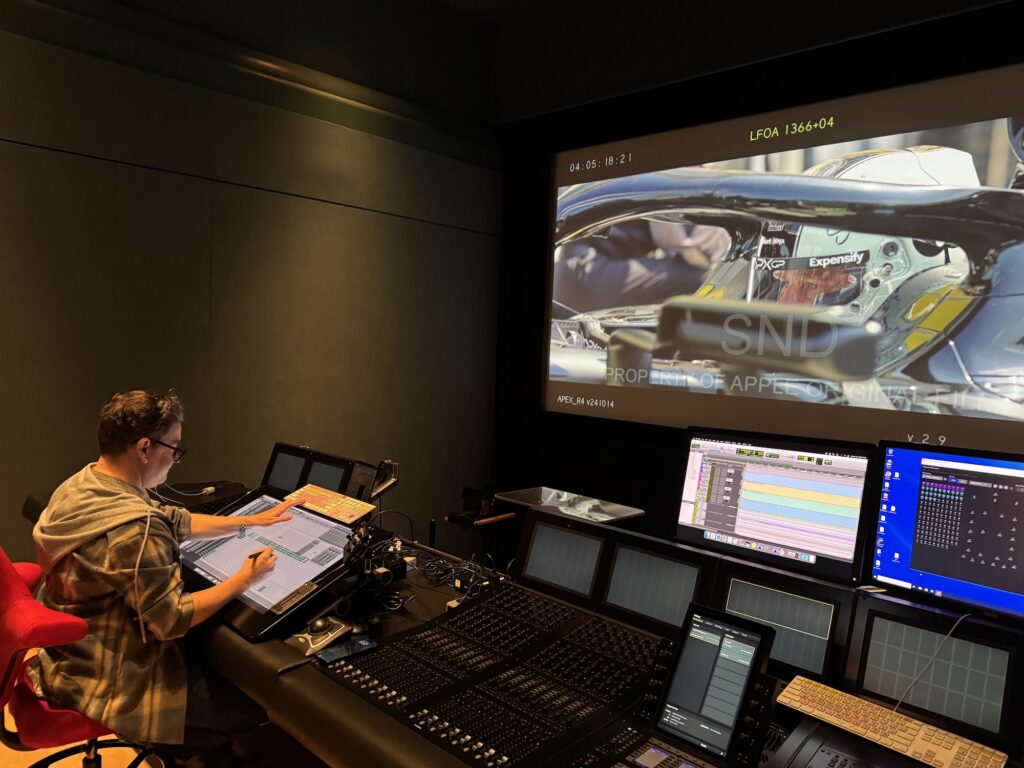
“Thankfully, those GT cars you hear on ‘Whole Lotta Love’ are different to the F1 cars,” adds Peralta. “I think if that song had played over a Formula One race, then that would have been trickier. Those V8 GTs are so throaty. They didn’t clash very much with the music, which was great. When it first starts and Sonny is walking to the pit, I’m just flying them around the room; it’s just those ‘pass bys’ that are kind of distant. That helps stay out of the way of the music.”
As the film builds to its later races, the score begins to dominate, carrying the emotional weight of the story. “For the final race, Hans is right there,” says Rizzo. “Hans Zimmer and Steve Mazzaro really brought it on this one, a classic score that you’re humming when you walk out. They are supplementing the adrenaline in that moment, like only they can.”
Signature Sequences for Sound
Each race in the film has its own sonic identity, but none demanded more precision than Silverstone. With no score to guide the audience emotionally, the effects had to do some heavy lifting.
“Silverstone had no music, just cars, Crofty and Brundle, and the crowd,” says Peralta. “I did a whole pass where all I did was move the crowd in and out as the cars approached the grandstands. Here they come, and now the crowd is behind us. It was raw, and it worked.
“Whenever we cut to the internal helmet view, I originally had more low-end rattling the room,” Peralta adds. “Joe said, ‘Whoa, it’s a little too much.’ He didn’t want it big just for big’s sake. He wanted it to feel real. So we reigned it in a little.”
By focusing on the race’s pure elements, engine whine, tires on tarmac, the Doppler of passing cars, and the rise and fall of the crowd, Peralta built a clear, immersive soundscape of the British Grand Prix. With no musical score to lean on, each shift and cheer becomes part of the natural rhythm of the race. This concept of creative restraint paid off for the crash at Monza, one of the film’s most dramatic sequences. When an incident like that happens in Formula 1, the air seems to get sucked out of the room for everyone watching.
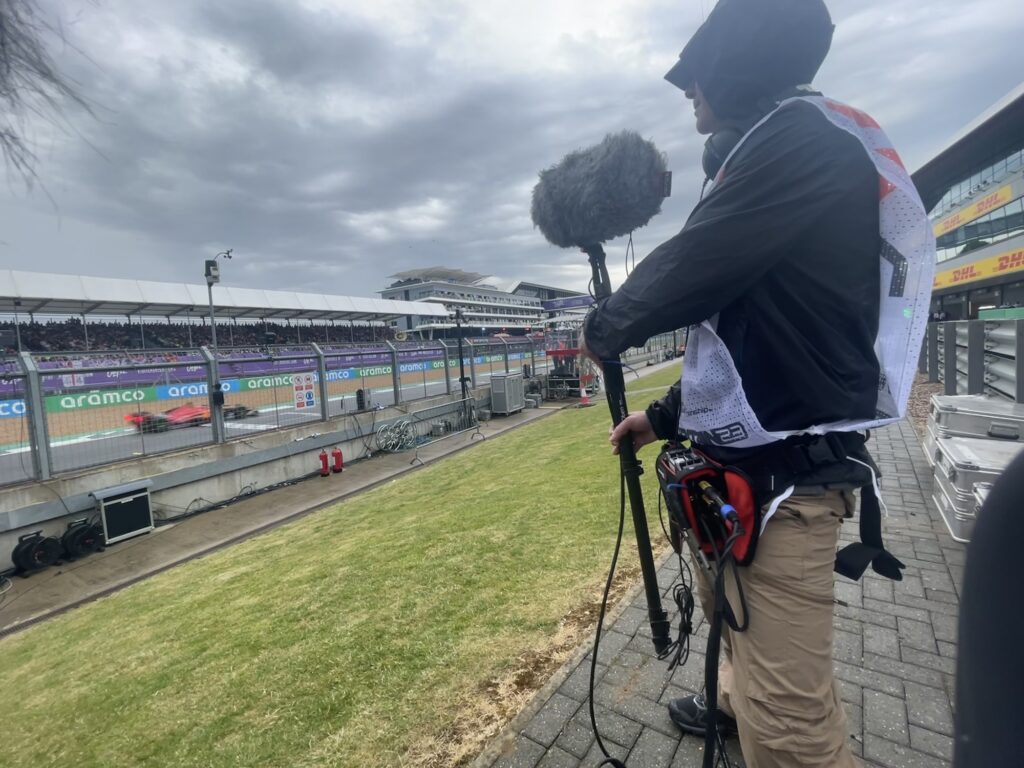
“The trickiest part was when do we suck it out?” notes Peralta. “It was either right as he hits or right after he hits, or midair. We played with that a lot. When Gwen, Al, and I went down to do one of our first big preview screenings, we did a temp mix. And that was the first time I realized that the moment really, really worked. The entire theater gasped at the same time. You could feel the air leave the room.”
That first temp also underscored the scrutiny they were under. “I knew it was a sport of magnitude and attention,” says Rizzo. “But with that first temp, I realized, ‘Wow, we are under a wildly focused microscope. That just made it more fun.”
“That’s our filmmakers. That’s Joe Kosinski and [editor] Stephen Mirrione doing what they do so well: create that story arc,” says Nelson. “That scene was determined from the moment it was edited, and we just fine-tuned it. Credit to Gary and how he mixed that event with the PA, the ‘No, no, no!’ Then it goes silent, and then the music comes in. All of that was predetermined by our filmmakers, but our mixers made it into the visceral event that it was.
“Monza is a mixing masterpiece,” Nelson adds. “We have earned our way into that adrenaline through the combination and the relationship that this film uniquely has between music and sound effects. We’ve got the audience invested. Now there is a little bit of movie-making magic, some sleight of hand that’s happening where we lure the audience into this, and we make the adrenaline pump.”
Dirty Air and Rumble Strips
The team even gave voice to the invisible physics of the sport. “Dirty air” refers to the turbulent airflow left behind by a leading car. The disrupted air reduces the aerodynamic efficiency of the car following close behind, making it harder to generate downforce and grip in corners. Drivers often feel it as understeer and instability, and in the film, Skywalker Sound needed to communicate that sensation sonically.
“The idea of dirty air was brought to my attention in a reference broadcast clip when the driver radio was enabled and you hear it right away,” says Rizzo. “It ultimately comes down to a bit of distortion. But how fun that we have this imperative story element that we can easily identify verbally, but sonically it can only be told through distortion. That was a tough one to sell in just a few seconds.”
Rizzo further explains that “Not only did it have to have that unique character, we also had to work around dialogue that’s happening in that particular moment too. So it’s a matter of hearing it, not hearing it, back and forth. So a fine combination of reality and authenticity, as well as design work, effects mixing work, dialogue mixing work, all coming together to make the concept of sonic dirty air successful in the scope of the movie.”
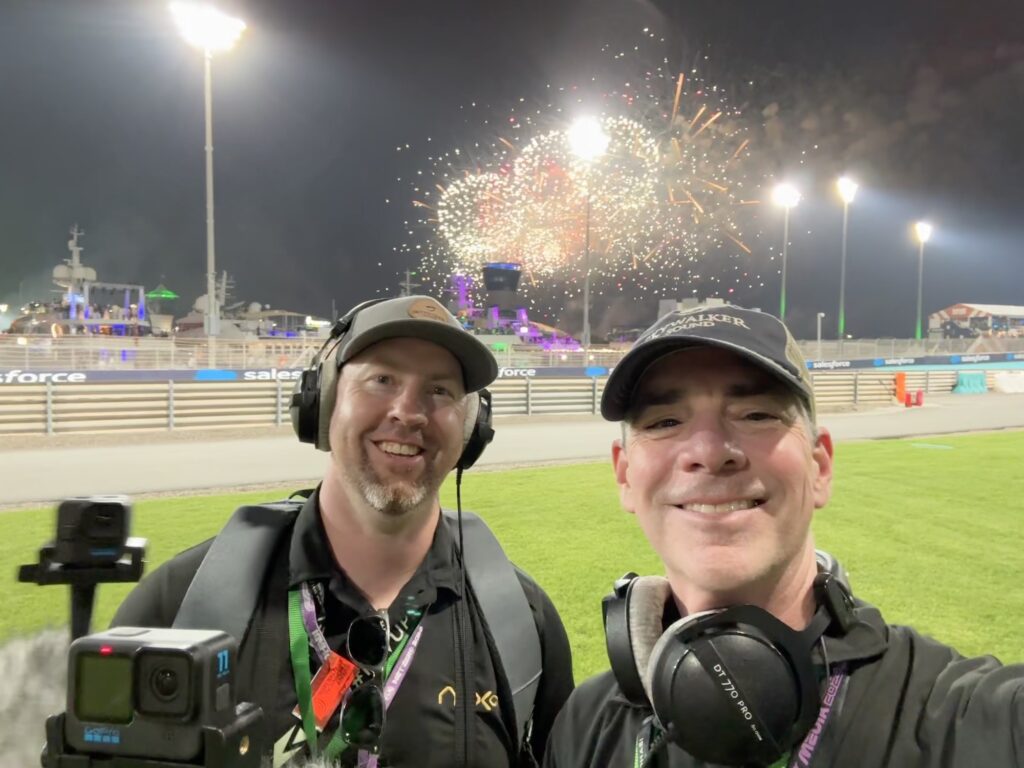
Every part of F1’s sound texture, from the grind of rumble strips to the mechanical blast of pit stops, was studied closely. The Skywalker Sound team made sure the sport’s DNA carried through every frame. For Nelson, that meant carefully observing sounds at the races.
“If you stand at turn one in Abu Dhabi,” says Nelson, “half of the cars will hit the curbs, half the cars don’t, depending on who the driver is, and whether they’re on a fast lap. But it is such a signature sound. That was something that revealed itself at the races. You’re always looking for personality. How can we find other things to keep this interesting? How do you make the car onboard interesting? How do you make the car exteriors interesting? How do you do things to make them feel fast? There are all kinds of other layers that you add in. The curbs were something that we really invested in. It was a fun discovery that we could add those.”
The Micro-symphony of a Pit Stop
If the roar of the engines is the body of a Formula 1 race, the pit stops are its lightning-fast punctuation marks. On-screen, they last less than three seconds, a display of drilled, mechanical choreography. From an audio standpoint, it begins with the car screeching to a halt, the front and rear jacks snapping into place. The wheel guns erupt in a sharp, high-pitched whir as the old tires come off, replaced in an instant by the fresh set. Another burst of wheel-gun chatter locks them down. The jacks drop, the car screams away, leaving behind the smell of rubber and the rapid heartbeat of an adrenaline-filled crew.
Nelson’s first-ever F1 race was at Silverstone in 2023. “To experience those 100,000 fans in the English countryside was incredible,” he says. “My first moments were being led through a garage into the pit lane. For the next three days, I saw and heard it all: the crowd roaring, the Red Arrows jets flying over, the cars blasting into the pit stop. That’s when you understand how it really feels.
“Being 10 or 15 yards away is different from being right there,” says Nelson of pit stops. “All the camera activity was right there. And I was fortunate to be right there when they did the practices, where there’s no engine, and they just push the car up and practice their pit stops. So I was able to get extreme close-up recordings. And it makes a world of difference because you don’t have all of that ambient sound, you’re right there as the tires are thunked on, and the bolts get driven in. And then it’s this wall of sound when the car peels away.”
These fleeting moments in the film carry the same adrenaline as the race itself. Every thunk, hiss, and whine had to be placed perfectly in the mix, a micro-symphony of mechanics and motion.
The Voice of the Crowd
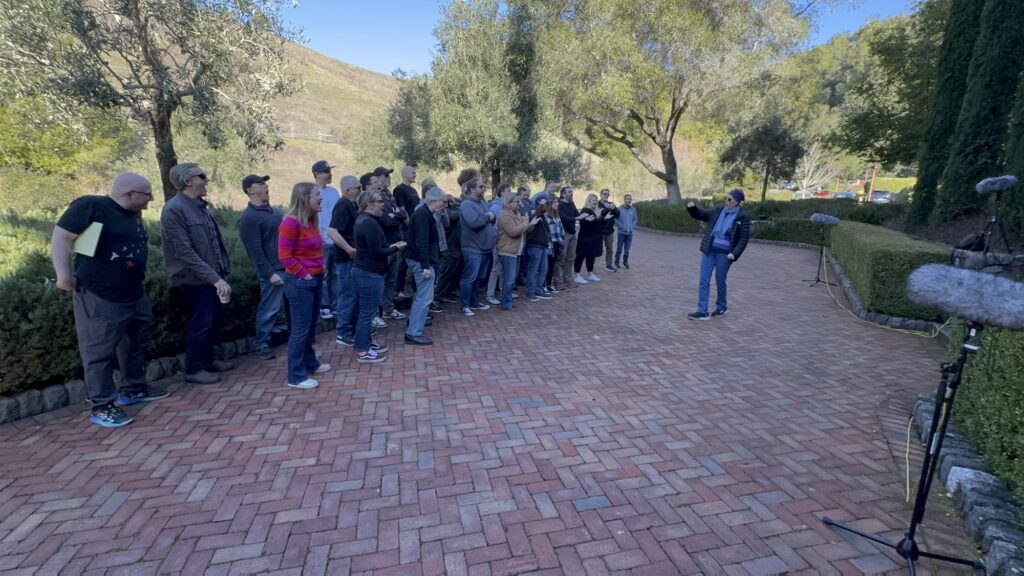
Crowd noise is an inseparable part of the Formula 1 experience, and Skywalker Sound treated it like a character of its own. From the swelling cheers at Silverstone to chants recreated during group sessions at Skywalker Ranch, the team carefully orchestrated how the audience would move through the film sonically, just as a race fan might experience an event in person. To layer that realism, they combined genuine crowd recordings from live F1 events with those staged sessions, matching the rhythm and energy of fans in the stands.
“The crowds were kind of an interesting thing because we had all this fabulous, real crowd material from the actual races,” says Whittle. “But at a certain point, you still needed the specifics to keep it from being too washy. And too many specifics made it feel unreal. It was a delicate balance. We actually ended up recording SAG actors at Skywalker Ranch. We had them outside chanting, ‘Apex! Apex!’ which was really pretty fun.”
A Collective Achievement
By the time the mix was complete, the film had evolved into a sonic love letter to motorsport, designed to immerse newcomers and meet the exacting standards of the paddock faithful, all while embracing the spectacle cinema was made for. Audience feedback proved the team’s attention to detail had paid off. “People told me the sound made the movie more exciting. That’s the best compliment you can get,” says Whittle.
Peralta points to Silverstone as a prime example of that success: “Silverstone was just the cars, the crowd, and Crofty and Brundle. When it worked, I felt proud. That’s the one I look back on and go, ‘Yeah, we nailed it.’” Rizzo shares the same measure of success, framed through the film’s immersive ambition: “You want the audience to feel like they’re right there. If they do, then we’ve done our job.”
For Nelson, the whole journey was a highlight. “I just remember having so much fun from beginning to end, especially putting it all together with the team and being there with Joe and seeing our filmmakers get so enthusiastic about how it felt. We made Joe happy, we made [producer] Jerry Bruckheimer happy, and we made Sir Lewis Hamilton happy. That’s a great feeling.”
Nelson adds that he is “so excited for our Skywalker family with sound nominations in three of the five films,” in reference to fellow nominees from Sinners and One Battle After Another. “Grateful for such a creative culture that we all share. Thrilled for our F1 filmmakers for their best picture nomination.”
F1: The Movie is now available on Apple TV+.
—
Jamie Benning is a filmmaker, author, and podcaster with a lifelong passion for sci-fi and fantasy cinema. He hosts The Filmumentaries Podcast, featuring twice-monthly interviews with behind-the-scenes artists. Visit Filmumentaries.com or find him on X (@jamieswb) and @filmumentaries on Threads, Instagram, Facebook, and YouTube.