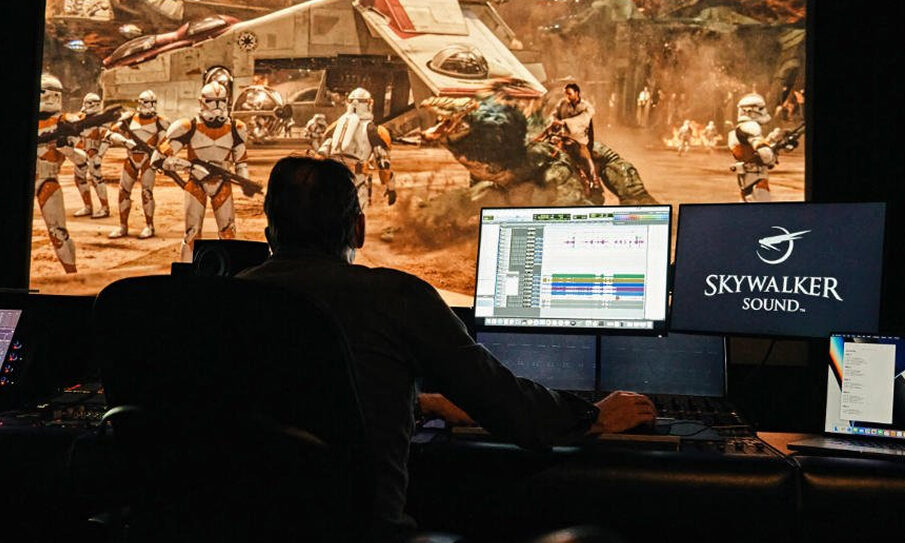
Skywalker Sound’s Jeremy Bowker and Dan Laurie Discuss Creating Soundscapes for Illumination
Sound designer and supervising sound editor Jeremy Bowker and supervising sound editor Daniel Laurie have each worked on several animated features from Illumination, including 2026’s The Super Mario Galaxy Movie and Minions & Monsters.
Skywalker Sound creatives regularly bounce back and forth between different clients and genres, as well as between live-action and animated films. Over the years, sound designer Jeremy Bowker and sound editor Dan Laurie have developed a unique relationship with one of Skywalker Sound’s animation clients, Illumination.
Both Bowker and Laurie worked on Illumination’s first feature film, Despicable Me, in 2010. Following other Illumination projects like The Lorax (2012) and Despicable Me 4 (2024), they worked their way up to supervisor roles as sound designer and supervising sound editor, respectively, on The Super Mario Galaxy Movie (2026) and Minions & Monsters (2026).
While each project, no matter the studio, will have unique challenges, and each director will have different aesthetics they are hoping for, Bowker notes that, “One thing that’s universal with Illumination’s films is that they take the process very seriously, but they don’t take themselves seriously. I think you can see that come out in the humor of their films. When [executive producer] Chris Renaud returns, there’s kind of this nostalgic feeling of ‘Wow, we were all there when this started.’”
An appreciation for film history and what made people laugh in earlier periods of animation is all a part of the plan in Illumination films. “There’s a lot of appreciation for slapstick, the history of slapstick, and a real musical timing to sequential events where one thing leads to another, and everything is a bit of a kind of hilarious domino effect,” says Bowker, who adds “quite often Illumination projects want a little bit of a callback to what we all grew up with as far as classic old school sound effects.”
 Credit: Illumination
Expanding the Universe
As The Super Mario Galaxy Movie and Minions & Monsters are both sequels to films in established universes, some of the team at Skywalker Sound already had experience creating sounds for some of the characters or environments in the film, but that doesn’t necessarily translate to an easier workload. “We are always going to push harder to explore and see if we can push the boundaries of what was done before,” notes Bowker.
Part of this process includes recording things the team has never recorded before and trying ideas, even if it feels like they might fail, just to see what sticks and what doesn’t. “And if it doesn’t work,” notes Bowker, “you set your ego aside for what’s best for the film. And now we know where that center threshold is, where it’s going to work.”
Laurie values how animators regularly know exactly what they want, in part because they’ve worked on the same project for so long. He’s also learned from earlier experiences on Illumination films what the client is hoping for. “[Founder of Illumination] Chris Meledandri always wants music to drive the film,” says Laurie. “It always comes back to that. The emotion, for the audience, is intertwined with the music. We didn’t mix Despicable Me like that at first and learned very quickly that he really wants the music to be pushed, so that’s how we approach these films now.”
Not Overloading the Audience
Both The Super Mario Galaxy Movie and Minions & Monsters are fast-paced adventures filled with stunning visuals from beginning to end. Not overwhelming the audience, especially younger viewers, was key to the sound design of both films. While neither film has much silence, making sure key sounds could grab the audience’s attention and have the desired emotional impact was essential.
“A lot of the latter part of the editorial process, the premix process and the final mix process involves a lot of muting,” Bowker explains, “and what that ends up doing is it gives the important sounds their own autonomy.”
For a sound the team really wants to shine in a sequence with a lot of interconnected elements, Bowker would de-emphasize, or take away, sounds right before or after it. “I remember reading articles long ago about [musician] George Clinton talking about what defined funk music and how so much of the silence in unexpected places gave it its sound,” he recalls. “I feel like I really understood that more once I got into sound design because it really does give something its moment if there’s silence in a place that you don’t expect. It just feels like the bottom of the room has been pulled out from under you, and it’s exciting. Sometimes a lack of something can be really exciting and fun.”
Adds Laurie, “The smallest sound can have the biggest impact. Sometimes it doesn’t have to be this massive, great sort of sound design whooshing around the room. It can just be one tiny little sound where the audience just laps it up.”
Stepping Into the Shoes of the Audience
Whether a film is set on Planet Bowser or in a version of Old Hollywood filled with Minions, it’s the sound team’s job to make sure the audience is immersed in the experience.
“I think sound helps you place yourself in the film, rather than just in front of it,” Laurie comments. “You want to be immersed, and it’s an emotional journey a lot of the time. What we’re trying to do is touch on the emotion of the film. If you’re just sitting in front of it, watching it on the screen, it’s okay. But the sound design and the music can bring it all together so you’re actually involved in it.”
“We’re constantly trying to make an effort to put ourselves into the shoes of the audience,” adds Bowker, “so any way that our workflow can cater to us becoming more like an audience member, the better.”
Techniques to achieve this include making sure not to spend too much time on one small section of a film, so the team doesn’t lose their perception of it, and becoming more proficient with the instruments and tools they use to create sounds so they’re not thinking about the process too much. “We don’t want our brains to be thinking too much about the gadgets or plug-ins,” notes Bowker. “If we get too into the bells and whistles, then we kind of lose our compass.
“We’re always trying to make that part of the process as much of an inherent part of who we are as creative people, just trying to let it flow through us,” Bowker continues. “Then hopefully our consciousness is based more upon what the audience is feeling.”
 Credit: Illumination
‘The Super Mario Galaxy Movie’
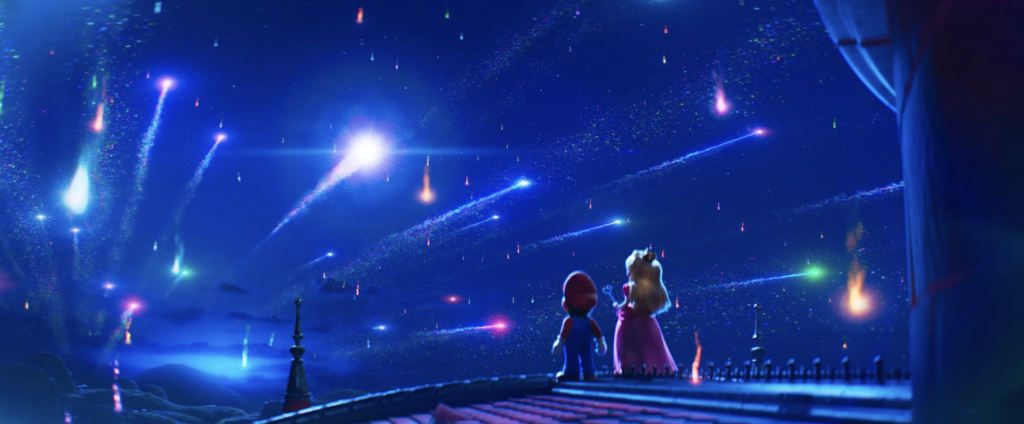
The Super Mario Galaxy Movie is the second Mario movie for Laurie, who also worked on 2023’s The Super Mario Bros. Movie. Bowker, a huge fan of the Super Mario games, followed in Randy Thom’s footsteps as the sound designer for Galaxy. “It was an absolute blast to kind of go back to a childhood full of these classic sounds that we grew up with,” says Bowker.
Elements from the 40-plus years of Mario video games history remained a vital part of the soundscape. “I think one of the interesting things about working on a film based on intellectual property that is so important to so many people is that even throughout the different iterations of the games, those sounds evolved within the games. So sometimes we would put in what could technically be perceived as the correct game sound. And then we would send off a demo of what we were working on to Nintendo, and they would say, ‘Actually, can we put in a more modern version of one of our sounds?’ Sometimes they’d want to lean on the kind of classic, very early eight-bit sounds, and then other times they would want to lean on a more modern version.”
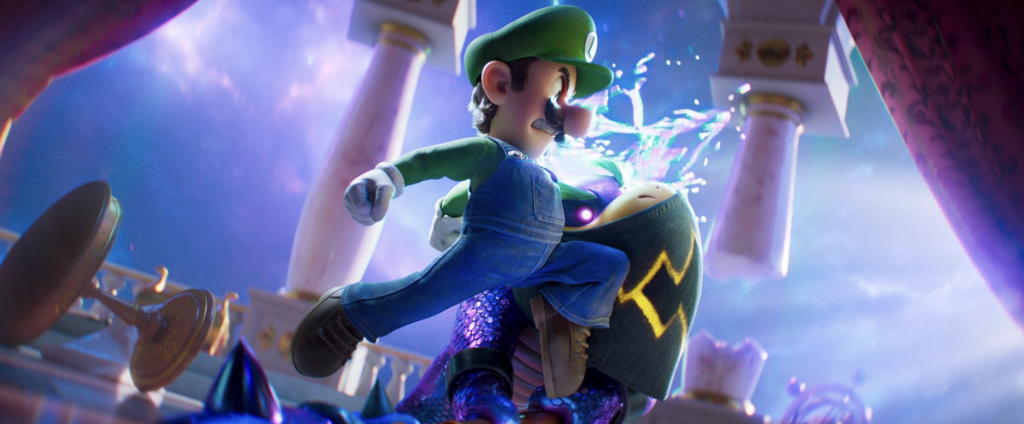
A sound from the video games led to one of Bowker’s favorite moments in the film. Right before the Mario brothers meet Yoshi in a pyramid, a vintage game sound provides a bit of comic relief. “Luigi is positive that he’s heard something terrifying right behind him, and he swings around and freaks out while throwing these fireballs really quickly,” the sound designer explains. “Everything leading up to that is very kind of classic horror, and there are no Nintendo sounds. But for this moment of comedy where he freaks out and turns around, you just hear the classic fireball throwing sound – BING BING BING – and it’s a perfect goofy moment that cuts the tension.”
Part of Bowker and Laurie’s job was also to manage the expectations and feedback from both Nintendo and Illumination.
“Sometimes Illumination wanted to push the music, and sometimes Nintendo were coming back wanting to hear more of their classic sounds, so there was a lot of back and forth,” says Laurie. “We’d send stuff over to them for Nintendo to listen to, get notes from them, then also get notes from Illumination. It was kind of unusual that we had two creative forces in the film, but I think it worked out very well in the end.”
 Credit: Illumination
‘Minions & Monsters’
For Minions & Monsters, working closely with composer John Powell made both Bowker and Laurie’s jobs easier. “I’ve worked with John in the past for other films,” notes Bowker. “And because we knew that music was going to be such an important driver in Minions & Monsters, we made an effort to make sure our sound effects were in a supportive role.”
“I wish every film was done like this,” adds Laurie. “It was a great experience, honestly. I wish the sound designer would always go and talk to a composer and say, ‘Where are you going to push the music here? And so then I can push the sound design here.’ It just works so well.”
Recreating Old Hollywood
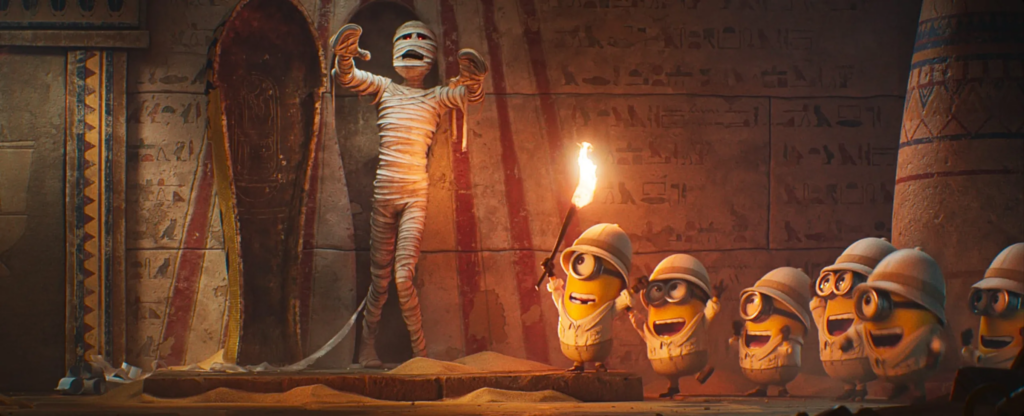
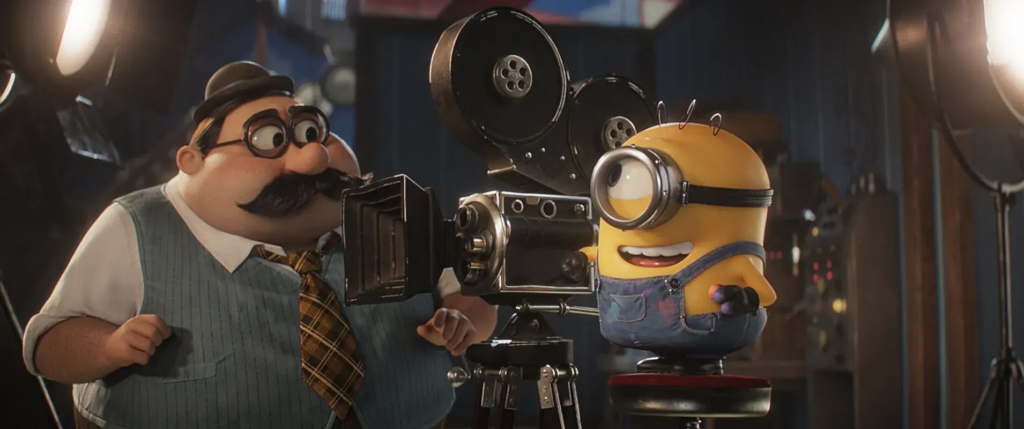
In many ways, Minions & Monsters pays homage to classic Hollywood films with the sound design playing a key role. Bowker put together a variety of mechanical sounds for the opening sequence of the film, including a zoetrope and the whirring film projectors in action.
“For the famous horse footage, we really wanted it to feel like a zoetrope starting up, but we didn’t have a recording of that,” recalls Bowker. “So a lot of that was listening to old recordings of mechanical things, and piecing together many, many different parts of anything that felt believable.” His team also added optical noise, as well as ticks and pops, to shots where audiences are seeing classic moments from film projected on screen to amp up the imperfections of the technology at that time.
Projector sounds came from a mixture of recordings of an actual projector starting up and “very carefully constructed messiness,” as Bowker describes. “We wanted to exaggerate what people remember of film reels starting up. The smallest sounds can be incredibly important and also can be the most difficult thing for us to design or edit if it’s something that we’re all familiar with. Trying to replicate the projector sound was a huge challenge, but once we got there, it was incredibly rewarding.”
A crash of thunder heard later in the film will be familiar to fans of old monster films. “We got a big kick out of adding that classic thunder that you hear in the 1930s Frankenstein movies,” Bowker explains, “when we switch to the camera footage of Goomi bringing Irene. In a way it’s more about not creating sounds, but finding little goodies from the thousands of hours that we’ve all collectively spent watching old films. It ends up being kind of a nice tip of the hat. It’s funny, in some ways it takes no time at all, and in other ways, it takes a lifetime of being a fan of film to kind of know where to hunt for that stuff.”
 Credit: Illumination
Irene
A brand new sound needed for the film was for the biggest monster of them all, Irene, an enormous, orange, eye-covered gelatinous creature. When the sound team first saw Irene, the footage included temp sound from the filmmakers, a common practice that gives the team a feel for what the director is looking for in the final version.
“And my initial thought was ‘Oh, this is going to be great. I’m going to do something based on that, and it’s going to be incredibly diverse, and it’s going to emote all sorts of different things,’” says Bowker. But making Irene too sympathetic became a concern. Bowker aimed for making Irene’s sounds somewhat cow-like as she left her soundstage to become a monster on the loose, rolling through the city.
“So much of sound design is quiet desperation that I got to a place where I thought, this does sound like a giant monster taking over the city, this is way too scary,” Bowker explains with a laugh. “It was this weird balance. We need it to feel sonically like Irene is the size of a city, but we also need to make sure it isn’t too diverse emotionally. And it also needs to make people chuckle a bit.”
After a lot of experimentation, Bowker made a cat-like voice in the back of his throat through a PVC tube and then harmonized that sound with a few plug-ins. “I wanted to make sure that the harmony, in a way, wasn’t harmony. If it was octaves or fifths, it would just sound like someone was playing a chord on a sampler,” he says. “So basically, trying to add in some sort of harmonic nuance.”
Irene’s “voice” was then slowed down and lowered by another octave since some of what audiences associate visually and aurally with size is generally slower movement. “Beyond that, it was a lot of making really silly sounds, having lots of fun, and being okay with a lot of failure,” notes Bowker, “and then taking those gold nuggets, setting them aside, and then our brilliant team of editors helped find the most appropriate and funny spots for her to live.”
The Universal Language of Gibberish
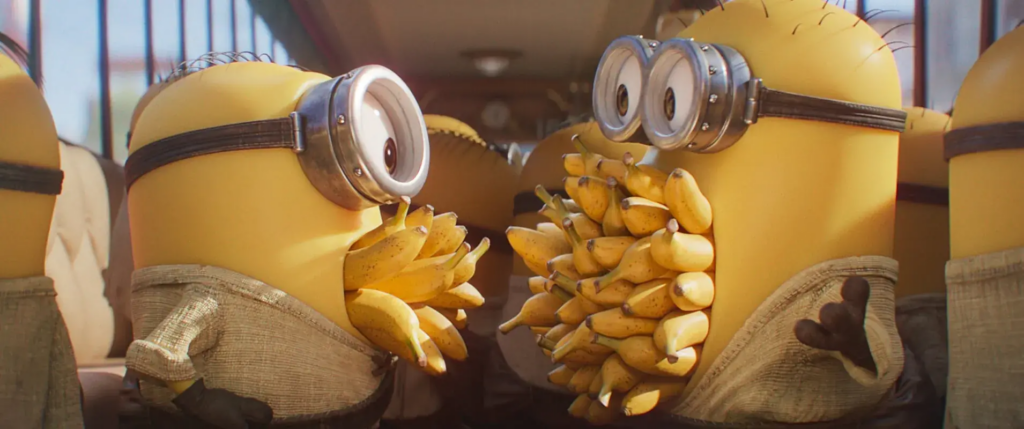
Much of Laurie’s work was centered around the film’s dialogue, much of which is Minion gibberish. While the Minions language is unique, for Laurie the different style of dialogue didn’t change his approach to his work. The goal was the same.
“If people come out of a movie, and they have no comments about the dialogue, that’s a success,” shares Laurie. “I always approach dialogue in that way. I just want to make it sound as good as possible, so I don’t think it is a particular challenge working on dialogue that doesn’t make any sense a lot of the time. If audiences come out and don’t even discuss the dialogue, that’s a good thing for me.”
In the end, the biggest challenge working with Minions’ dialogue revolved around the fact that one country’s gibberish talk might be unintentionally offensive to another, causing the voice of the Minions, Pierre Coffin, to have to re-record lines for some countries. “When you speak enough gibberish,” notes Bowker, “you’re going to run into a few issues somewhere.”
 Credit: Illumination
Putting it All Together
The Minions’ voices, which are pitched up compared to other dialogue in the film, proved to be just one part of the sound design puzzle for the team to plan around. “The Minions dominate a very specific part of the register,” says Bowker. “So I’m sure John Powell’s thinking about which instruments he’s going to highlight and how that’s going to fit around the part of the register that they dominate. And it’s the same in the sound effects and sound design portion – the question of how are we all going to work as an orchestra together? Irene takes up a very specific part of the spectrum as well. So we find ourselves figuring out what parts of the puzzle we want to be contributing to and what parts of the puzzle we want to leave empty because those pieces already exist.”
—
Amy Richau is a freelance writer and editor with a background in film preservation. She’s the author of several pop culture reference books including Star Wars Timelines, LEGO Marvel Visual Dictionary, and Star Wars: The Phantom Menace: A Visual Archive. She is also the founder of the 365 Star Wars Women Project – that includes over 90 interviews with women who have worked on Star Wars productions. Find her on Bluesky or Instagram.