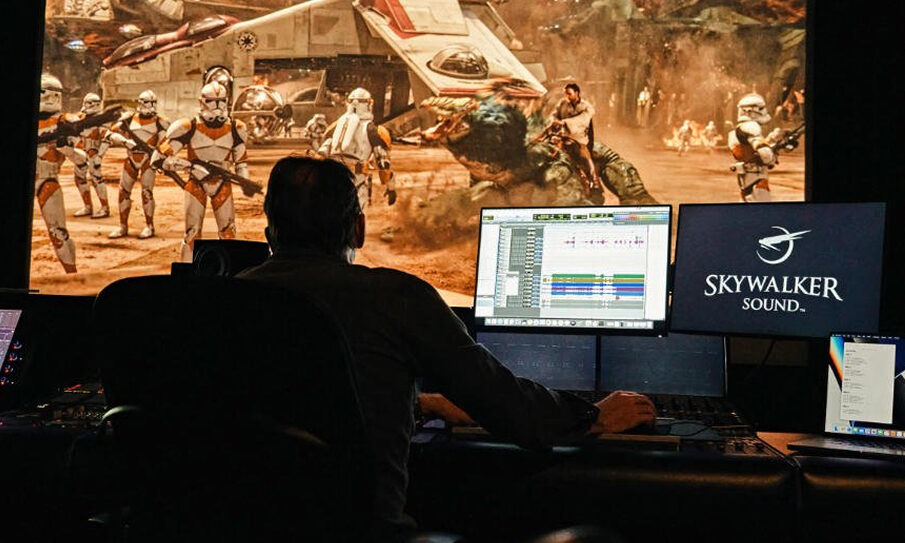
Blending Serious Reality and Subconscious Adventure: The Sound Design of In Your Dreams with Mac Smith
Skywalker Sound and Kuku Studios assemble a dream team for the Netflix animated feature.
In Your Dreams (2025) tells a heartfelt family story that spans the conscious and subconscious realms – mixing the serious reality of childhood anxieties with ludicrous dream-world scenarios, like a stuffed giraffe farting lasers to thwart an attack by a horde of rotting food.
In other words, a perfect sonic challenge for the talented crew at Skywalker Sound.
Now streaming on Netflix, the animated film features Stevie (Jolie Hoang-Rappaport) and her little brother Elliot (Elias Janssen), two kids who sense growing tension between their parents (Cristin Milioti and Simu Liu). When they stumble on a mysterious book about the Sandman (Omid Djalili), the two kids set out to find him in the dream world, hoping he’s the key to family harmony in the real one.
For its first feature film, Bay Area production company Kuku Studios and director Alex Woo chose Skywalker Sound to help bring a complex soundscape to the screen.
“The story goes back and forth between reality and dreams, which made it a lot of fun for sound,” says award-winning sound designer Mac Smith, a veteran of animated and live-action productions including Your Friendly Neighborhood Spider-Man (2025), What If…? (2021-2024), Moon Knight (2022), and She Hulk: Attorney at Law (2022). Bonnie Wild and Tony Villaflor were the film’s re-recording mixers.

One of the first creative decisions involved ground rules for how the dream and waking worlds should sound.
“I wanted the real world to sound just as ordinary as possible,” Smith tells Skysound.com. “Not do anything too crazy, and also make their home – where you spend a lot of time – a little bit noisy. It’s winter in Minnesota, so you have the heat going, those room tones and hums and ambiance.”
Subtle aural clues help ground the audience as the story shifts realities.
“In one of the first dreams that the kids go into after finding the book, you come into the home and see the clock stop. And then you go into their bedroom, and we made it very silent,” says Smith. “I don’t know if the average person would catch that, but it was just one thing to show the audience subconsciously that something’s a little off and different here.”
Other times, the two realms share cues that tie them together. During a visit to Polly’s Pizzeria with his family, Elliot plays a Bash-A-Bager game, swinging a mallet to pound the pop-up varmints. Later in a dream, the tables turn as Elliot and Stevie are attacked by a towering, nightmarish version of the game.
“We were taking the sounds of those things popping up and manipulating them in the dream world, when it’s a giant version of that,” Smith explains. “Taking essentially the same ingredients and just embellishing them to give some connections between reality and the dream world.”
Smith says the atmosphere in Polly’s Pizzeria needed to be noisy, but not so noisy that the mixers would simply have to pull it all down.
“Joel Raabe, one of our sound effects editors, took that scene on his own,” Smith says. “He created this nice tapestry in the background. He found a great way to pepper in little sounds of game beeps or kids screaming around the dialogue. And those are tricky things. You don’t want to distract the audience from the conversation, but you want it to feel alive.”

Back at home, Stevie tells Elliot that their parents might be separating and their mother is up for a new job in another city. Composer John Debney did not score the scene with music, leaving Smith to score it with sound.
“I created these layers of rain that evolve through the scene,” Smith reveals. “They start a little bit bigger, hitting the glass on the window. And as the conversation gets more and more serious, different layers start to drop out,and you hear the rain peter out in the distance. By the time Stevie turns over in bed, the rain is almost completely gone. It’s this really subconscious, subtle thing: How do we create those same emotions that a composer might do?”
In another dream sequence, Elliot’s bed comes to life, taking brother and sister on a harrowing ride across neighborhood rooftops and through city streets, careening around corners and nearly colliding with several cars. Elliot triggers “rocket mode,” propelling the bed and the siblings into the clouds.
In a sequence with so much action, Smith says there’s always a possibility of overdoing it.
“Those sequences are tough because you’re trying to really immerse the audience in the story, and it’s easy to put too much in and get distracted. Or get muddy or not have a lot of clarity,” he says. “So, those sequences are always ‘less is more’ – just trying to hit the moments and stripping things out to reveal certain details. It’s a big, big challenge.”

Soaring high above the ground, Stevie and Elliot encounter dark storm clouds summoned by Nightmara, the giver of nightmares, who at first seems to be a dream world villain.
“When she is revealing herself, I didn’t want to have typical lightning and thunder sounds. I wanted to create lightning and thunder out of other elements to make it feel a little unique and off-kilter,” says Smith. “I started thinking about sounds that are scary, that sort of terrify humans on a primal level. So I incorporated tiger growls, animal roars, and things within that thunder to make it that much more unsettling.”
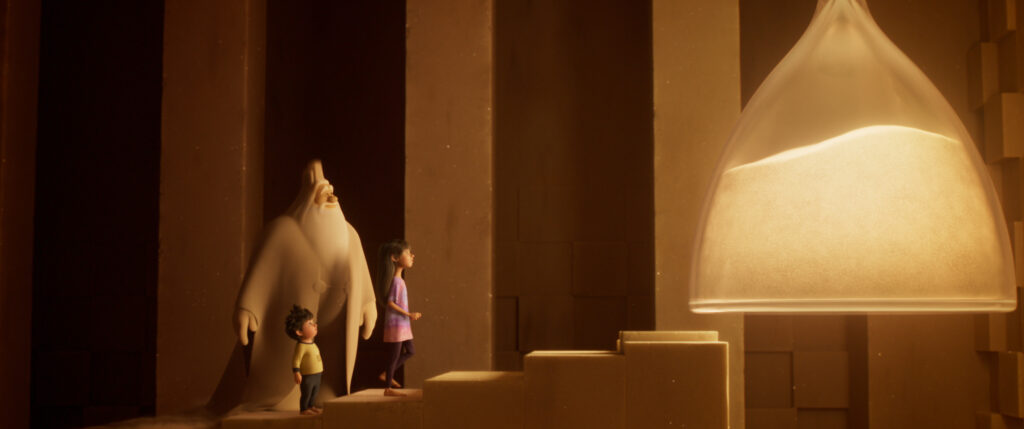
The children eventually reach Sandman’s domain, signaled by his immense, M.C. Escher-inspired castle that emerges from beneath the sand and rises skyward.
“That was definitely an important shot for Alex,” remembers Smith. “It was described like a multilayer cake with all these levels, and he wanted to hear every single level. Steve Bissinger, one of our sound effects editors who did additional sound design, took that scene upon himself and created hits for all the levels coming out.”
“But it was definitely a balance,” Smith continues, “because if you played every single hit, it would start sounding undefined. So if you go back and look at it, you’ll see we’re not really hitting every single layer but still giving it the magnificence that Alex wanted to evoke.”

Of all the new sounds created for the film, one of the toughest characters to finalize came in the form of an inanimate object that becomes quite animate: Elliot’s wooden bed frame.
“The thing I knew was going to be the hardest challenge – and it really did become the hardest challenge – was the bed. Because the bed is this character that comes to life. It kind of behaves like a half-horse, half-dog. It doesn’t really have a real face. It doesn’t speak, but it needs to evoke a personality,” Smith says.
“Alex was open to ideas,” recalls Smith. “And my original thought was ‘How can I warp wood sounds to mimic things like a neighing horse?’ And Heikki Kossi, one of our Foley artists, had a bunch of really great wood contraptions that we recorded with a high-frequency microphone. So we were able to vary speed and stretch, and get things at different frequencies. There is a beautiful house in the Berkeley Hills that’s a little bit dilapidated that I had access to, so I recorded all kinds of doors that had gnarly creaks, and dressers and cabinets and dining room chairs.”
The sounds of the bed in flight proved more difficult, as Smith added Doppler and other effects, trying to dial it in to the director’s satisfaction.
“Alex’s reaction was ‘It sounds kind of sci-fi,’ and I was scratching my head because I was not intentionally doing anything sci-fi with the bed flying by,” Smith says. “And this went back and forth like five, six, seven times, and we’re approaching the final mix, and I’m starting to get nervous. At some point, it finally dawned on me that he thought it sounded like a TIE fighter from Star Wars. And I was like ‘Okay, that is making sense now. I can wrap my head around that.’ I could go back and create something that was different, that didn’t evoke the sound of a TIE fighter.”
Smith says he also asked fellow sound designer and Skywalker Sound legend Gary Rydstrom for advice.
“Gary is good friends with Alex Woo. They worked together at Pixar, and he was available to talk off and on about the sound challenges,” Smith says. “And the satisfying thing was, Alex was so happy with how the bed finally turned out that he was like ‘Oh man, if I had known how much personality we could have given to the bed on a sound level, I would have put the character in the movie more.’”
 (Credit: Netflix).
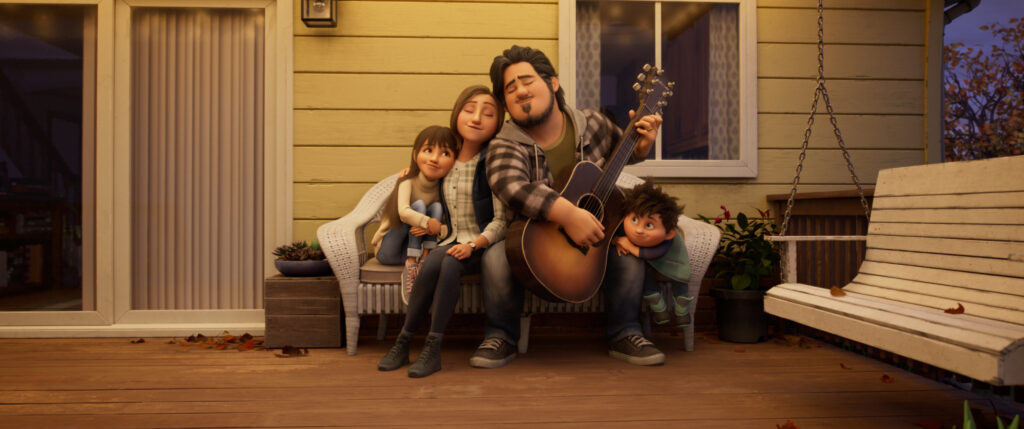
There were also times when the most appropriate approach was to take sounds out of the mix, including during a montage set to the song “Holding On and Letting Go” sung by Daniel Blake. The family laughs, skips rocks on the water, and jumps into a pile of leaves, scenes that came to the Skysound team with temporary effects already edited into the soundtrack.
“We all kind of looked at each other and said, ‘How about we take everything out, and just present the song?’” says Smith, harkening back to the time he watched director Pete Docter make a similar creative decision about removing all Foley sound from the opening sequence of the movie Up (2009). “And they loved it. They’re like ‘Yeah, that’s the right approach.’”
Woo, who co-founded Kuku Studios in 2016 with former Pixar Animation colleagues Tim Hahn and Stanley Moore, took inspiration from his own childhood for In Your Dreams.
“Alex is such a sweet guy. And he’s really into other people’s ideas and hearing what people think, and wanting to try things,” Smith says of the director’s time among the many consoles on the Orson Welles mixing stage. “He was kind of like the commander of the Starship Enterprise, directing and leading everybody. We definitely felt like we were in good hands with his direction.”
 (Credit: Netflix).
Smith also credits the team members who – after working on many productions together – function like a well-oiled creative machine.
“Bonnie and I did Moon Knight together, and Tony and I did Your Friendly Neighborhood Spider-Man and a season of What If…?, among other things. And Vanessa Lapato, our dialog supervisor; Steve Bissinger; sound effects editors Joel Raabe and Ian Chase – they all were on multiple shows with me,” Smith says. “It’s just so great when you have a team that you know is going to bring their A-game, and you just have a shorthand. It’s so much fun to collaborate with them. They were all incredible and just brought so much to the movie.”
Smith often compares a sound designer to a fine-dining chef crafting a complex recipe.
“I’m the chef with a home kitchen and a pantry with a million ingredients. I don’t just have salt. I have like 45 different kinds of salt. And if I don’t see the ingredient that I want, I can go hunt it or grow it, which means I go out and record new sounds,” Smith explains. “I’m building the recipes and the dishes, and then once I’m happy, and I organize all the layers, I put it aside. And when it’s time for the mix, I bring all my ingredients, laid out for the head chef in the fancy restaurant kitchen. And they’re taking the recipes and refining and dialing them in.”
Occasionally, if a director raises an early objection to a specific sound effect before the re-recording mixers have configured all the proper EQ settings, Smith might lean on the recipe analogy and ask that director to “Let them cook.”
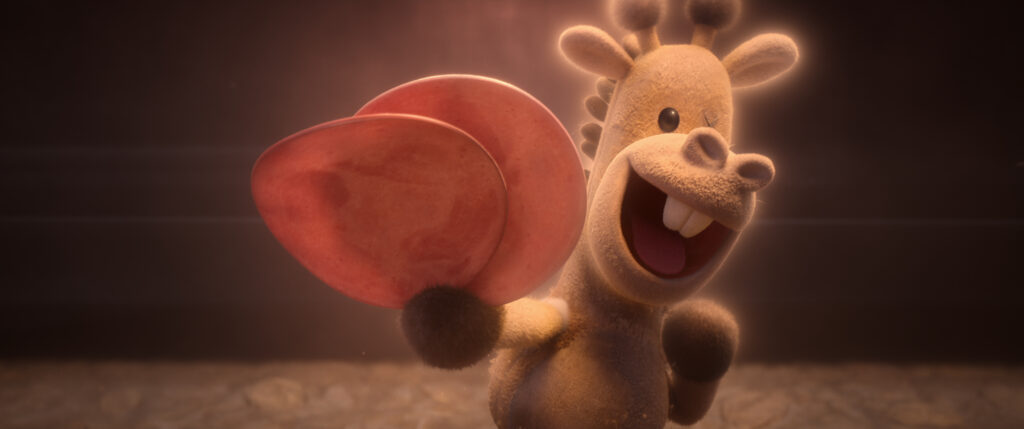
Sometimes that means cooking up something like a… “laser fart.”
Summoned by Nightmara, a creepy crowd of moldy zombie food closes in on Stevie, Elliot, and Elliot’s beloved stuffed giraffe, Baloney Tony (Craig Robinson). Attempting to escape by channeling the power of the dreamverse into a fireball, Baloney Tony instead unleashes a hilarious barrage of stinky, rainbow-colored laser blasts.
“That was really fun,” Smith admits. “Part of the challenge was creating some silence for those sounds to really sell. I think they got a loop grouper that goes ‘Ew!’ in the background.”
“It’s so funny because I’ve worked on a number of movies where you’re spending 45 minutes or an hour scrutinizing stomach gurgles or fart sounds or toilet sounds,” says Smith, laughing. “And it’s like ‘Wow, we’re getting paid for this? This is incredible.’”
 (Credit: Netflix).
—
Clayton Sandell is a Star Wars author and enthusiast, Celebration stage host, and a longtime fan of the creative people who keep Industrial Light & Magic and Skywalker Sound on the leading edge of visual effects and sound design. Follow him on Instagram (@claytonsandell) Bluesky (@claytonsandell.com), X (@Clayton_Sandell), or Tik Tok (@claytonsandell).