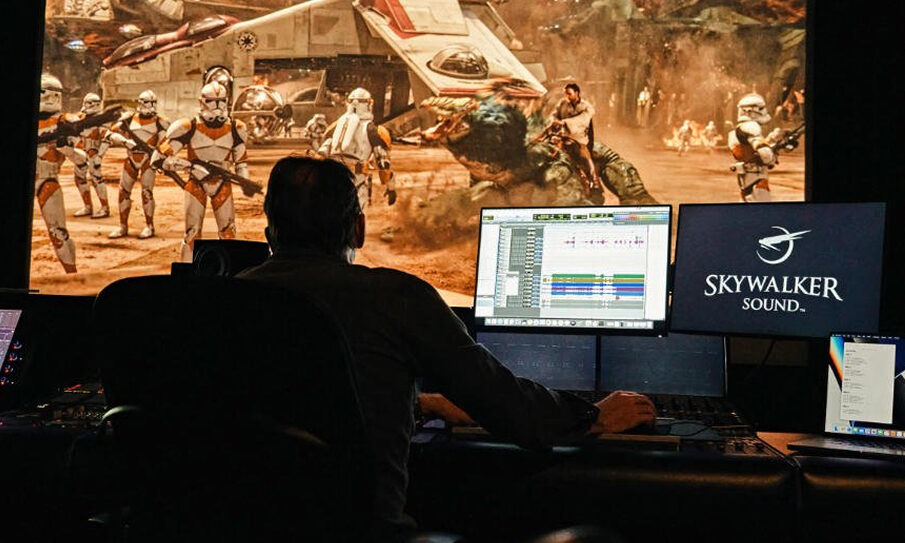
Skywalker Sound’s Randy Thom Looks Back on Brad Bird’s The Incredibles
20 years after its release, this Pixar classic remains a uniquely-accomplished animated feature in the field of cinematic sound.
Released 20 years ago, The Incredibles (2004) is the only animated film ever to win an Academy Award for achievement in sound. As Skywalker Sound’s Randy Thom and Michael Silvers went onstage to accept their win for Sound Editing at the 77th Oscars in 2005, the former took the opportunity to make an important point about the way their craft, and others like it, are perceived by the larger film industry.
“Certain Academy Awards like Sound and Visual Effects and Editing are sometimes referred to as ‘technical awards,’” Thom said in his acceptance speech. “They are not technical awards; they’re given for artistic decisions.” He was then interrupted by applause from the audience. “Sometimes we make them better than others and I guess we made a couple of good ones on this one.”
Looking back on that night, Thom admits now that “I was a little nervous about doing it, because in a way, I was making a political speech. It wasn’t about politics in the normal sense of the word, but rather the politics and culture inside of the movie business. I was bothered then, and I’m still bothered, that so many of the creative people in film tend to be thought of mainly as technicians. But we’re all technicians; actors are technicians these days; we all have to use technology in everything that we do. But I know that I spend the majority of time working on a film making aesthetic decisions.”
He’s quick to add that his point “is not a dig at people who are technicians or engineers. That work is absolutely crucial and demands creativity in certain kinds of ways. But the way I define artistic creativity is that it’s always about storytelling. No matter what kind of art it is — if it’s dance, writing, landscape-painting, it’s always about figuring out how to tell a story and how to stimulate somebody’s imagination in terms of a narrative. All of us who do sound for films are storytellers.”
Animated films, in particular, demand a heavy assortment of sound effects. With no live production recordings to begin with, a feature like The Incredibles is a completely blank slate for an artist like Thom, who worked as sound designer, supervising sound editor, and re-recording mixer on the project. It was his second collaboration with director Brad Bird, who’d first recruited Thom for his Warner Brothers animated feature, The Iron Giant (1999). The Incredibles was both Bird and Thom’s first Pixar Animation Studios film.
Skywalker Sound had formed a partnership with Pixar since the latter’s days as the graphics group within the Lucasfilm Computer Division back in the 1980s. Before Thom, sound designer Gary Rydstrom had taken the lead on breakthrough productions like Toy Story (1995) and Monsters, Inc. (2001). “Gary had done such an amazing job on all the previous Pixar films that I felt there was a lot of pressure on me to measure up and keep the standards high,” Thom explains.
A seasoned animation artist, Brad Bird pulled on the methods and techniques of live action cinema as much as he did the animation medium. Starting on the project roughly a year out from release, Thom received a written screenplay of The Incredibles, an unusual approach for animated features, which are typically developed sequence by sequence on storyboards. “Very often, that process continues for quite a while before a screenplay develops, but that was not the scenario with The Incredibles,” Thom says. “In part, it was because Brad is also a great screenwriter, so he had a complete version when I started. There were also concept drawings, including ideas of what the characters would look like. Those are always helpful for a sound person to look at and think about.”
 (Credit: Pixar).
Thom notes that on any film, be it animation or live action, he often begins by asking the director about the overall sound style for the picture. This is equivalent to a film’s visual style, both in purpose and importance, although as Thom notes, many directors usually think less about the soundscape’s role. “It’s the way the human brain works,” he says frankly. “We tend to be more analytical about the visuals. Thinking about sound style is not something that’s really taught in film schools to any degree. But Brad had thought about a lot of things.”
Bird would explain during production of The Incredibles that animation is really about “capturing the essence of something and putting your own spin on it. We’re doing a movie that absolutely could be done in live action in terms of telling the story, but we couldn’t tell it this way.” As the story of a superhero family trying to live their lives in a seemingly normal, suburban setting, The Incredibles featured a diverse blend of contrasting elements from the fantastic to the mundane. Thom’s sound design had everything to do with that distinct approach.
“It was clear that in some ways Brad wanted to emulate the James Bond films,” Thom notes, “both in terms of visual and sound styles, the latter including the score and sound effects.” Again, live action is as much an influence as animation itself, which as Thom points out, was appropriate considering the majority of his experience up to that time was in live action. “Quite a few of them were action-adventure films that were similar in some ways to The Incredibles. I felt well-prepared to approach that.”
According to Thom, Bird was “a student of animation history and film sound history, and knew very well that the best soundtracks almost always happen when the sound people get involved very early.” Bird would’ve known, for example, that Skywalker Sound’s Ben Burtt had worked some two years on Star Wars: A New Hope (1977) before its ultimate release. A key starting place for The Incredibles was what Thom calls the “super-hero profiles” of the main characters.
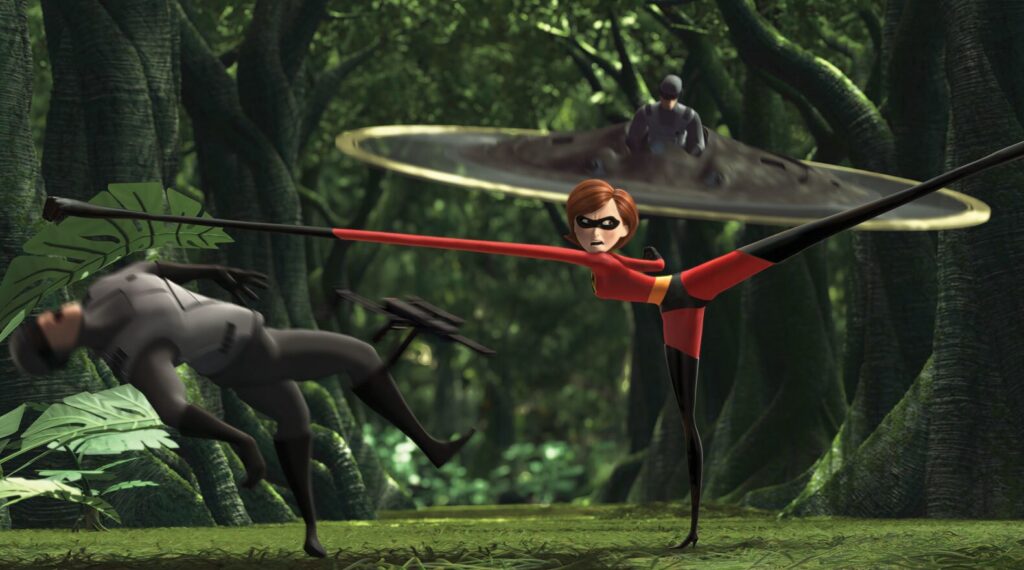
Voiced by Holly Hunter, Mrs. Incredible, or Elastigirl, could stretch and contort herself into every sort of position. “I had to put on my thinking cap about how I might come up with stretching sounds of all kinds that wouldn’t just sound like rubber,” notes Thom. Among the many field recordings captured by Thom and assistant sound designer Will Files were “every kind of stretchy thing we could think of,” as Thom puts it, including all manner or rubber bands. These ingredients were then blended together in subtle combinations.
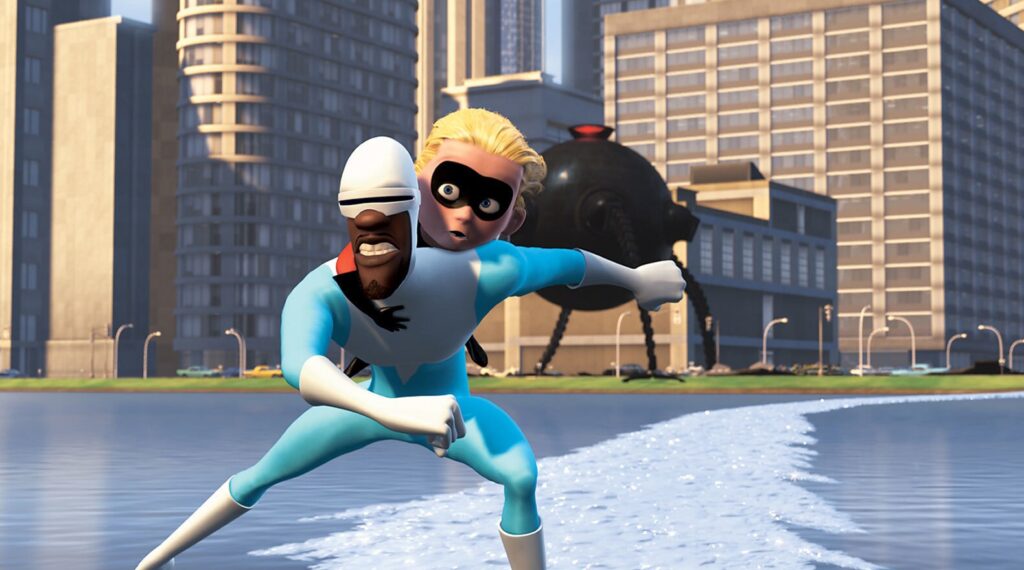
With his ability to conjure fields of ice at the wave of a hand, Samuel L. Jackson’s Frozone presented a number of intriguing challenges. Thom and Files recorded dry ice, a common element in sound design because, as Thom explains, the frozen carbon dioxide sublimates. “This means it changes from a solid to a gas without becoming a liquid first. As it warms sitting out in the air, it’s constantly shooting out molecules of carbon dioxide.
“If you press a really warm piece of metal against dry ice, it creates a type of resonance in the metal,” Thom continues. “It basically makes the metal vibrate back and forth. The bigger the temperature difference is, the more pronounced the sound is. You get a kind of Jimi Hendrix, almost electric feedback sound. But some also have that aspect that you associate with ice. I was looking for that kind of sound that was both really strange and evoked the feeling of ice.”
 (Credit: Pixar).
Throughout the design process, Thom experimented with combinations of sounds to share with Bird. “Since we didn’t have a well-developed set of moving, visual images,” he explains, “I would often just send wild sounds to Brad for him to listen to. He would give me notes about what he liked and didn’t like. That’s how this creative collaboration works best, when you get an initial note from the director about what to do, you do some experiments, play them for the director, they give you feedback, and then you’re really off to the races in terms of tailoring it for how it will eventually work in the movie.”
Among the new technology in The Incredibles were the ‘velocipods,’ saucer-type aircraft that pursue the family of super-heroes at high speed. As he often does early on in a project, Thom sampled random sound effects based on keyword searches in the Skywalker library. Typing in “speed” and “velocity,” he eventually came upon Formula 1 racing cars. These formed the basis of the velocipods’ propulsion system. But as Thom notes, the vehicles also appeared to have sharp edges, almost like blades, so he then incorporated the “rapidly-repeating sound of a chef’s knife being scraped along a sharpener.”
The most difficult sound to crack, however, was more a mix of the organic and technological: bullets striking the bubbly force-field of teenaged-daughter Violet (voiced by Sarah Vowell).
“I tried so many things for that, and neither Brad nor I were bowled over by any of them,” Thom recalls. “I’d tried hundreds of sounds to get across the idea that projectiles were hitting her force-field, but it finally occurred to me that I should try something comedic, which we hadn’t thought of before. We had been thinking about the danger primarily. So I tried a sound of me banging on a huge beach ball, which resulted in a kind of boingy sound. When I did it, I thought Brad might hate it, but I didn’t have anything else to try at that point, so might as well, and he loved it. ‘That’s it!’ It’s funny that something can be right in front of you the whole time but what you don’t see is that what would really make it work is comedy rather than danger.”
The encounter between Violet and an enemy gunman comes early in a rousing chase sequence where the young son Dash (voiced by Spencer Fox) takes center stage with his superhuman speed. “One thing that goes into making a really great action sequence is finding places to have either silence or relative silence,” Thom explains. “If everything is loud, nothing feels loud. If you do that for too long, the audience gets kind of numb and stops listening in a certain way. Brad designs these relatively quiet moments in the middle of big action sequences that give the audience a breather. Then, when you get back into the big action, it’s all the more shocking because you’ve just been in a quieter place.”
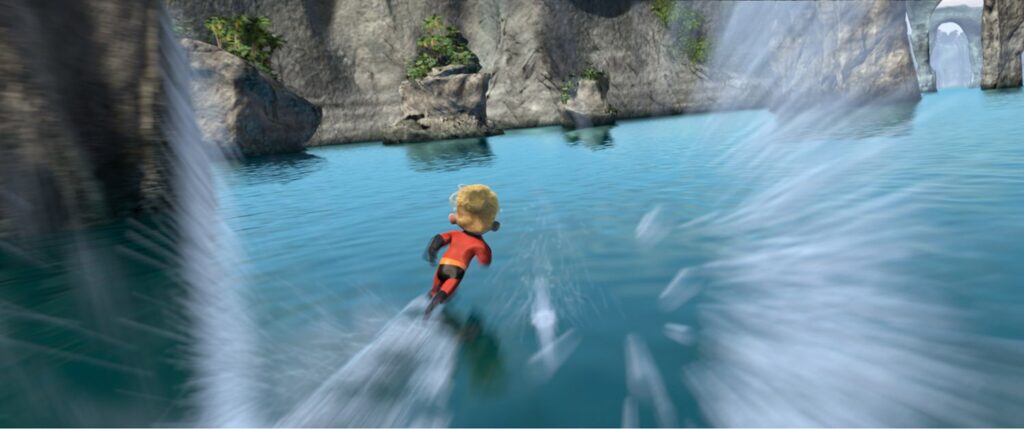
Among these types of moments is when Dash, with velocipods close behind, runs onto a lake, unsure what might happen next. As the boy winces in fear, the soundtrack pulls back in its intensity, and we hear the pitter-patter of Dash’s feet propelling him across the surface. Thom and Foley artists including Dennie Thorpe and Jana Vance used their hands in a tub of water to simulate the patter of the character’s feet, carefully changing their hand-shapes as they repeated the motions. Those recordings were then sped up considerably.
 (Credit: Pixar).
Throughout the sequence and the film overall, Thom’s sound designs are integrated with composer Michael Giacchino’s jazz-infused orchestral score, which were handled in the sound mix (along with dialogue) by Gary Rizzo. As Thom notes, it was clear from the outset that Bird planned for a substantial use of musical score in The Incredibles, particularly in action sequences. He describes an “intense mix” to “make the dance work between the music and the sound effects in ways that it often doesn’t.”
As Thom elaborates, “I think — and I think Brad feels this way too — that it has to be a baton pass back and forth. There are some instances when you can have big music and big sound effects at exactly the same moment and it’ll work, partly because of the sonic spectrum that each of them occupies in a way that they’re not stepping on each other’s toes. But most of the time, the mix of a big action sequence is about figuring out how to orchestrate it so that in one moment we’re featuring the music and keeping the sound effects at a lower level, or adjusting the equalization so that a specific part is featured.
“It’s about making adjustments every second or two throughout one of those sequences to make the music read when it needs to,” Thom continues, “and the sound effects when they need to, but orchestrating it so that the audience doesn’t think, ‘where did the music go?’ or ‘where did the sound effects go?’ You feel like you’re hearing everything you’re supposed to be hearing. The Incredibles was a great example of a film where that was a big challenge and I think that we put enough energy into it so that it turned out well.”
At the time of its making, Thom had described The Incredibles as one of the most demanding films he’d ever worked on. Part of that is plainly evident: a story of huge dramatic scope with many individual sounds to cover in any given scene, and once again, the encompassing musical score. But there was also what Thom describes as the director’s high standards. “Brad tends to generate a lot of notes, which is a challenge, but it’s also a great thing because it pushes everybody to do their best and be very precise and work their hardest on every single moment in the film.
“Brad has a great imagination for sound,” Thom continues. “He’s always thinking about sound, both musical and design, even when he’s writing the movie. He thinks very specifically about how sound will work best in each sequence.” Coming from one of the world’s leading proponents of sound’s essential place in cinematic storytelling, these are among the highest marks.
No doubt Brad Bird’s directorial sensibilities helped propel The Incredibles to win the Academy Award for Best Sound Editing and become the aforementioned only animated film to win a sound Oscar. But as Thom is keen to point out, this should be a call to action more than a celebratory note.
“Though I’m very proud of this distinction, I’m also disappointed about it as an Academy member,” he explains. “It’s indicative that something is wrong. About 520 films have been nominated for sound Oscars, and only nine of those films were animated. I worked on a couple of them, Ratatouille [2007] being the other one, another Brad Bird movie. I think it’s a problem that should be addressed. Partly, it’s because it’s really difficult for an animated film to get nominated in the sound category, and the nominations come from the sound branch of the Academy. A big portion of the sound branch are production mixers who work on live action film sets and record the dialogue, etc. Because they are rarely, if ever, employed on animated films, they don’t have any skin in the game. So I think that’s one of the reasons why it’s so difficult for animated films to get nominated.
“It’s really, really difficult and requires a lot of creativity to do the sound for an animated film,” Thom concludes. “You’re basically starting from nothing and having to invent a whole world. I’m going to try to think of ways to help the Academy pay a little more attention to the sound of animated films. When you think of a film like WALL-E [2008], for which Ben Burtt supervised the sound, it has amazing sound design, and so much of the power of that film depends on the sound, especially in the first half when there’s no dialogue. That film should’ve gotten an Oscar for sound.”
—
Lucas O. Seastrom is the editor of Skysound.com and ILM.com, as well as a contributing writer and historian at Lucasfilm.