Skywalker Sound’s Ren Klyce Takes Us Inside the Mind of Inside Out 2
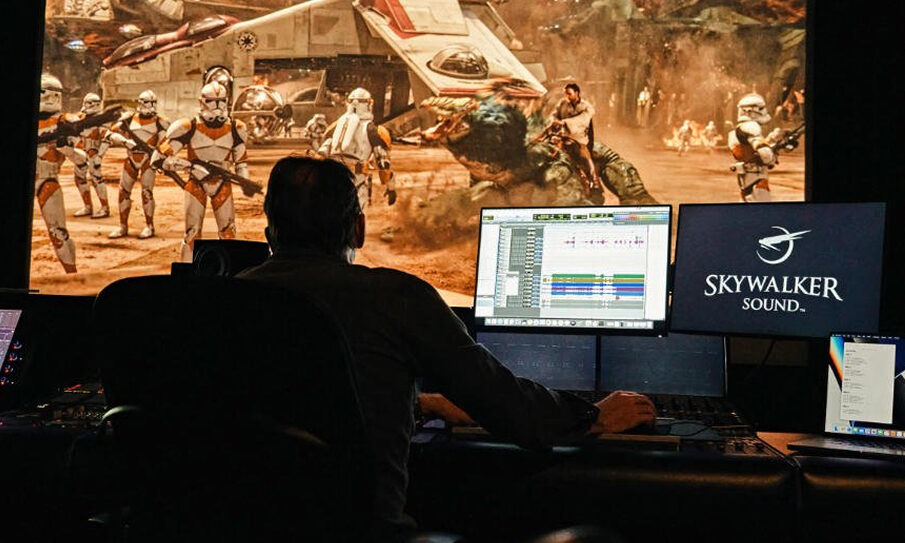
The sound designer, supervising sound editor, and re-recording mixer has worked on half a dozen Pixar features.
 (Credit: Pixar).
Inspiration can come from a multitude of places, and Inside Out (2015) was no exception. Pixar’s 15th feature-length animated movie began life back in 2009 when co-screenwriter and director Pete Docter noticed changes in his daughter Elie’s personality as she grew older, and from that the idea germinated, the project was green-lit, and a five-and-a-half-year journey to the screen began.
Consulting psychologists and neuroscientists were brought in to help accurately portray 11-year-old Riley Andersen’s mind as the story developed. A stellar cast was assembled, led by Amy Poehler as Joy with Phyllis Smith (Sadness), Richard Kind (Bing Bong), Bill Hader (Fear), Lewis Black (Anger), Mindy Kaling (Disgust), and Kaitlyn Dias as Riley, (not to mention Diane Lane, Kyle MacLachlan, Bobby Moynihan, Muppets legends Dave Goelz and Frank Oz and perennial Pixar voice actor John Ratzenberger).
The wizards at Pixar worked to bring the mind of Riley to life through groundbreaking animation techniques, while the team at Skywalker Sound, led by sound designer Ren Klyce, strove to create a unique soundscape, one that complimented the score by Academy Award-winning composer Michael Giacchino (Up, Rogue One: A Star Wars Story, Star Trek).
The film debuted at the 68th Cannes Film Festival on 18th May 2015, and arrived in theaters that June. The world loved Inside Out, winning Best Animated Feature at the 2016 Oscars, but even as the nominations were being read out, Pete Docter was already thinking of a sequel. Development began in 2020, with the film announced onstage at D23 in September 2022 by Amy Poehler and the existing cast (led by incoming director Kelsey Mann) joined by Maya Hawke as Anxiety, Adèle Exarchopoulos as Ennui, Liza Lapira as Disgust, Tony Hale as Fear, Ayo Edebiri as Envy, Paul Walter Hauser as Embarrassment, and Kensington Tallman as 13-year-old Riley.
 (Credit: Pixar).
Everything and everyone was in place, but what would differentiate the sequel from the original? We took the opportunity to sit down with the nine-time Academy Award-nominated Ren Klyce (Star Wars: The Last Jedi, Fight Club, Soul) to delve into the sound design of Inside Out 2. We asked how his team made sure the sequel sonically fell in step with the original while also broadening the soundscape.
“I met with the filmmakers to find out what their priorities were, specifically what they were concerned with or what they felt was needed for the storytelling through sound,” explains Klyce. “What’s great about the Pixar team is that they’re very open to getting people like me involved early on, and they’re not precious or guarded. They’re very comfortable with being uncomfortable.”
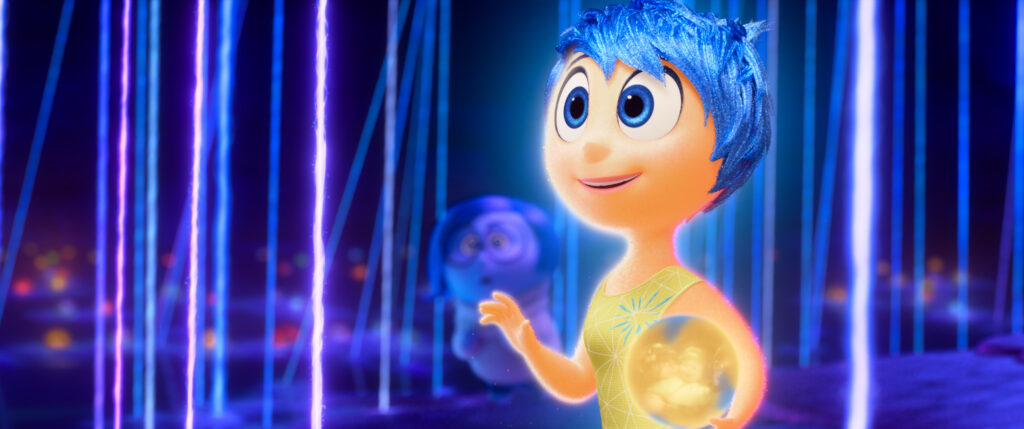
Incoming director Kelsey Mann had sequences in Inside Out 2 that were key moments for him, and it was the job of Klyce and his team to bring those moments home. “He really wanted to discuss what the sense of self is,” remembers Klyce. “In our world, it’s a place located in Riley’s mind that we first saw via Joy and Sadness. They both descend down an elevator to this place that is covered with water, with nerve endings that go upwards into what is the emotional center of her brain. In the water are memories, and as these memories float around, they hit the nerves and the nerves vibrate and send fragments of her personality up, which form Riley’s sense of self. This was a very important sequence for all of the filmmakers involved, because they wanted to establish that in the beginning everything’s calm and great. Riley’s a happy young girl on her way to becoming a woman, but because she’s now in puberty, things are going to change.”
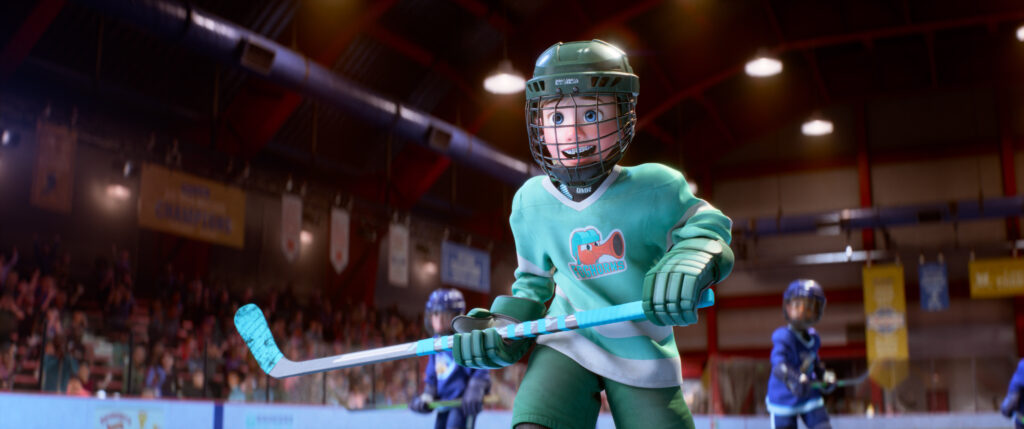
From a visual point of view, the audience sees these emotions as visible characters, but Klyce has to give each of these vivid images a character all of their own through the sounds he and the team assign to them, a trickier task than one might imagine. “First, there’s happiness and positivity. Those sounds are very important to Kelsey. There were moments where Kelsey and Pete Docter wanted to establish an affirming ‘pluck’ sound, so every time you heard this pluck it would say all the things that were great about this young woman. She loves hockey, she likes her friends, she likes her favorite band, she likes a certain kind of food, and so on and so forth. However, that sound changes when the new characters are introduced.”
 (Credit: Pixar).
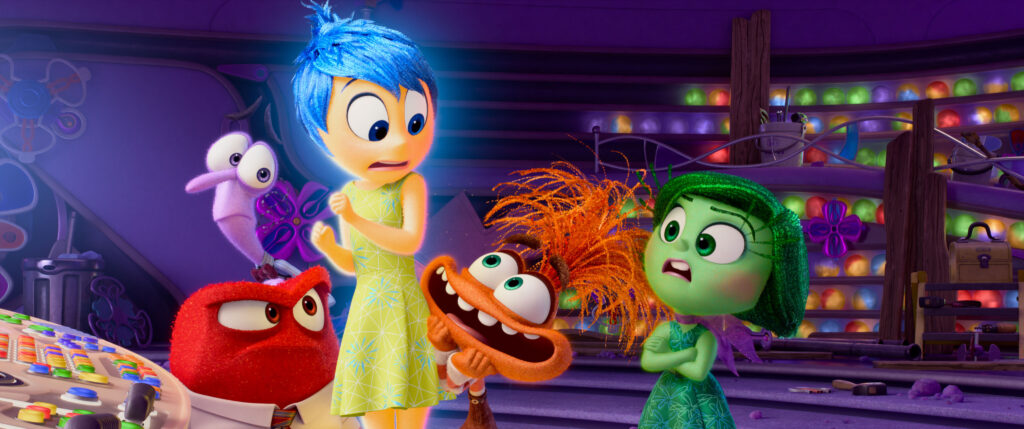
These characters include Anxiety (along with Envy, Ennui, and Embarrassment) who joins the existing emotions and adds an entirely new energy to the movie, taking control of Riley’s sense of self and changing both the look and sound of her mind.
“There’s a chaotic moment where Anxiety gets trapped in a vortex,” says Klyce, “and Joy jumps in there and desperately tries to reason with and calm her. In essence, she’s communicating that we can’t control who Riley is. What makes Pixar so great in terms of their aesthetic choices, how they write and what they communicate, are great messages like this. We can’t control someone; that’s a hard lesson for anybody to learn at any age, so to try and teach that through animation in a film that we know a lot of children will see, I think it’s lovely.”
Composer Andrea Datzman, wife of composer Michael Giacchino, began to work closely with Klyce to figure out how the sounds and the music would slot together, a seemingly simple task but one which would occasionally see overlaps that required addressing.
“Kelsey not only wanted the sounds to feel harmonious and happy, but he wanted those sounds to work with the score that our composer Andrea was writing,” remembers Ren. “As we start mixing, these collisions or moments do happen. For example, in the first film there’s a set piece where all of Riley’s memories are being stored, and I had pitched all of those sounds to be harmonic to match the temporary music track. Michael ultimately scored it in a different key, so I then re-tuned all of the sounds to match his music.
“In many of the set-pieces, Andrea’s score was flourishing with the orchestra going at full tilt, and the sounds needed to work with that,” Klyce continues. “That was tricky for us because we needed to allow space for all the dialogue and the intimacy of what these characters were saying to each other to land emotionally, because ultimately, we need to hear what the characters are saying. At the same time, the chaos happening with the sound also needed to feel visceral and loud.”
 (Credit: Pixar).
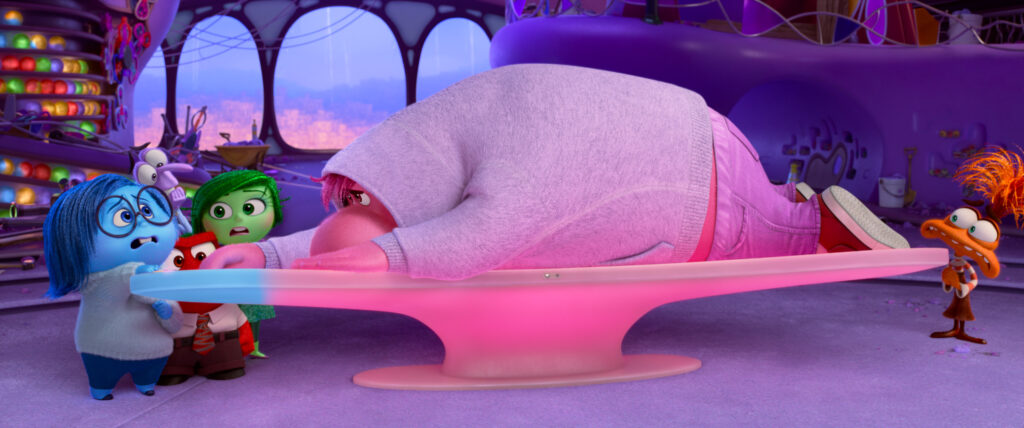
Inside Riley’s mind is a maelstrom of emotions that requires visualizing both through images and sound, as Ren explains.
“There’s a stressful moment where Riley’s sense of self gets broken off and they’re trying to reattach the old sense of self, which is ‘I’m a good person.’ It sticks, but it doesn’t work. It’s a flourishing of different emotions that we wanted to create, which is a lovely subtext. Becoming a multifaceted, emotional character versus a child who is happy or sad.
“Pete Docter was there that day,” Klyce adds, “and he wanted to have these flourishes of sound come up and down and have different sonic colors as we hear what those emotions are — ‘I’m a good person, I’m mean, I’m nice’ — and a lot of these things conflicted with each other. If you watch that sequence, you can hear the sound interspersing these different emotional perspectives and colors. It’s kind of abstract.”
Building so expertly on the 2015 original, the sequel ends the year as the world’s number-one movie. How does Ren feel about that incredible success?
“We did a film for Pixar a few years ago, Elemental [2023]. It had a disappointing opening weekend at the box office, and we were all a bit crestfallen, but we still felt the same — we loved the film. Conversely, this one doing so well really was a wonderful surprise, on a different level. Of course you want it to do well, but we’re happy finishing the film for ourselves, and then off it goes out in the world. People I hadn’t heard from in years, adults in their 60s or 70s, were getting in touch going to see it. ‘This was a beautiful film. I went and saw it with my wife in New York on a Thursday, so thank you,’ said one of my friends whom I hadn’t spoken to in years. So it’s really nice to know that the film resonated with so many people.”
 (Credit: Pixar).
—
Mark Newbold has contributed to Star Wars Insider magazine since 2006, is a 4-time Star Wars Celebration stage host, avid podcaster, and the Editor-in-Chief of FanthaTracks.com. Online since 1996. You can find this Hoopy frood online @Prefect_Timing.