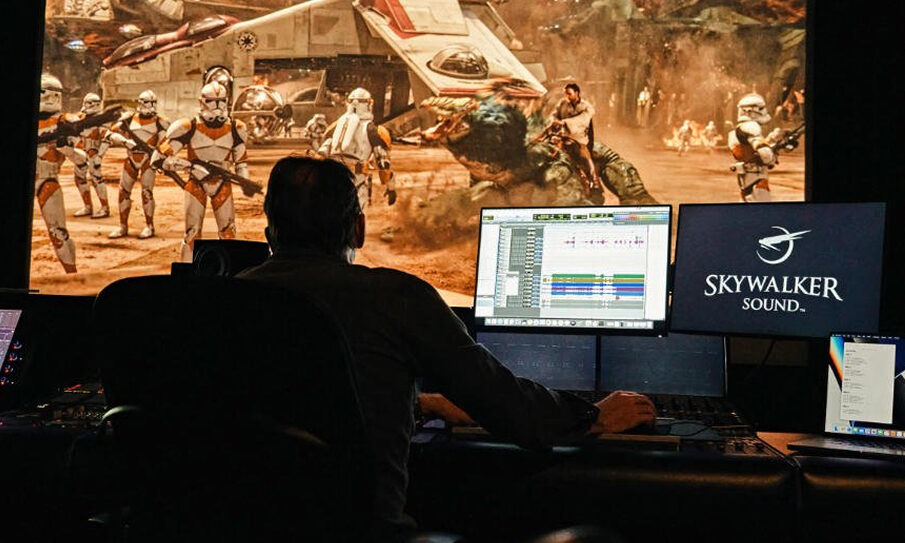
Cats, Dogs, and Oven Mitts: Summoning the Sounds of Dinosaurs for Jurassic World Rebirth
Skywalker Sound reteams with director Gareth Edwards to bring an unforgettable prehistoric soundscape to life.
One of the most endearing and adorable new dinosaurs to light up the screen in Jurassic World: Rebirth (2025) is a raccoon-sized Aquilops named Dolores.
Almost like a pet, the creature adopts 11-year-old Isabella Delgado (Audrina Miranda) on the fictional island of Ile Saint-Hubert. To help bring Dolores’s charismatic personality to life, Skywalker Sound veteran Tim Nielsen unearthed a few audio recordings of another pet: his beloved, late female cat named Howard.
“This was a neighborhood cat that decided to live with us for ten years,” Nielsen tells Skysound.com. Howard, Nielsen explains, was once in a catfight that left her with an injured windpipe and an oddly unique sound.
“She purred nonstop because she was just a very happy cat, but she would make these crazy little gurgling sounds that became a lot of the lower sounds whenever Dolores is eating or licking her lips,” says Nielsen, the film’s sound designer and supervising sound editor. “It makes me happy to finally find a movie where I could use some of the recordings I made over the years.”
Nielsen and the Skywalker Sound team once again assembled their best roars, grunts, and snarls for Rebirth, directed by longtime Skywalker Sound and Industrial Light & Magic collaborator Gareth Edwards (Rogue One: A Star Wars Story [2016], The Creator [2023]).
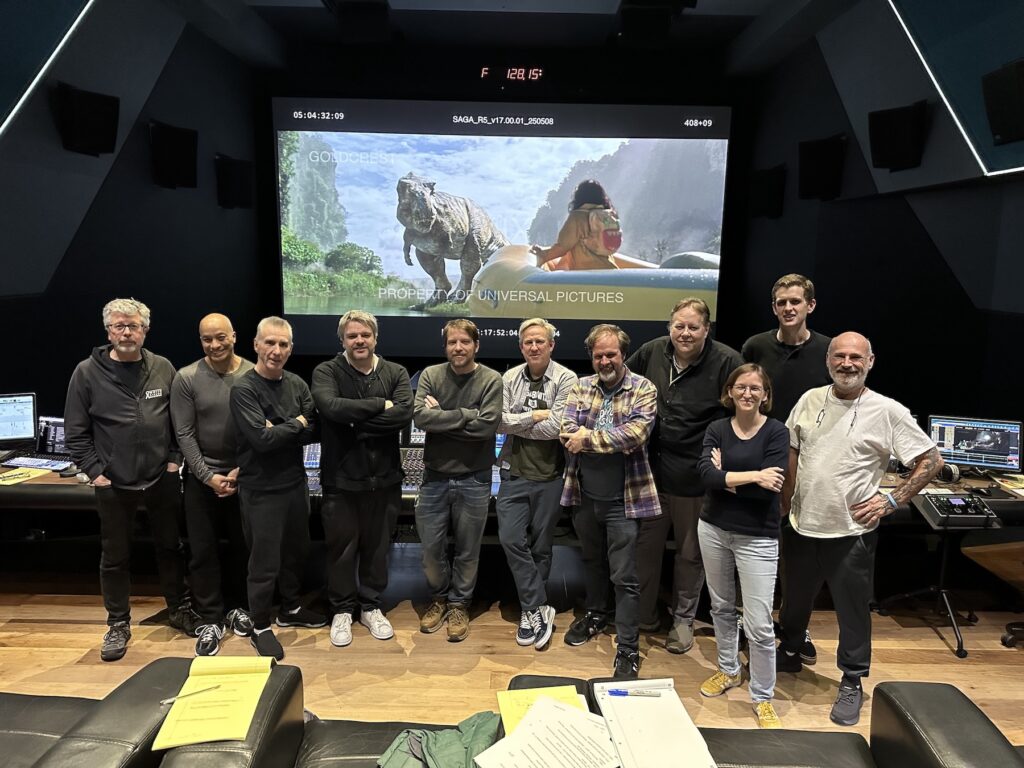 Members of the sound team during the final mix with director Gareth Edwards (center) (Credit: Skywalker Sound & Universal).
The strong creative partnership between Skywalker Sound and the epic dinosaur franchise has flourished over seven films, beginning with director Steven Spielberg’s 1993 original, Jurassic Park. The film won Academy Awards for Best Sound (Gary Rydstrom, Gary Summers, Shawn Murphy, and Ron Judkins) and Best Sound Effects Editing (Gary Rydstrom and Richard Hymns). ILM also took home an Oscar for Best Visual Effects.
“I was just tickled pink to be to be asked to be part of such a huge franchise and couldn’t wait to get started and meet Gareth,” says supervising sound editor Bjørn Ole Schroeder. “It was also a huge challenge because at the same time, both Tim and I knew that we had an incredibly compressed schedule.”
The team got to work fast, focusing first on designing distinct sounds for the bevy of new prehistoric beasts that come with every Jurassic film.
“You have all the dinosaurs that came before in six other films, so each of them can’t really sound like any of those,” Nielsen says. “We were just trying to find the identity for each of the main dinosaurs. And what happens on a project like this is that toy producers need access to those sounds long before the filmmakers do. So the first conversations were really about approving sounds for the toys, which had to be made a year in advance.”
Two experienced Jurassic sound design veterans helped early on to create new dino vocals for Rebirth: Al Nelson and Gary Rydstrom.
“I’d missed it,” Rydstrom tells Skysound.com. “And I had some material I wanted to play with. I’d forgotten how much fun it was to make sounds for a dinosaur.” Nielsen adds that “to have Gary involved and offering thoughts and notes was a huge asset to us.”
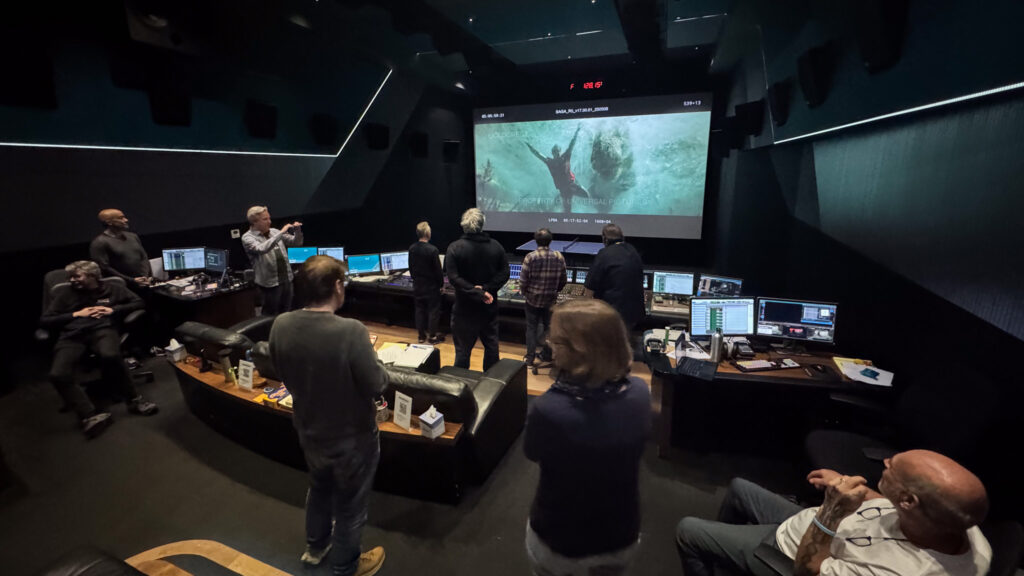 The final mix (Credit: Skywalker Sound & Universal).
As the production roared full speed ahead, the Skywalker Sound team discussed their ideas with Edwards, often without the benefit of having seen any finished visual effects.
“Al and Gary and I would all go off and we would all make a version of a dinosaur, but we’re working with concept art. No footage,” Nielsen explains. “Sometimes we ended up doing something kind of similar to each other, and sometimes we did something very different. It was great to come back, compare notes, and talk to Gareth. And he would kind of say, ‘Oh, I’m leaning towards this,’ or, ‘I really like this.’”
Schroeder says that during early temp mixes, Edwards wanted the sounds to suggest the presence of creatures that weren’t necessarily seen.
“He didn’t want to give away too much too early,” says Schroeder. “There are moments where we kind of tease some things with sound that we didn’t even reveal. And that was exciting.”
On Ile Saint-Hubert, an expedition team led by Zora Bennett (Scarlet Johansson) cautiously enters a large field of tall grass that first appears empty. The sequence incorporates near silence into the mix, helping build emotional tension. The mood suddenly breaks when Dr. Henry Loomis (Jonathan Bailey) begins noisily chomping breath mints. The Skywalker Sound team spent hours working to get the timing and rhythm of the crunching just right.
“When I saw it a couple of times with an audience, I was surprised how much of a jump scare moment it was,” Schroeder laughs. “When Dr. Loomis chews on the breath mints again, literally the whole audience jumped up.”
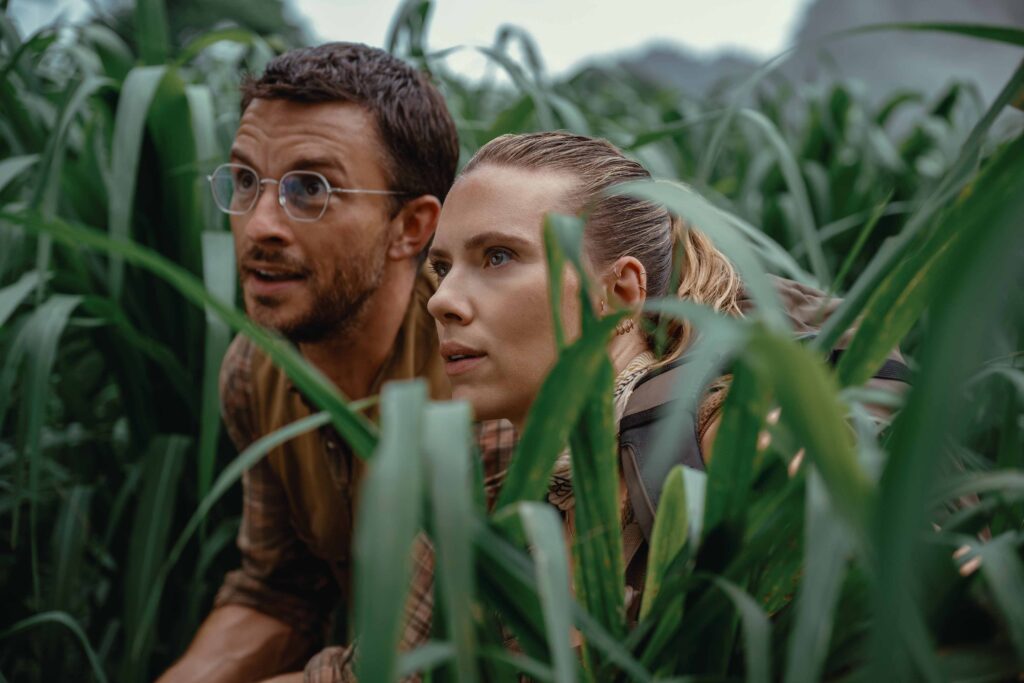 (Credit: Universal)
Quietness conveys a different emotion moments later. After the team collects a blood sample from a herd of Titanosaurs, Dr. Loomis – who has never seen any dinosaur outside of a zoo – reverently approaches one animal and reaches out to touch its leg.
“It’s not fully silent, but it really feels like we’re almost dropping to absolutely nothing,” says Schroeder. “And that was so emotional. We were always kind of going back and peeling away more and more layers to almost nothing. And when we finally got with Gareth and were mixing with him in London, he said, ‘That’s it!’ That’s exactly what he wanted.”
Nielsen and Schroeder say the sequence – which culminates with the Titanosaurs walking away as the original Jurassic Park theme by composer John Williams begins to swell – is a proud one for the entire team. “I do love that sequence,” Nielsen says. “It’s probably the most dynamic sequence of the movie.”
While there are plenty of new dinosaurs in Rebirth, Nielsen also had a chance to develop his own version of an iconic Jurassic sound: the terrifying roar of a Tyrannosaurus rex. The powerful sound comes as the T. rex attacks the Delgado family’s inflatable raft during their desperate attempt to escape downriver.
“That’s a Gareth throwback to the original film,” notes Nielsen. “This was his chance to get to play with his T. rex toy and have it roar the way he wanted.”
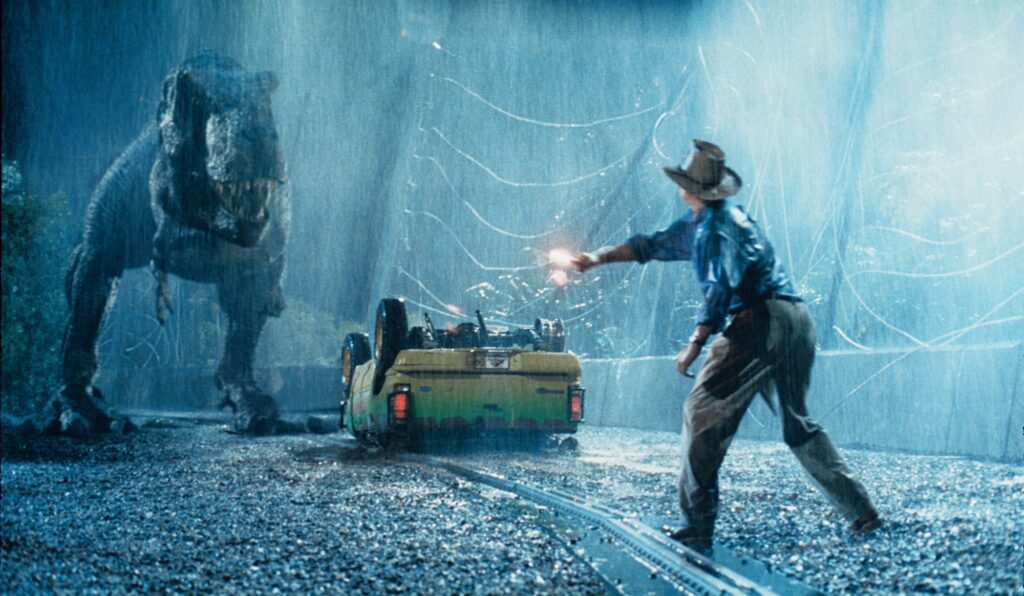 Skywalker Sound's Gary Rydstrom led the efforts to create the soundscape for the original Jurassic Park from 1993 (Credit: Universal).
Thanks to Skywalker Sound librarian Kai Paquin, Nielsen says he was able to access an original digital audio tape featuring a key T. rex roar element: a noisy baby elephant first recorded decades ago at a zoo by Rydstrom and assistant sound designer Christopher Boyes (today an accomplished sound designer in his own right) for Jurassic Park.
“I layered it with a few other things because every T. rex sounds a little bit different, but, of course, it has to sound like the core T. rex,” Nielsen says. “Hopefully, what you got was that same experience. It technically sounds a bit different, but the heart is still there.”
Rebirth is the first film in the series to feature the sound of a yawning T. rex, an effect Nielsen says was crafted from many sources. “That was probably the hardest single vocal of everything. It was built layer by layer by layer. There are probably 17 or 18 pieces of audio to make that one sound.”
Another of the film’s new dinosaurs is the enormous, six-limbed mutant known as Distortus rex. The frightening creature escapes its containment cell and stalks the humans trying to flee the island. Sound design plays an important role in building the D. rex into a more complex character.
“The D. rex is sympathetic in a way. This is a dinosaur going through an existential crisis, knowing that it’s not supposed to exist. It’s confused and it’s alone, and it has this angst to it,” explains Nielsen.
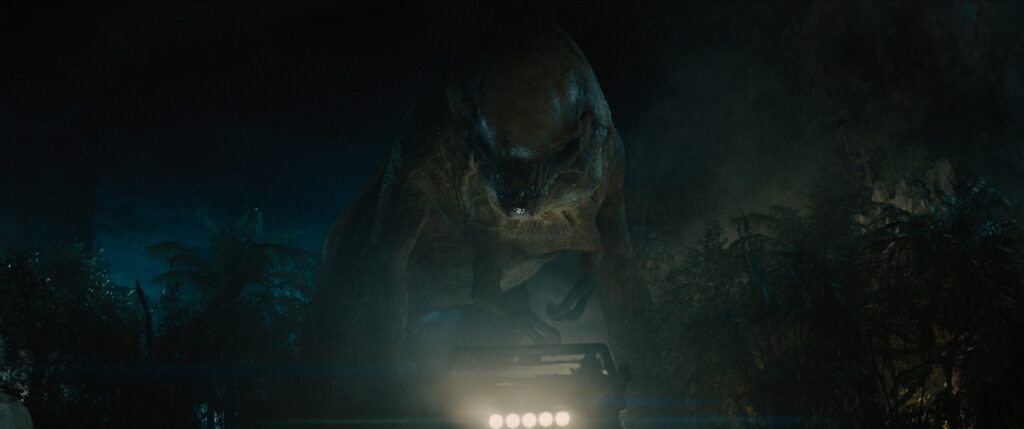 (Credit: Universal).
To build on those emotions, one of the last sounds audiences hear coming from the D. rex is a frustrating, even questioning moan. “I’m really glad that it made it in,” Nielsen says. “Because to me, it shows that this dinosaur can go from full-on assault to something a little more empathetic, at least in some way, which I think is important.”
D. rex sounds were achieved with a combination of recordings, including dogs and Nielsen’s own voice. “A friend of mine recorded his French bulldog, and another buddy recorded a couple of pugs that make tiny sounds. But when you pitch them extremely down, you can get these crazy moans and weird snorts and breaths,” he says. “Some of the growls and the deep things are just me and a microphone. The nice thing about doing that is you can perform the emotion that you need.”
In contrast, the coarse, screechy sounds of the winged Quetzalcoatlus and Mutadon hybrid species leaned away from using real animal sources. “A lot of the Mutadon was just a rubber oven mitt, screeching it across my quartz countertops at home,” Nielsen reveals. “And ripping cardboard was the bulk of the scratchy, papery kind of stuff. All of these things get blended with other things and manipulated heavily.”
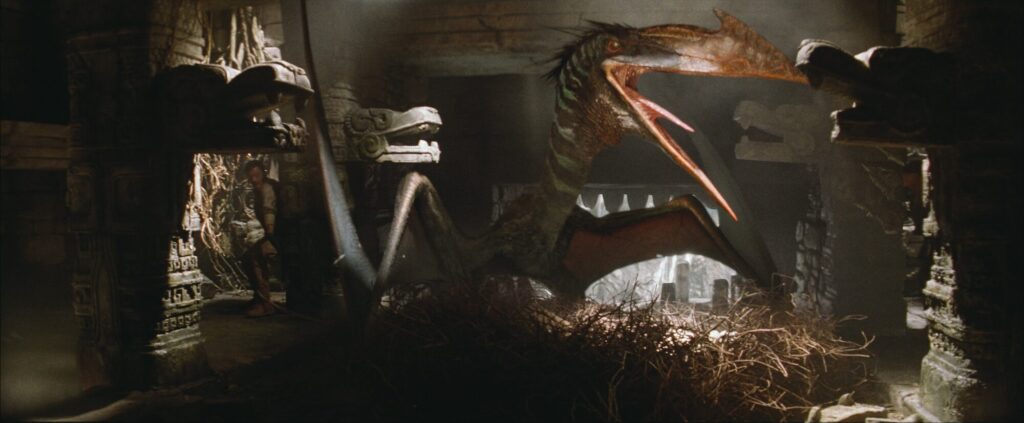 (Credit: Universal).
Howard the cat isn’t the only feline influence in the sounds of Dolores the Aquilops.
“One of the main things in Dolores are actually tiger vocals. The little interesting, weird sounds that tigers tend to make in between their growls,” says Nielsen.
The film also contains a fair share of audio Easter eggs. During a visit to Skywalker Sound, actor Audrina Miranda recorded a vocal sound that Nielsen turned into a dinosaur-like bird scream heard off-screen, including during the swamp sequence. There’s even a nod to Skywalker Sound icon Ben Burtt, who celebrates his 50th anniversary with the company this year.
“There’s one Star Wars sound tossed in there in the background,” Nielsen says. “Most people didn’t catch it, but it was an homage of mine to Ben and his work on Star Wars.”
Both Nielsen and Schroeder praise the entire team that worked long days and through a few holidays to bring Jurassic World: Rebirth over the finish line in time, including re-recording mixers Pete Horner and Gary Summers, effects editors Andre Zweers, Gina Keller, and Nick Docter, Foley artists Shelley Roden and Heikki Kossi, and dialog editor Ryan Cota.
“I’ll give Nick Docter a shout-out, one of our effects editors and our first assistant,” Schroeder says. “He absolutely killed it. He was really the backbone. I think without him being on the crew, I don’t think the film would have come out on time.”
Working with a director like Gareth Edwards, Schroeder adds, ultimately made the hectic schedule more fun. “Gareth really is one of the most collaborative directors that we’ve ever worked with,” he explains. “It helped us because the schedule was so crazy. We were doing roughly 14-hour days every day during the final mix. And to have that support, everyone feels like they’re contributing creatively.”
Schroeder and Nielsen say working on a Jurassic film for the first time was a career bucket list achievement. Nielsen, who started at Skywalker Sound in 1996 as an intern for seven-time Academy Award-winner Gary Rydstrom, says it feels like his contributions to Rebirth have brought him full circle.
“This is the icing on the cake,” Nielsen says. “This is the last piece of all the giant things I wanted to do, and to get to do it on a project that was so influential to me growing up is fantastic. It’s an honor.”
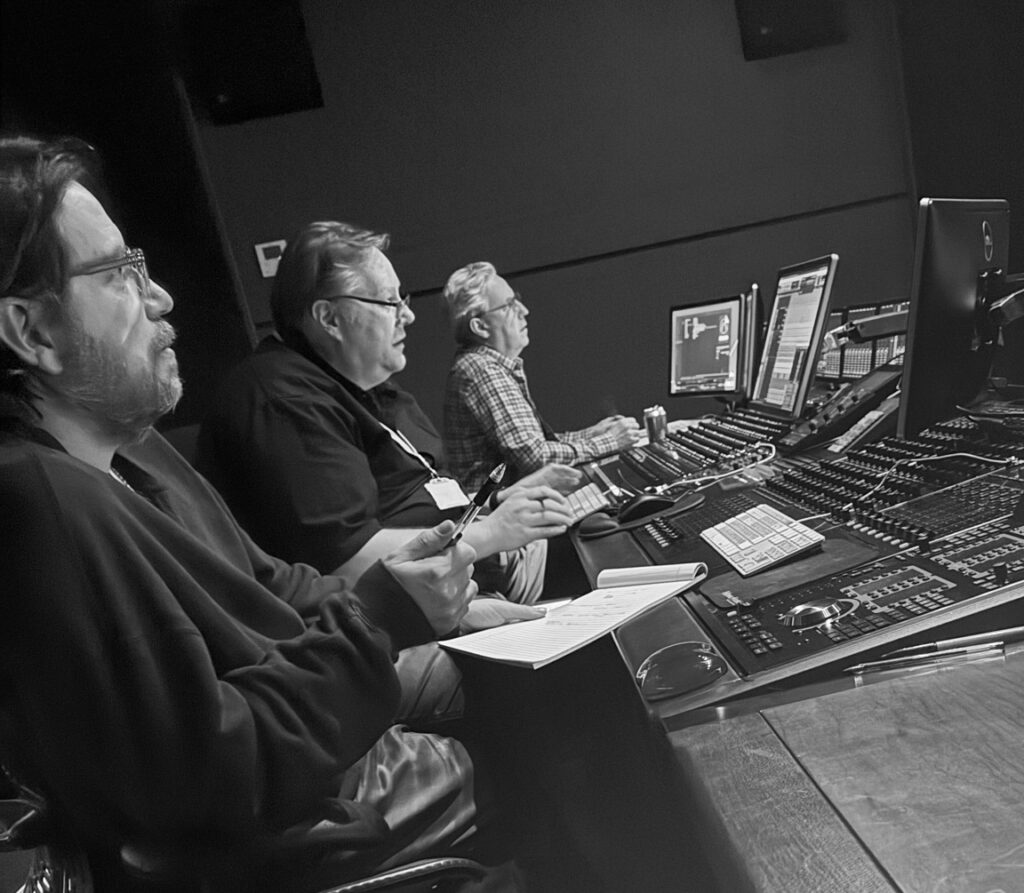 (Credit: Skywalker Sound & Universal).
—
Clayton Sandell is a Star Wars author and enthusiast, Celebration stage host, and a longtime fan of the creative people who keep Industrial Light & Magic and Skywalker Sound on the leading edge of visual effects and sound design. Follow him on Instagram (@claytonsandell) Bluesky (@claytonsandell.com) or X (@Clayton_Sandell).