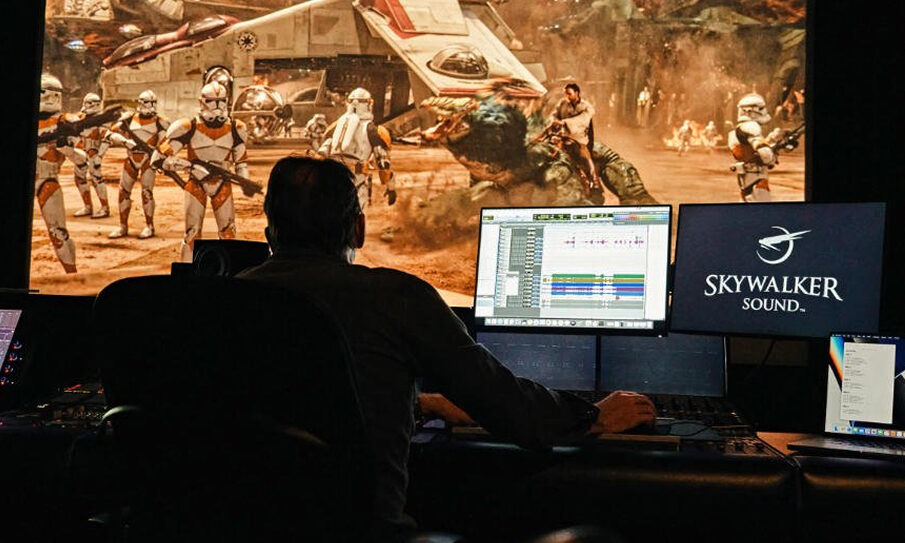
Director Justin Simien and Skywalker Sound’s Al Nelson Talk Haunted Mansion
Inspired by the beloved Disney Parks attraction, Skywalker Sound devised a soundscape both scary and fun.
One of Disney’s most iconic theme park attractions, The Haunted Mansion has been strongly associated with sound from the beginning. Before the attraction even opened at Disneyland in 1969, two vinyl records previewed the frightening delights to come. 1964’s “Chilling, Thrilling Sounds of the Haunted House” was composed almost entirely of creepy sound effects used in previous Disney films. Shortly before the ride debuted, “The Story & Song From The Haunted Mansion” introduced guests to its narrative with an audio drama. When guests walk into The Haunted Mansion at a Disney park, sound forms much of their early impressions, as they hear ominous music, the howls of a dog, or the narration of a “ghost host.”
Telling stories with sound is something the artists and technicians at Skywalker Sound know all too well. They lent their skills to Disney’s 2023 film inspired by the classic attraction, Haunted Mansion, directed by Justin Simien, himself a former Disneyland Resort cast member.
“My mom couldn’t afford a camera for me growing up,” Simien recalls. “All of my first stories are audio recordings. I remember getting my first boombox with two sides on it, and I was able to mash up soundtracks and special effects. I would do voices. I still have all these homemade radio plays on cassette. When I went to film school, learning to do sound recording was the first thing I tried. I was a boom operator. Now the first thing I do when I’m writing something new or taking on a new project is build a playlist. I don’t really know how to enter the world mentally or psychologically without having contact with what it sounds like. Sound is half of the work of what a movie is doing psychologically.”
Skywalker Sound’s Al Nelson joined the Mansion crew as supervising sound editor and sound designer, collaborating with other lead artists including supervising sound editor André Fenley, ADR supervisor Gwendolyn Yates Whittle, and re-recording mixers Tom Myers and Chris Scarabosio. “I grew up in Florida and spent many years visiting Disney World, so I rode The Haunted Mansion at Magic Kingdom many, many times,” says Nelson. “It really does leave a mark. I remember it being very scary. I loved recalling those things and working on a film that brought them back to life in a much more dynamic, visceral, and fun way.
“The music and the voices are signature parts of the attraction,” Nelson continues. “The ghostly-voice processing was definitely something that we paid attention to. But sonically, we wanted to make it our own signature thing, even take it up a few notches. We definitely went ‘haunted-housey’ with it, but we wanted it to feel the way that Travis and his mom felt. We wanted people to experience the house as pretty scary. It was a Dolby Atmos film with full-fidelity sound.”
Nelson admits that a typical sound artist enjoys working on scary movies, but the genre also presents a certain challenge. “It’s hard because it’s very much about pacing,” he says. “You could say the same thing about comedy, and this movie is a combination of both. It’s all about timing and pacing. You’ve got to have those moments of pause. Allow for the beats and know when to hit it and know when to quit it. There’s a shape to it.”
The blend of horror and comedy is apt, considering that the original attraction was the result of a similar balance in themes. “We very much had the same debate as the original Imagineers,” Simien notes about the story development for the film, “and it was really interesting to see that play out. It was also gratifying to screen the movie and see that the children wanted to be scared.”
Much of Simien’s approach to Mansion’s sound design was what he calls “a game of withholding. You don’t want to show certain things too soon.” Nelson adds that “it’s always helpful and wonderful when you have a shape that your filmmaker is presenting to you. Justin was very invested in the track. We knew what he wanted right down to how you might feel it build up as a character approaches a portrait in the hallway. The music was shaped in that way as well. The score is a great harkening to the original, but also [composer] Kris [Bowers] did these amazing builds. We’re paying attention to the music and to where the beats are.”
As an example, Nelson explains the early scene when Travis (Chase W. Dillon) and his mother, Gabbie (Rosario Dawson), arrive at the Mansion, which they have recently purchased. What they don’t know, however, is how spooky their new home is. “From the moment we’re out of the car and up the steps, you hear a voice say, ‘Travis,’ and as he turns, you hear just a hint of the door open and it goes quiet,” explains Nelson. “He walks in with his footsteps and the rolling suitcase. Each moment has its little shape. Justin was really helpful in explaining what they wanted and didn’t want to hear. We finally get up to Travis’ room where you just hear the door handle. It’s a playground where you can kind of go crazy, but you also need to build into those specific moments, such as when the blanket falls off the portrait and you hear a voice whisper again, ‘Travis.’ All these components come together.”
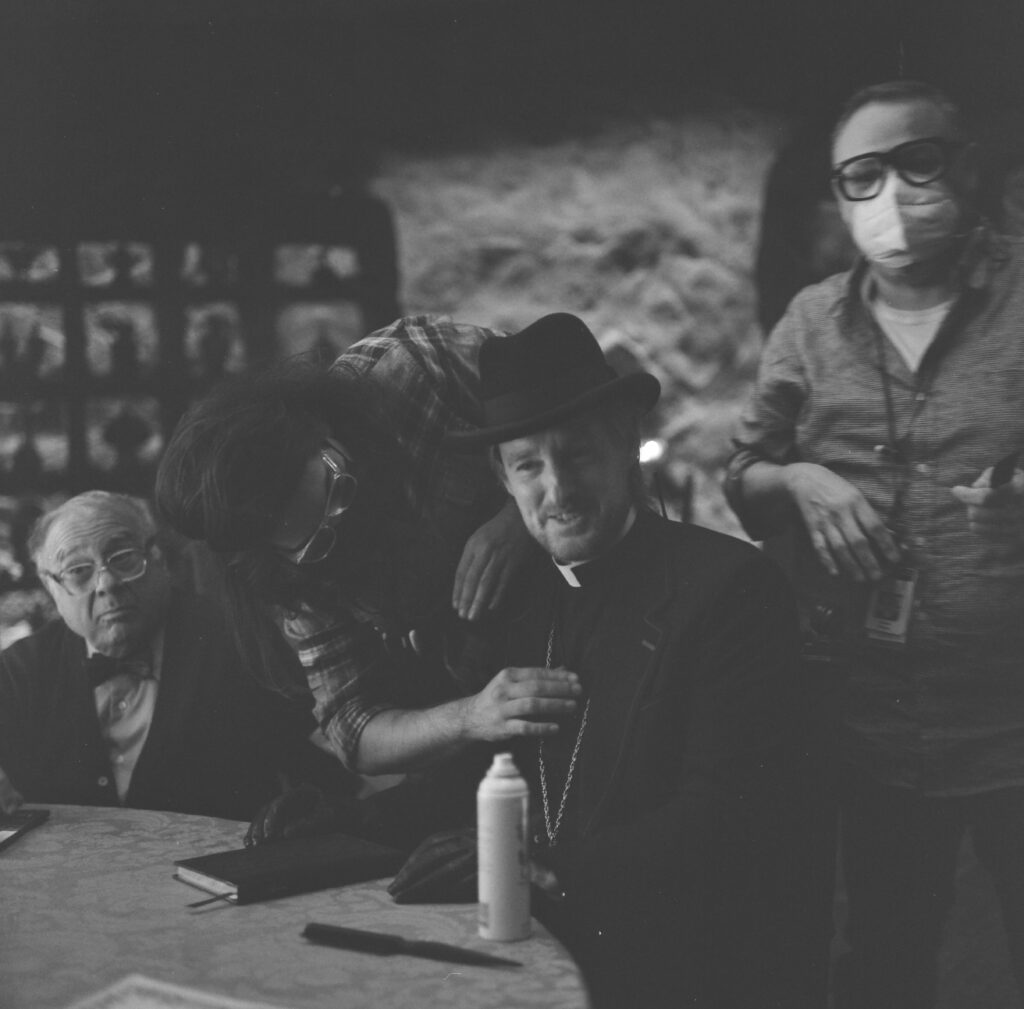 Crew members attend to actors Danny DeVito (left, playing Bruce Davis) and Owen Wilson (Father Kent) during filming of the seance scene (Credit: Justin Simien/Disney).
When Travis, Gabbie, and their newfound friends conduct a seance, Ben (LaKeith Stanfield) enters an alternate realm within the Mansion populated by 999 happy haunts. The otherworldly space presented a distinct opportunity for both the sound design and musical score, each working in tandem. “I was really influenced by some of those Quincy Jones scores of the ’60s and ‘70s,” explains Simien. “He was one of those composers who played jazz and traditional orchestral score music. In our movie, you hear both kinds at different times, and when you get to the ghost realm, they start to mix in ways that are very unsettling. That felt really appropriate. There’s a lot of weird stuff going on.”
Nelson adds that Bowers “was good at creating those odd places like the ghost realm. One of the directions that Justin gave us was that the ghost realm was not just trippy, but also a party. This is where they live and have fun. It needed to feel like it was full of life. So we experimented with crazy whispering and laughter, things that weren’t just spooky. It doesn’t get creepy until the Hatbox Ghost shows up, which is when we go really dark. The music helped carve that up well, but we were also able to add to that.”
The film’s central villain, the Hatbox Ghost (Jared Leto) is a fan-favorite character from the attraction. A memorable gag when Ben encounters him for the first time involves a small, anthropomorphized candlestick, complete with an endearing little face. As the Hatbox Ghost approaches them, the terrified candle attempts to blow itself out. “That was one of the things I remember seeing early on in pre-viz and thinking it was brilliant,” says Nelson. “It went through a number of alterations for the sound, but ultimately we had a member of the loop group perform that moment. It couldn’t be too cute or too funny. At this time, we don’t really know yet how scary the Hatbox Ghost is. When he finally arrives, all of the ghosts are telling us that you don’t want to mess with this guy.”
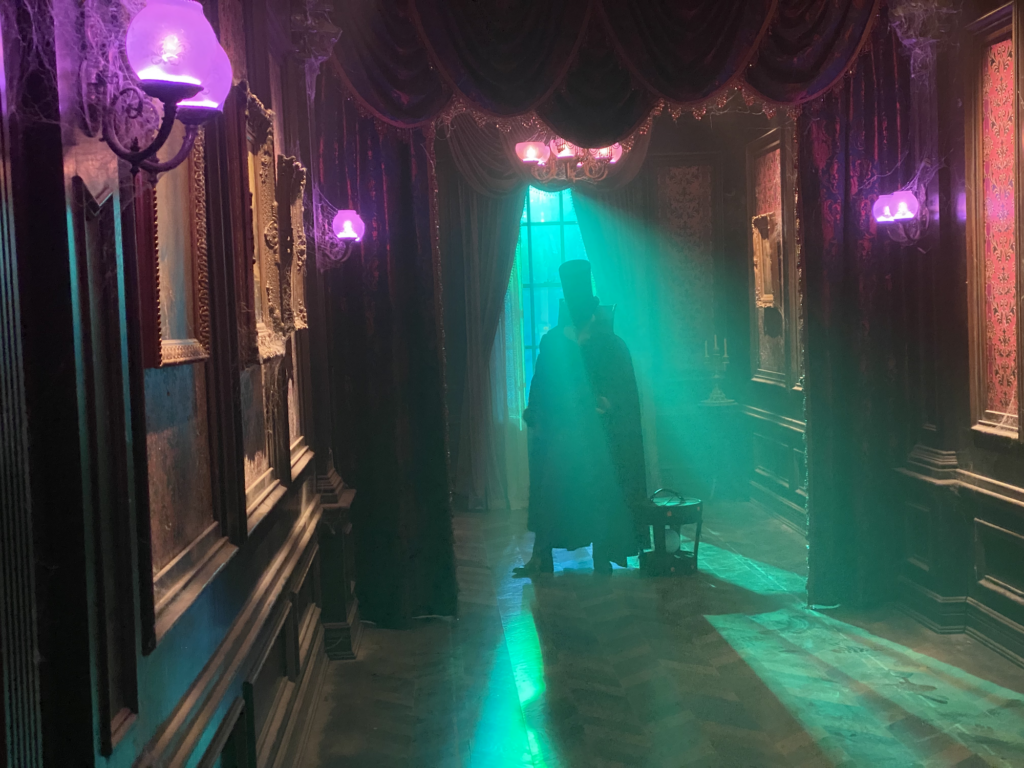 The villainous Hatbox Ghost appears onset (Credit: Justin Simien/Disney).
Both the Hatbox Ghost and Madame Leota (Jamie Lee Curtis) received voice treatments, primarily created by Chris Scarabosio. “One of the old school tricks Chris used is to take a voice and reverse it so you get that kind of Poltergeist effect,” Nelson explains. “We did a bit of that with Leota, adding some echo. There’s a balance between understanding the character and feeling the ghostly elements. Are we in a different world when we’re with Leota? Chris would have the raw Jamie Lee Curtis element and the reverse reverbs to work with. Justin would tell us to use more or less of specific elements. When we first meet her in the opening sequence, she comes in with a ghostly tone, but there’s a lot of information she has to provide, so we clear out the voice more and stay primarily with Jamie and her performance.”
Simien adds that “for a character like Leota, we don’t know where she’s from or what kind of history she has. That’s not part of the ride. So these are things we have to invent for the movie, especially for someone like Jamie Lee Curtis, who wants to tap into the motive of the character. She didn’t want to just do a weird voice. It needed to have an intention and purpose. So we spent a lot of time on that. But it’s funny, because if you do the voice right, it’s kind of invisible. You don’t want the audience to think about those things. For Leota and the Hatbox Ghost, in particular, there is a certain quality to the voices — they sound there but not really there. I’m so grateful to Al and the team for what they did.”
For Simien, Haunted Mansion was his first collaboration with Skywalker Sound, and his first chance to work onsite at Skywalker Ranch, something he hopes to do again. As Nelson comments, “This is why the Ranch exists. It’s a place for filmmakers to escape and be creative and let the juices flow.
“It’s fun to concoct environments and atmospheres that are otherworldly,” Nelson concludes about Mansion. “It’s nice to be able to create a proud scenario in a normal feature film, and that’s a challenge in itself. But when somebody says, you’re in a world where there’s nothing but ghosts and they’re all happy and it’s wild and weird, there are all sorts of fun challenges for sound. I’m always grateful to work on any project where sound helps tell the story.”
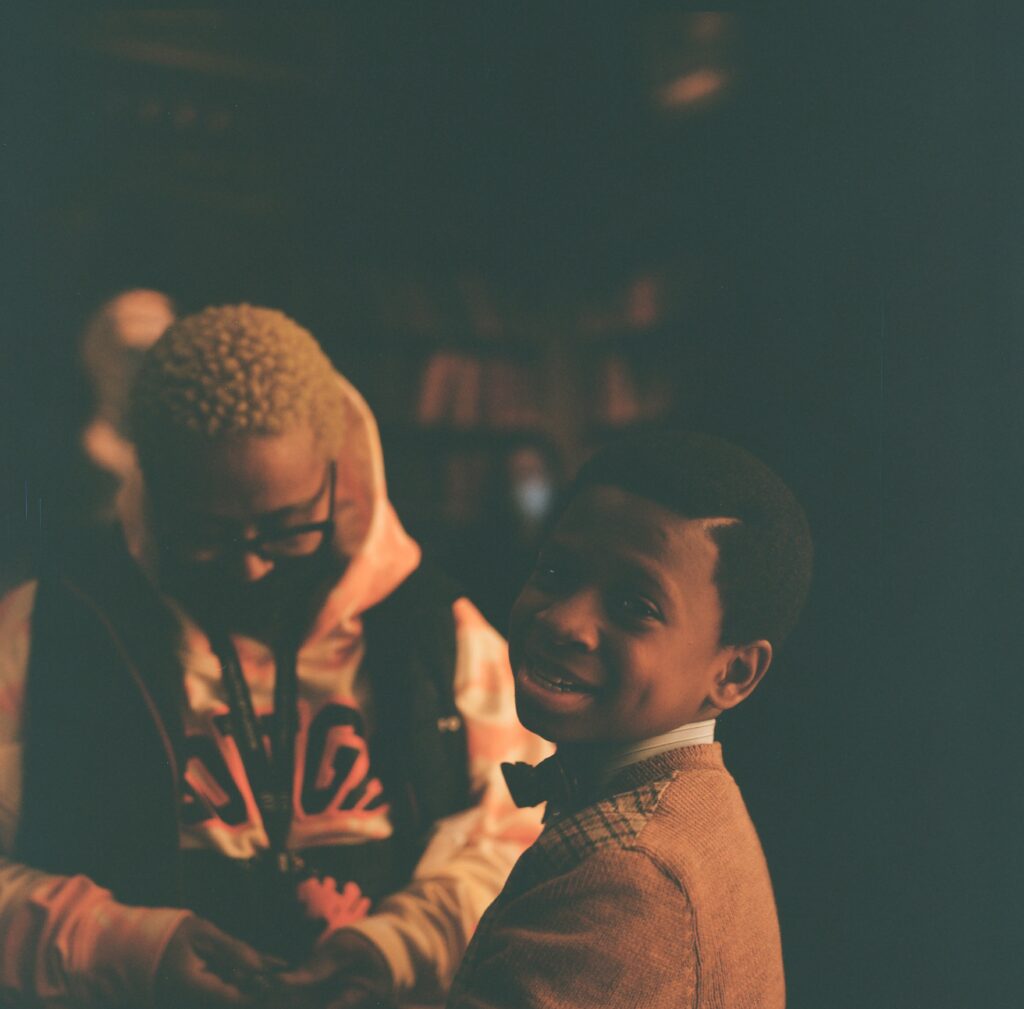 Actor Chase W. Dillon (Travis) onset (Credit: Justin Simien/Disney).
A story about love, loss, and letting go, Haunted Mansion captures the Disney attraction’s spirit of a celebratory swinging wake. For Simien, that spirit is perhaps best encapsulated in the film’s last line of dialogue, when Travis leads a toast, “To life!”
“That wasn’t always in the script, but it was there in terms of my feeling,” Simien recalls. “What I love about movies from Tim Burton and others from the ’80s and ’90s is that for an introverted, depressed kid — which is probably my point of view — the afterlife in the world of Haunted Mansion is so alive. The closer the characters moved into darkness or spaces that scared them, the more alive and colorful the movie became. All of that is very intentional. The setting of New Orleans also speaks to that. When you embrace the shadow aspects of life, when you stop denying that darkness exists in the world and in yourself, it becomes a lot fuller. To me, that was a really powerful piece that Travis articulated brilliantly in the moment.”
—
Lucas O. Seastrom is the editor of Skysound.com and ILM.com, as well as a contributing writer and historian at Lucasfilm.