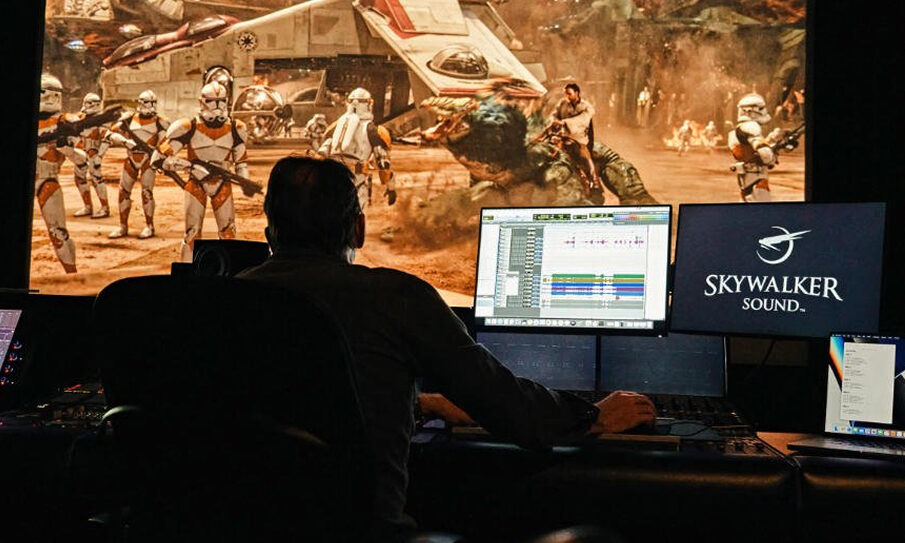
Skysound at 50: General Manager Josh Lowden on a Half-Century of Sonic Storytelling
The 25-year veteran of Skywalker Sound kicks off the 50th anniversary celebration with a discussion about the company’s legacy, creative process, and future.
“It starts with community.” For Josh Lowden — senior vice president and general manager of Skywalker Sound — the people are at the heart of what makes this company distinct.
“The culture is a really good entry point into understanding this place,” Lowden says. “In other markets like Los Angeles or London, the creatives move around between different facilities more often. Since we’re the only ones based in Northern California, our community of artists have been here working together for years. It’s the people, the setting at Skywalker Ranch, the technological infrastructure and support, and the filmmakers who come here with their amazing stories — that’s the combination that’s made the difference as we mark our 50th anniversary in 2025.”
Storytelling Roots
Back in the summer of 1975, writer and director George Lucas was busily preparing Star Wars: A New Hope (1977). With an audacious vision for a space fantasy unlike anything audiences had seen or heard before, Lucas had to create new units within Lucasfilm to help realize his creative goals. While Industrial Light & Magic (ILM) quickly grew into a large visual effects team, Skywalker Sound originated with a sole hire: sound designer Ben Burtt. A recent USC film school graduate, Burtt’s Oscar-winning achievement on A New Hope not only laid the groundwork for the growth of a company, but also helped change perceptions about the use of sound as a storytelling device in filmmaking.
“The way that George approached sound was unique at the time,” Lowden explains. “He hired Ben a year before production even started on Star Wars, and approached sound like it was a principal creative consideration rather than an afterthought. There were unique worlds inhabited by unusual creatures, with weapons and ships and environments that had never been imagined before. All of these elements needed sounds that felt real and gritty, and practical. Ben collected organic, real-world sounds and built a library that was completely bespoke. And it wasn’t just about individual recordings, but also about combining them and using various technologies to augment them.
“Try to imagine Star Wars without Darth Vader’s breathing,” Lowden continues, “or lightsabers, or TIE fighters, or a Wookiee language, or R2-D2’s expressive responses, and on and on — it wouldn’t be the same movie without them. By the time Ben was finished, he had unique sounds for a distinct world that helped make it seem real. And they weren’t sound effects just for their own sake. They were serving a broader story and they had everything to do with understanding the vision of the filmmaker and what they were trying to achieve in each scene, what was at stake, and how the sound contributed to moving that forward. It was a fundamental part of defining the characters and their world through sound.”
That methodology continues to define how Skywalker Sound collaborates with its client filmmakers to this day. Skywalker Sound’s 50-year legacy has been the story of establishing the prominence of sound design, editing, and mixing in the overall production process. Skysound artists have not only been great practitioners of the art form, but great proponents of it as well.
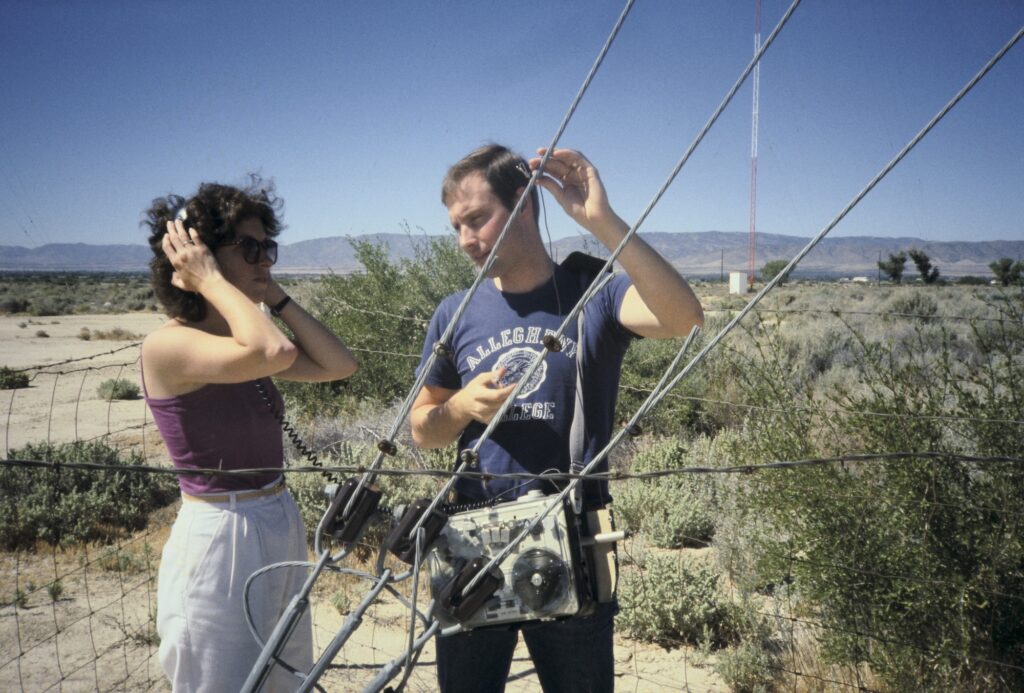 Ben Burtt and Lucasfilm’s Miki Herman in the California desert in the 1970s, where Burtt collected sounds off guy wires to create laser blasts (Credit: Skywalker Sound).
An Innovative Home
First known as Sprocket Systems and based in the Northern California town of San Anselmo, Lucasfilm’s post-production sound team grew in size on early projects like Star Wars: The Empire Strikes Back (1980) and Raiders of the Lost Ark (1981). Later, moving to the Kerner facility in nearby San Rafael, Sprockets worked directly alongside teams from ILM and the Lucasfilm Computer Division. Soon technological breakthroughs emerged like the SoundDroid, a first-of-its-kind digital audio editor. Sprockets engineer Tomlinson Holman created the THX Sound System in the early 1980s, ultimately becoming an industry standard for movie theaters around the world.
In 1987, Sprocket Systems moved to its current home, the 153,000 square foot Technical Building at Skywalker Ranch. What appears to be a historic 19th century winery on the outside is in fact the world’s best-equipped post-production facility on the inside, boasting multiple mix stages, sound design and editing suites, Foley stages, and a state-of-the-art scoring stage. Two years after moving to the Ranch, Sprockets changed its name to Skywalker Sound and adopted a client-service business model, working with filmmakers from around the world.
For Lowden, discovering Skywalker Ranch was a major influence on his decision to join the team. “I started as a project manager at ILM, my first gig was for the Model Shop on Kerner,” he explains. “I was a freelance employee for the first couple of years, doing various projects around ILM and Lucasfilm. One of the projects was up at Skywalker, and as soon as I got there, I said to myself — This is where I want to be. It was very distinct. I’d been floating around the company, and I loved the work, but when I got to the Ranch, there was something special and different and I knew this was where I wanted to stay.
“Even after all these years, I still think Skywalker Ranch is a special place,” Lowden adds. “This is the place created by the person out of whose mind came Star Wars and Indiana Jones and all these amazing stories, along with hundreds of other filmmakers who have come here to dream and collaborate with other artists and finish their movies — you feel that here. Being part of this community, this facility, and this legacy is an incredible honor.”
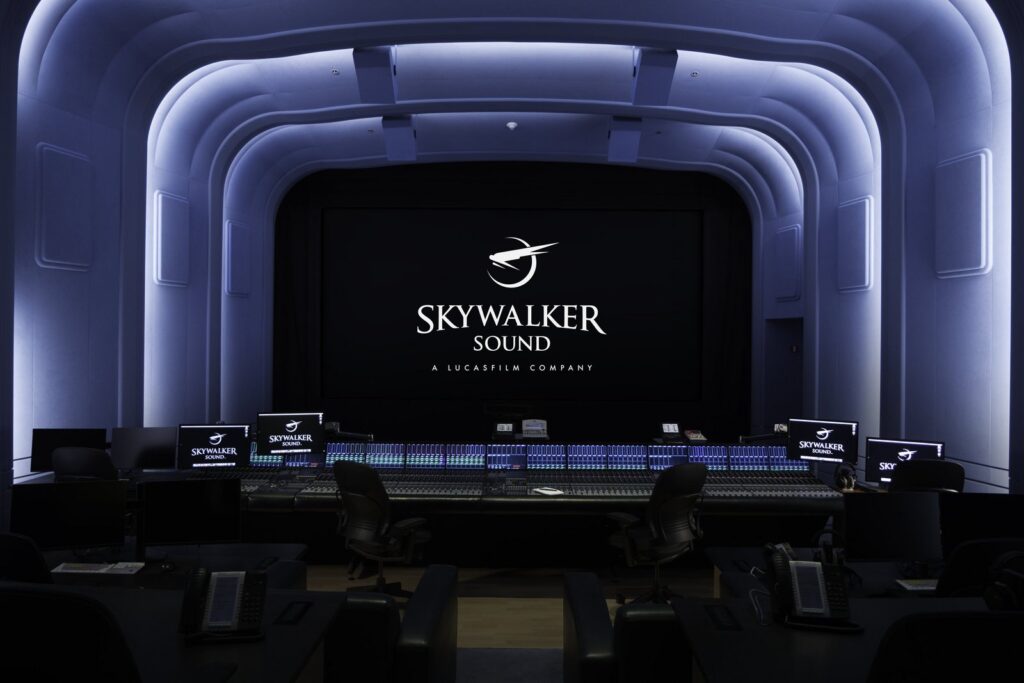 One of Skywalker Sound’s mix stages at Skywalker Ranch’s Technical Building (Credit: Skywalker Sound).
Finding the Stories
Skywalker Sound works on dozens of projects each year, including feature films, streaming series, animation, documentaries, video games, interactive experiences, theme park attractions, and scoring & music recordings. No matter the scale or style, Skysound strives to empower every story with the capabilities of sound, involving its artists on projects as early as possible and maintaining close collaboration with the filmmakers throughout the process.
Although its clients include the largest studios and most established directors, Skysound also makes a point to seek out partnerships with a broad range of storytellers, no matter the size of their project. “Film at its best is about artists who have something to say about the world we live in and about our relationships with each other,” Lowden says. “Each artist has a unique way of expressing themselves that may connect with a different audience. Society is a rich and complex tapestry of people; you need voices that can reach all of them.
“We want to find the best stories, told by authentic artists with unique voices,” Lowden continues. “The bigger budget films aren’t the only stories worth telling. Each successive generation has different perspectives on the world around them, and on the things that concern them and move them. We do the best we can to find and help amplify those voices.”
The diversity of styles and media between Skysound’s clients exemplifies how sound is a versatile and broadly applicable storytelling tool. Even within a specific form like documentary filmmaking, there can be a mix of approaches from just one filmmaker. Celebrated director Morgan Neville, for example, has collaborated with Skysound on a wide range of projects, including 20 Feet From Stardom (2013), Won’t You Be My Neighbor (2018), and the LEGO-animated Piece by Piece (2024).
“When you watch these films, what matters is whether it connects with the audience,” Lowden notes. “Does it move them? Can it get past their rational, intellectual interpretation into something that they feel in a more emotional, heartfelt way that viscerally affects them? All of Morgan’s movies do that, as do many of the documentaries we work on. They’re just as impactful emotionally as a fictional narrative feature. They’re just a different way of telling a story.”
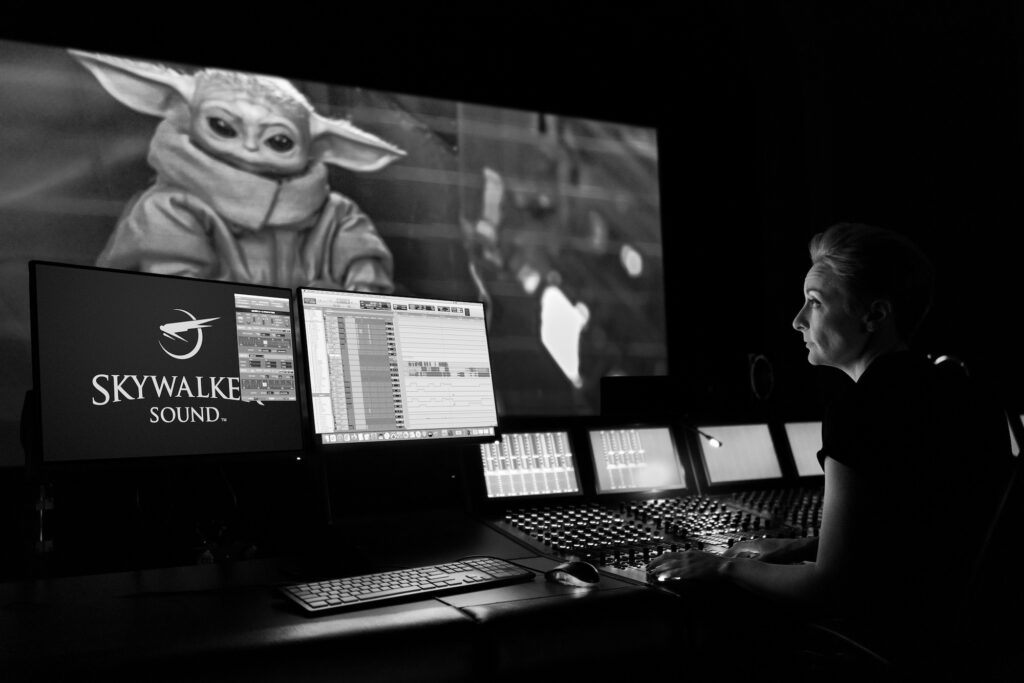 Supervising sound editor and sound designer Bonnie Wild (Credit: Balazs Gardi & Skywalker Sound).
The Invisible Art Form
Filmmakers collaborate with Skywalker Sound all the way through to the final stages of their projects. And as Lowden is keen to point out, these last phases are about incorporating the final layers of emotional complexity and nuance to make a story feel whole. The logistical process of filmmaking can often be “a reductive one,” as Lowden explains. “The practicality of it all meets what the filmmaker initially imagined when they dreamt up the story in the first place. You have to get the story onto the page and then onto the set and then onto the screen. Along the way it has to fit within budgets and timelines and locations and other practical constraints. Sometimes you can’t capture the entirety of what you initially imagined.
“With sound, we can reinforce or amplify moments that might have involved compromise at other phases,” Lowden continues. “We can affect the audience emotionally in ways they don’t see coming. If we’re doing our job right, as you’re watching a movie, if you’re feeling impacted, you don’t necessarily need to pull apart why. Was it a line of dialogue? The music? A setting? A specific sound? A performance? It’s actually the whole thing together. Sound is a secret weapon that allows the filmmaker to impact the audience in subtle and unexpected ways. It’s an incredibly potent and effective tool, but it doesn’t necessarily draw attention to itself. [Head of sound design] Randy Thom has a saying that we sneak in the side door without being noticed.”
Skysound works with its partner filmmakers to embrace the inherent risk “of trying to say something that might be controversial, and put something new out into the world,” as Lowden says. Skysound artists bring a commitment to the storyteller’s vision and bring an equal measure of care and dedication to seeing it through. “You have to be vulnerable when you’re an artist trying to say something new, you have to bare your soul, and take the risk that it won’t be received well. You have to be authentic to tell a genuine story. We offer a safe and supportive place where ideas can be experimented with and refined.”
That partnership extends to where a filmmaker needs to be situated. Skysound artists will often travel around the world to work alongside clients for final mix sessions, bringing Skywalker Ranch’s sense of community and collaboration wherever they go.
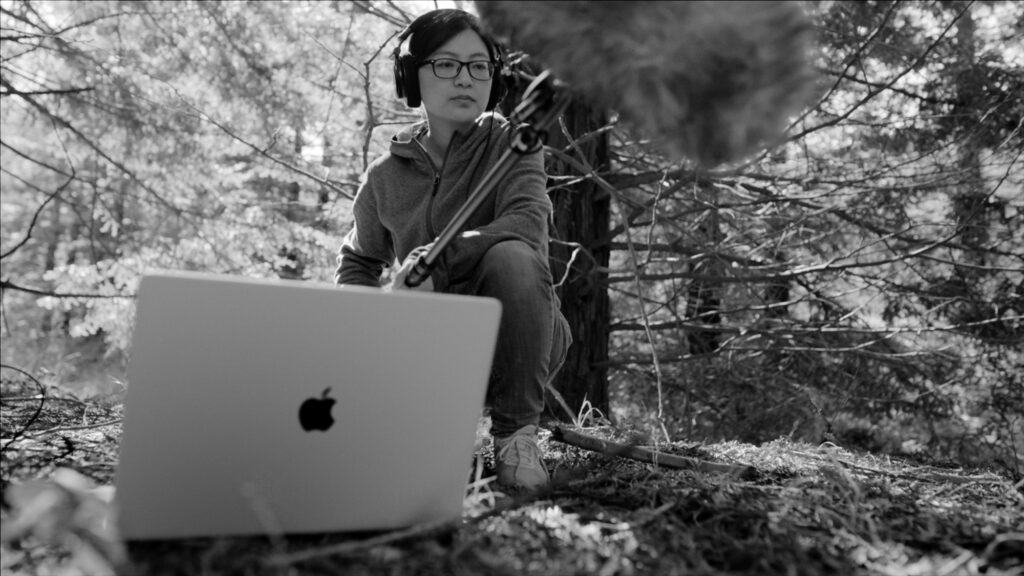 Supervising sound editor Baihui Yang conducts a field recording (Credit: Skywalker Sound).
Adapting Tools for a Changing Industry
“Another part of our legacy from George Lucas is that we’ve always been on the cutting edge of technology, some of which we get from third-party vendors and adapt to our needs, and some of which we develop ourselves,” Lowden says. “Skysound has always had an incredible infrastructure of technology and support; it’s really one of our defining characteristics.”
In recent years, that’s meant keeping pace with an increasingly competitive and diversified industry. Skysound’s work is disseminated to media markets in regions around the world, resulting in a complex web of localization needs in multiple formats. To help increase the quality of these global deliverables while keeping costs down, Skysound has introduced its groundbreaking “Coda” software platform that utilizes an automated system to help with creating localized versions.
“We made the decision many years ago to invest in our technology infrastructure and automation tools rather than expanding our brick-and-mortar facilities into additional markets. As the industry has become more price sensitive and more work is being sent overseas, we need to find ways to expand our business and utilize our core strengths that are in step with the direction that the industry is realistically headed. So we’ve been developing tools that are going to allow us to leverage our core strengths and protect our creative work by diversifying our revenue streams.
“We’ve seen more change in the film industry over the last few years than any other time I can remember,” Lowden continues. “It means we have to adapt if we want to be here for another 50 years. But regardless of how much technology we develop, our community of creatives will always be at the center of the work that we do, even if we’re using new tools to augment or deliver it.
 (Credit: Skywalker Sound).
A Legacy Powered by People
As sound cinema approaches its centennial in a few short years, Skywalker Sound celebrates its legacy of creativity and innovation over more than half of that century. What began as a single hire for just one film directed by an independent filmmaker has since grown into the world’s premier facility, comprised of hundreds of artists working on every conceivable type of project. Together with ILM and Lucasfilm, they have reshaped our ability to tell stories across multiple artistic mediums.
“I feel the gravity of the legacy of all the people that came before me here,” Lowden says. “They are, frankly, much more important to the legacy of this place — people like Ben Burtt and many others who have been here for 30, 40, or even 50 years. They’ve contributed so much, not just to this company but to the industry. I just want to create an environment where all of our artists can do their best work.”
“I am a steward who is here temporarily,” Lowden concludes. “This place existed before me and it will exist after me. We’re all here to play our role for a moment in time until the next set of artists comes in and takes it over. It’s the honor of a lifetime to lead this place and hopefully set it up for the next generations to carry forward over the next 50 years. We’re here to help artists tell personal stories that are important, that help people make sense of the world, stories that are told with authenticity and empathy, and hopefully, help to connect people.”
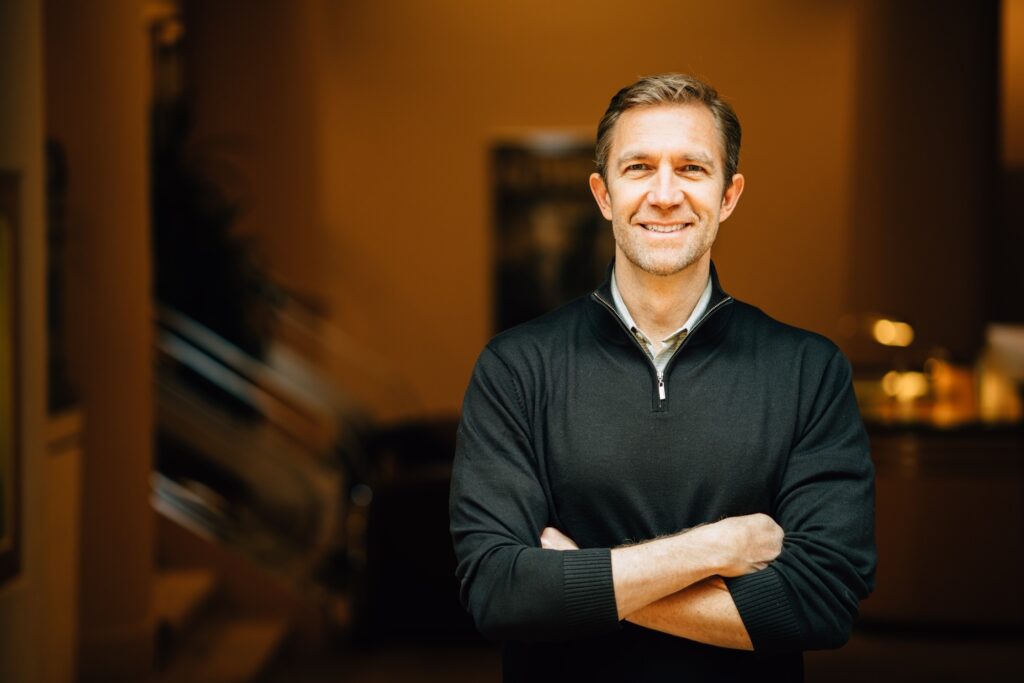 Skywalker Sound’s Senior Vice President and General Manager, Josh Lowden (Credit: Skywalker Sound).
—
Lucas O. Seastrom is the editor of ILM.com and Skysound.com, as well as a contributing writer and historian for Lucasfilm.