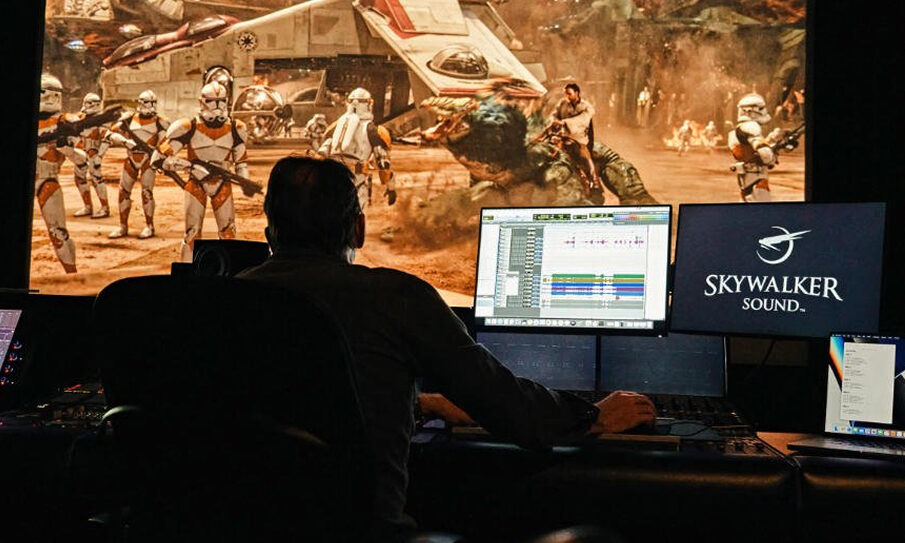
Skywalker Sound’s Randy Thom Brings His Love of Sonic Storytelling to The Wild Robot
The veteran supervising sound designer creates movie magic for the DreamWorks Animation film both behind the scenes and in front of the microphone.
Over a career spanning more than four decades, Academy Award-winning sound designer Randy Thom has helped bring life to a lot of movie robots.
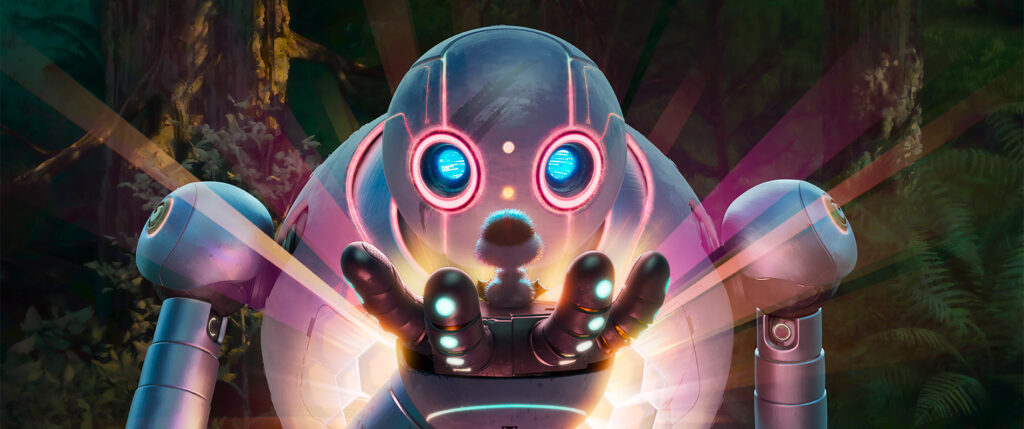
As the supervising sound designer on The Wild Robot (2024), Thom knew ROZZUM Unit 7134 — “Roz,” for short — needed a unique sound.
“We didn’t want to lean on what’s really kind of a cliché of the servo motor sounds that are typically used for robots,” Thom explains. “We figured that’s kind of been done to death.”
The titular character in the DreamWorks Animation film finds herself shipwrecked on a deserted island and forced to adapt to her new environment. Roz — voiced by another Oscar winner, Lupita Nyong’o — inadvertently becomes the adoptive mother to an orphaned gosling named Brightbill (portrayed at different ages by Boone Storm and Kit Connor).
In early discussions with director and screenwriter Chris Sanders about what Roz’s physical movements should sound like, Thom says the goal was to convey a feeling that wasn’t too synthesized or electronic.
“I thought maybe pneumatic or hydraulic sounds, so I started playing around with those. And that seemed to work pretty well,” recalls Thom.
Going one step further, Thom experimented by recording his own breath, sequestering himself in his Skywalker Sound edit room where no one could see him.
“I usually try to be by myself so that nobody’s laughing at me too much or hurting themselves falling down laughing at all this weird stuff that I’m doing,” Thom jokes. “You just start making all kinds of breathing sounds, blowing sounds, and sucking sounds. My shooting ratio is probably about 100 to one. I have to make 100 sounds before I get one that I think is believable and interesting.”
Thom also credits Skysound foley artists Ronni Brown and Jana Vance for helping create a library of similar noises.
Roz’s movements aren’t the only place in The Wild Robot where audiences can hear Thom perform. Credited as Randall Thom, he also provides voices for the RECOs, the film’s scary robot antagonists.
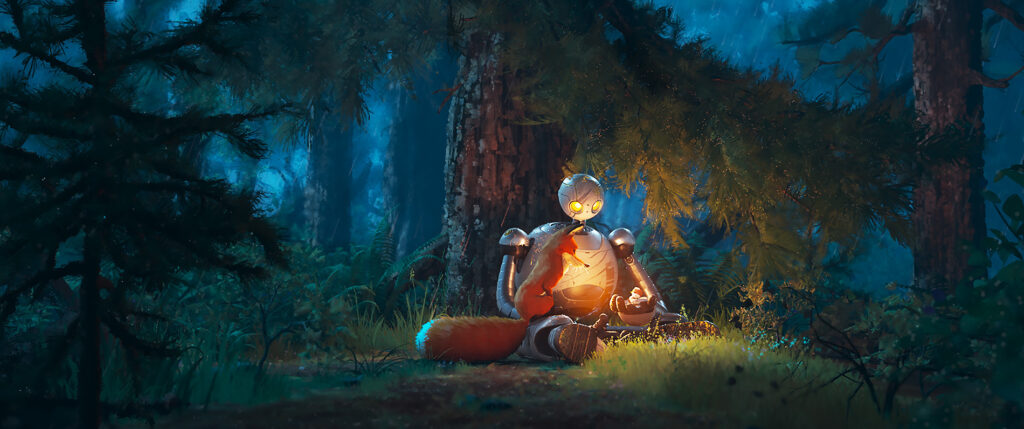 (Credit: DreamWorks).
A skittering crab suddenly snatched away by a hungry seagull? That’s Thom, too.
“That idea developed fairly late. It just occurred to me that maybe we should hear the crab scream. I should have gotten a credit for that too,” he laughs.
Thom says filmgoers have probably heard his voice more than they know.
“My voice is used in one way or another in almost every movie that I work on,” Thom says. “More often, it’s some kind of creature sound. It hasn’t been very often that I’ve actually had English dialogue.”
Astute audiences might catch Thom in The Right Stuff (1983) as the voice of a doctor administering a painful medical exam to astronaut candidate Alan Shepard (Scott Glenn). In Star Wars: The Empire Strikes Back (1980), Thom can be heard making announcements on the public address system during a scene in the Echo Base medical lab.
As for Roz’s speaking voice, determining the appropriate level of electronic processing was the subject of many creative discussions, Thom says. For certain moments in the film, such as when Roz first boots up, re-recording mixer Gary Rizzo added subtle effects to Nyong’o’s recorded dialogue.
“Her performance is so good, so evocative, so emotional, and so real, but we wanted to experiment with robotic kinds of vocalizations,” explains Thom. “The more we played with it, the more we decided that we should get to Lupita’s voice or something very close to her natural voice sooner rather than later, because that’s really where the heart is.”
Sanders, who wrote the screenplay based on the 2016 book by Peter Brown, also wanted the island where Roz is stranded to essentially be a character of its own, Thom remembers.
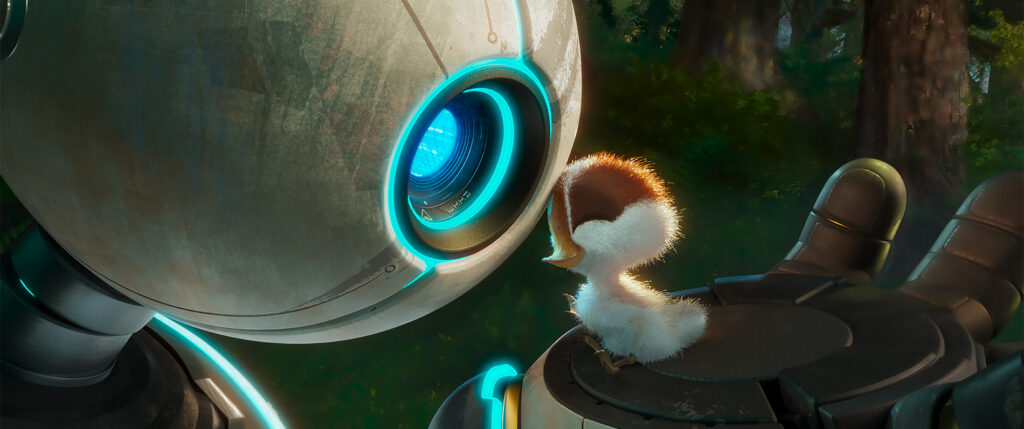 (Credit: DreamWorks).
Discovering the right soundscape took Thom back to his Academy Award-nominated work on Cast Away (2000) with director and longtime collaborator Robert Zemeckis.
“Chris liked the way we built the character of that place,” Thom says of the deserted island in Cast Away. “So we used that as a reference. Obviously, we didn’t want to use all of those sounds and do exactly that. But you can do a lot with just the sound of waves sloshing over rocks. Sounds like that can actually evoke a feeling of loneliness and isolation. So that’s one of the things we were trying to do in those scenes where Roz is by the seaside all by herself and wondering what to do next.”
Thom says he first began talking to Sanders about The Wild Robot sound design roughly two and a half years ago.
“Chris is just the best,” Thom says. “He’s such a great director to work with for anybody, but certainly as a sound person.”
As a longtime advocate for involving sound designers in creative discussions as early as possible, Thom says ideas coming from Skywalker Sound can offer filmmakers tremendous creative solutions.
“I can sometimes make suggestions related to sound that will affect the way a director is thinking about the story, specific scenes, or specific characters,” Thom says. “On an even more nuts-and-bolts level, if I start producing sounds early, it helps inspire the animators. They may hear a breath or a grunt that will inspire them to have a bear do something physical that might not have occurred to them otherwise.”
The best collaborations happen, Thom says, when everyone is contributing their best work — including actors like Mark Hamill, who plays the gruff grizzly bear Thorn.
“Mark Hamill is doing many, many of the bear sounds in this film. Both the dialogue, and he was great at doing sound effects, too,” laughs Thom.
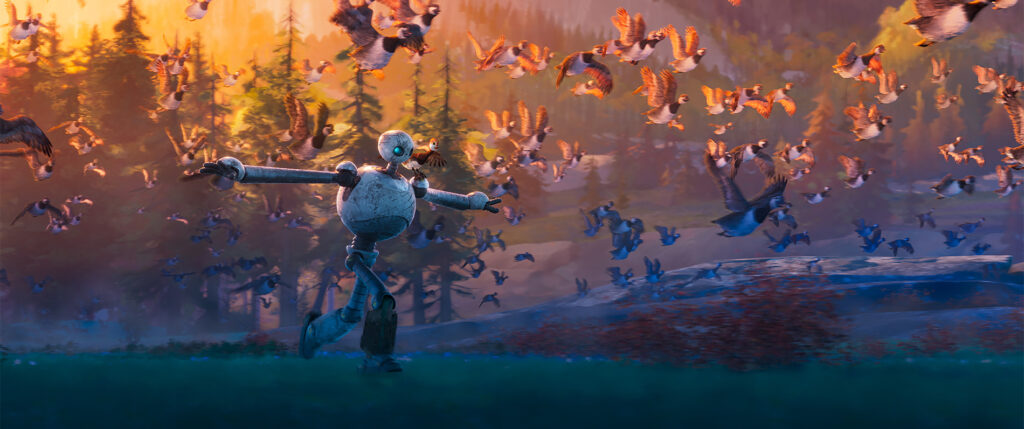 (Credit: DreamWorks).
With an illustrious and expansive body of work that includes Apocalypse Now (1979), Star Wars: Return of the Jedi (1983), The Revenant (2015), and more than 40 animated features — Thom says he’s slowly beginning to turn the reins over to a new generation of sound professionals.
He has high praise for the entire Skywalker Sound team that contributed to The Wild Robot, including supervising sound editor Brian Chumney, sound effects editors David Farmer and Jamey Scott, re-recording mixer and supervising sound editor Leff Lefferts, and re-recording mixer Gary Rizzo.
“They’re all great,” says Thom, who adds that he’s not going away anytime soon.
“The most fun for me has always been designing sounds and manipulating sounds and figuring out what things are going to sound like with the director and all my other colleagues,” reflects Thom. “I like doing the creative work. I’m in a really happy place now where that’s the most of what I spend my time on.”
 (Credit: DreamWorks).
—
Clayton Sandell is a television storyteller, a Star Wars author and longtime fan of the enormously creative people who keep Industrial Light & Magic and Skywalker Sound on the leading edge of visual effects and sound design.